The crepes craze, which began in the 1960s, became intense in the 1970s. By the late 1980s it had all but disappeared.
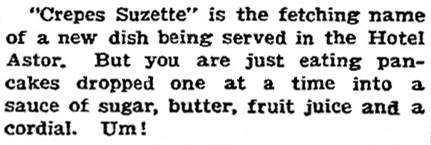 But before crepes achieved popularity, they were almost unknown in the U.S. The exception was Crepes Suzette, thin, delicate pancakes with an orange-butter sauce and liqueurs that were often dramatically lit aflame at the diners’ table. Like Cherries Jubilee, Crepes Suzette usually only appeared on high-priced menus, such as the Hotel Astor [1908 quotation].
Before 1960 even fewer restaurants served savory crepes, and those that did would also seem to have been expensive restaurants. In 1948 the Colony in New York City served Crepes Colony with a seafood filling. And in the late 1950s New York’s Quo Vadis offered Crepes Quo Vadis, filled with curried seafood and glazed with a white sauce, as hors d’oeuvres.
Although few Americans had ever eaten Crepes Suzette, it’s likely that the fame of this prized dish helped pave the way for the creperie craze, with restaurants primarily featuring crepes. Crepes were regarded as an exotic luxury dish that, by some miracle, was affordable to the average consumer, sometimes costing as little as 60 or 75 cents apiece around 1970.
Crepes enjoyed a mystique, offering a link to European culture and a break from the meat and potatoes that dominated most restaurant menus in the late 1960s and early 1970s.
At a time when America was seen as the world leader in modern ways of living – including industrially efficient food production — Europe was imagined as a romantically quaint Old World where traditional ways were preserved and many things were still handmade.
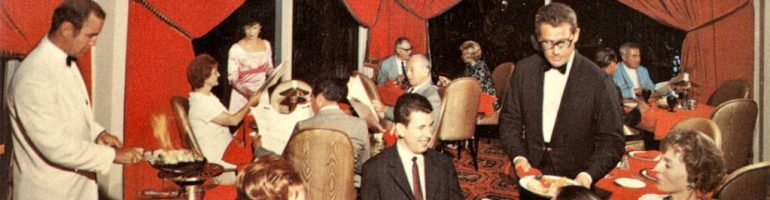
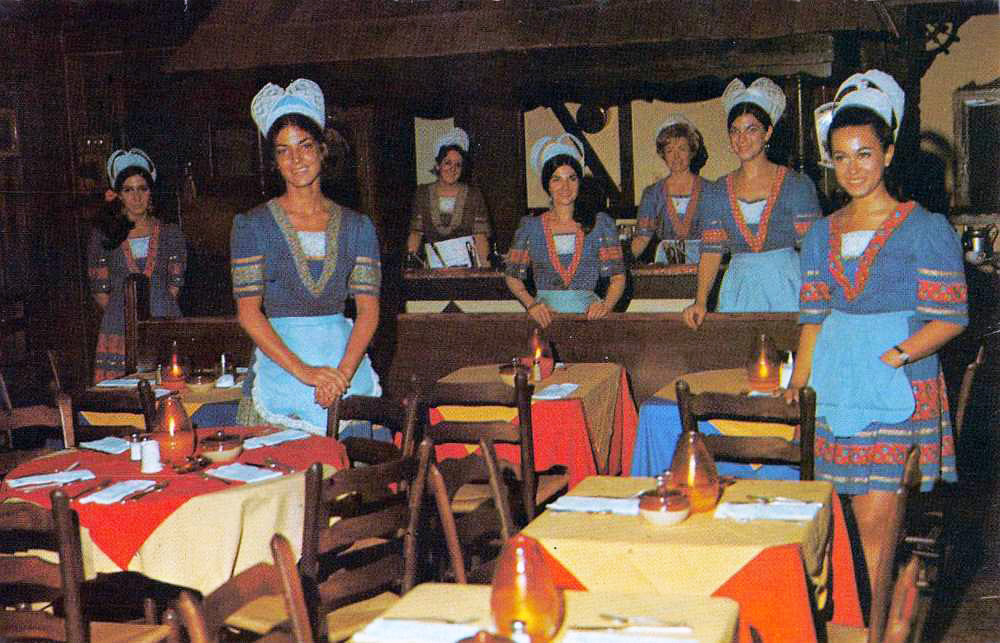
 American creperies catered to their customers’ wish for a taste of Europe. With country French decor, servers in folk costumes, and names such as Old Brittany French Creperie and Maison des Crepes [pictured at top, Georgetown], diners were imaginatively transported to a delightfully foreign environment quite unlike the brand new shopping malls in which many creperies were located. Another exotic touch employed by quite a few creperies was to use the French circumflex mark in crêpes (which I have not done in this blogpost).
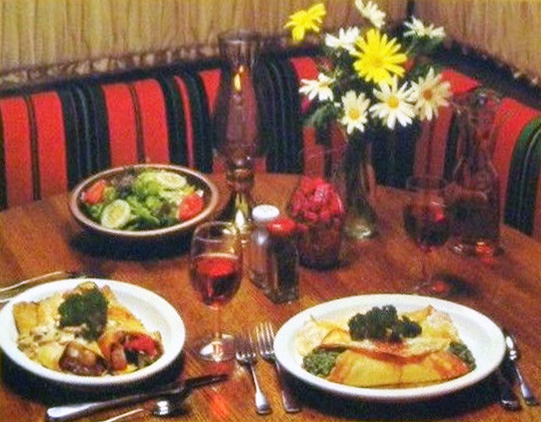
Filled with creamed chicken, ratatouille, or strawberries and whipped cream (etc.), crepes soon became a favorite lunch, dinner, and late-night supper for college students, dating couples, shoppers, and anyone seeking “something different.” Along with crepes, menus typically included a few soups, most likely including French onion soup, a spinach-y salad, and perhaps a carafe of wine.
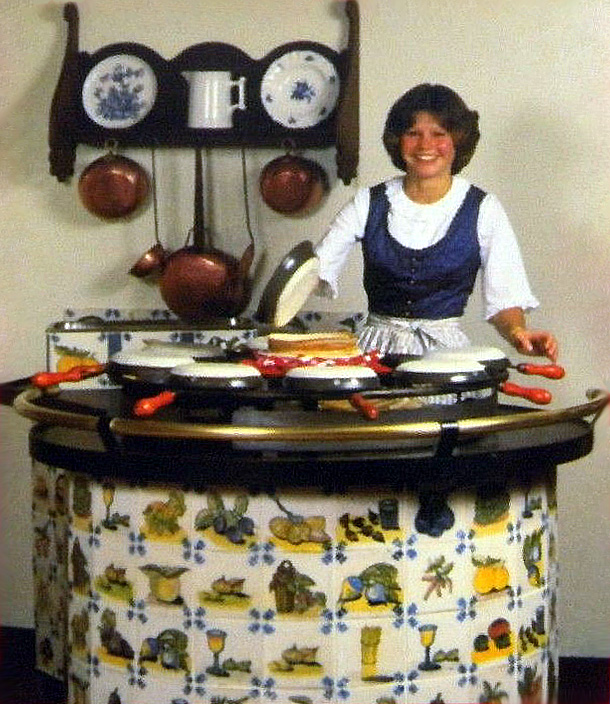 San Francisco’s Magic Pan Creperie led the trend and, after being acquired by Quaker Oats in 1969, spread to cities across the country, with the chain eventually totaling about 112. The first Magic Pan, a tiny place on Fillmore Street, was opened in 1965 by Paulette and Laszlo Fono, who came to this country in 1956 after the failed anti-Communist uprising in their native Hungary. A few years later they opened another Magic Pan in Ghirardelli Square and Laszlo patented a 10-pan crepe-maker capable of turning out 600 perfectly cooked crepes per hour [pictured here].
As Quaker opened Magic Pans, they invariably received a warm welcome in newspaper food pages. It was as though each chosen city had been “awarded” one of the creperies, usually situated in upscale suburban shopping malls such as St. Louis’s Frontenac Plaza or Hartford’s West Farms Mall. When a Magic Pan opened in Dallas’ North Park shopping center in 1974, it was called “as delightful a restaurant as one is likely to find in Dallas.”
 Among Magic Pan amenities (beyond moderate prices), reviewers were pleased by fresh flowers on each table, good service, delicious food, pleasant decor, and late hours. Many of the Magic Pans stayed open as late as midnight – as did many independent crepe restaurants. [Des Moines, 1974]
In hindsight it’s apparent that creperies responded to Americans’ aspirations to broaden their experiences and enjoy what a wider world had to offer. It was a grand adventure for a high school or college French class or club to visit a creperie, watch crepe-making demonstrations, and have lunch. [below: student at the Magic Pan, Tulsa, 1979] But what one Arizona creperie owner called the “highbrow taco” did not appeal to everyone. The operator of a booth selling crepes at Illinois county fairs reported that hardly anyone bought them and that some fairgoers referred to them as creeps or craps.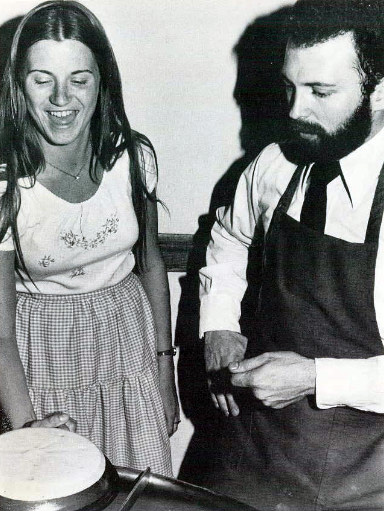
I would judge that crepes and creperies reached the pinnacle of popularity in 1976, the year that Oster came out with an electric crepe maker for the home. Soon the downward slide began.
Quaker sold the Magic Pans in 1982 after years of declining profits. The new owner declared he would rid the chain of its “old-lady” image, i.e., attract more male customers. Menus were expanded to include heartier meat and pasta dishes.
Even though new creperies continued to open here and there – Baton Rouge got its first one in 1983 – there were signs as early as 1980 that the crepe craze was fading. A visitor to a National Restaurant Association convention that year reported that crepes were “passé” and restaurants were looking instead for new low-cost dishes using minimal amounts of meat or fish. A restaurant reviewer in 1986 dismissed crepes as “forgotten food” served only in conservative restaurant markets. Magic Pans were closing all over, and by the time the 20-year old Magic Pan on Boston’s Newbury Street folded in 1993, very few, if any, remained.
© Jan Whitaker, 2018

 It's great to hear from readers and I take time to answer queries. I can't always find what you are looking for, but I do appreciate getting thank yous no matter what the outcome.
 Restaurant-ing through history
This is an interesting thing to learn about and I’m really inspired to do this in my own way. It is very lovely.
Will 2025 be the Year of the Crepe in western Mass?? Two new joints opened within miles of each other, at the same time.
HAS ANYONE EVER HEARD OF A CREPE SHOP IN NEW ORLEANS CALLED PETUNIAS, LATER NAMED THE ST. LOUIS CREPE SHOP? THE CREPES WERE WONDERFUL, THE ABSOLUTE BEST. I WAS LOOKING FOR COPY CAT RECIPES FOR THOSE CREPES.
Pingback: 10 70's Food Trends That Make You Want To Be A Kid Again. | Internet Vibes
I LOVED the Magic Pan, and have fond memories of going to either mall (in California, heyday of malls) in the 1980’s with my mother (I was in High School), and it was all very romantic and seemed (at least to my eyes), very chic. Yes, fresh flowers, tablecloths, and great service. I was also able to order a fair amount of alcohol, which I loved. I always wondered what happened to The Magic Pan, and know I know. Sad, really. But the whole era is very bygone, isn’t it? Pomp and circumstance is quite over in the world, abandoned for fast and not-so-fresh styles. Too bad, because there was an elegance to the world that has been lost- fashion, food, style, all of it.
My boss had us serving crepes in one of our five restaurants at the 1988 World’s Fair in Brisbane. They went over, well, meh, and were a pain. I’d liked them in the seventies and early eighties though, savory ones were a way for a single, restaurant working girl to go out to eat: a glass of wine and a ratatouille or spinach filled crepe for less than ten bucks with tip. (La Crepe Nanou in New Orleans, still there)
I had no idea this was a trend. As I entered my tweens, my parents brought me to le Maison des Crepes in Georgetown for a birthday dinner. Having watched “The French Chef” throughout my childhood I was familiar with crepes and the experience left me feeling terribly sophisticated. Needless to say, I was not the most popular boy in class. No real memories other than this but thanks for reminding me and for finding the image!
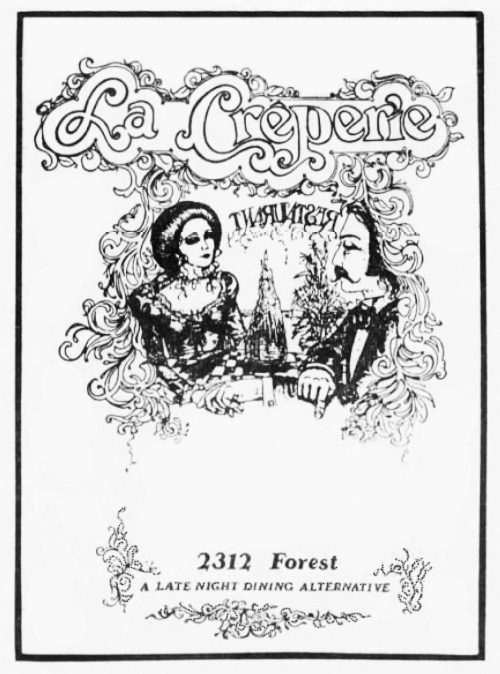
I have positive memories of La Creperie on Forest in Des Moines in the 1970s (menu pictured here). The decor also made an impression — hippie Victorian I guess you could call it — with rough wood, stained glass, macramé hangers holding potted ferns. Wine and candles were also a rarity then, considering the modest prices and coffee-house atmosphere. At least that is how I remember it!
When New Orleans got their Magic Pan in the French Quarter, I think around 1975, on Royal St., the restaurant was very interested in cultivating local interest so they passed out free coupons for dinner to all the shopgirls and bartenders working in the Quarter. Hopefully, we would recommend the place to tourists, but there was way too much local competition! They were open a few years and then quietly slunk away.
That makes sense since New Orleans wasn’t a restaurant desert like so much of the rest of the country.
Karen, I was opening “chef” there. Started at their NOLA area franchise at Lakeside Shopping Center (mall) and that location was great. Suburb of the city. Loved it. This was before the days of celebrity chefs and being paid well. I always complained to corporate about not allowing recipe “tweaks” or changing menu. I was told that they wanted customers to have the exact same experience at any one of their 115 franchises at the time. No matter where they were located. For example, on the menu was something called Chicken Gumbo (I believe that’s what it was called). It was almost like Campbell’s Chicken and Rice Soup with extra tomatoes and okra. They wouldn’t raise my pay and eventually I quit. I loved my manager and I’m still in touch with him. After I quit, they came to me months later and asked me to come back, that they were going to open the location in the French Quarter. I told them they were crazy, that they were going to lose a lot of money, that people went to the quarter for great dining experiences and their restrictions on the menu and recipes were not going to work. They had decided on a location, literally a few doors away from the original Brennan’s on Royal Street. They kept asking for me. I finally said, ok, but I want to be on a salary, not an hourly employee, and that I wanted to have input on kitchen layout. They agreed.
We were open all of 6 months. Initial traffic was good. months later I had people standing around because of no customers. Throwing food away because it wasn’t moving. I couldn’t stand it and left, again. They closed and because of the ridiculous lease they had signed on the building, they took a HUGE loss. So much so that they shut down the suburban mall location too. (It became a Ruby Tuesdays for a few years and then PF Chang’s, which is still there). I didn’t take any recipes with me but I always loved the Bleu Cheese dressing, which we made from scratch. I recently went on a search to replicate the dressing because I could never get it exactly the same at home. I’ve seen the recipe comments on this site, but I distinctly remember something that I’ve not seen in any recipe. I remember using Coleman’s Dry Mustard in it. Anyway, it was a fun ride and I’m glad I found this site.
Felix
Thanks for sharing your experience.
great post!
I loved the Magic Pan. We used to go to the San Francisco one for lunch whenever we would be downtown shopping around Union Square. My favorite was the Spinach Souffle crepe. Apparently the filling was thawed Stouffer’s Spinach Souffle. I’ve tried making them at home, and they taste pretty close to what I remember, but it’s not as much fun. Our current crepe chain, Crepevine, just doesn’t cut it – their crepes seem very heavy and muddy-tasting, but it is very popular.
Love your posts – always fascinating.
Crepevine is not good at all, IMO. LIke you said, muddy tasting and in my words, blah. Try every once in a while, and then remember why I don’t go there. Nothing like the Magic Pan at all.