Tag Archives: restaurant art

Famous in its day: Well of the Sea

A short time ago I had a chance to visit the fascinating second floor of the Fishs Eddy store in New York. It is piled high with not-for-sale dishware of all kinds, collected by the store’s owner Julie Gaines. The collection includes restaurant ware from the golden past when this country still produced such things. (Tours of the collection, hosted by Julie, are given periodically and booked by the New York Adventure Club.)

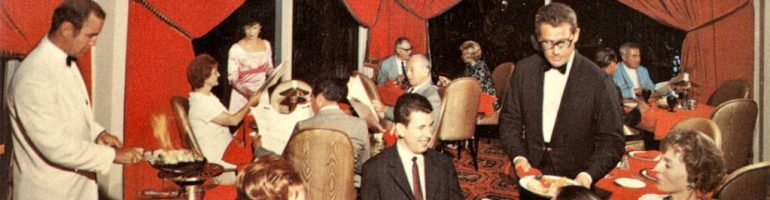
The Fishs Eddy collection also includes records from china producers that show pattern designs. A page from Shenango China in Newcastle PA — closed in the 1970s — depicted the design for a plate made for use at the Well of the Sea restaurant in the former Hotel Sherman in Chicago. (A ca. 1950 painting of the restaurant by Cal Dunn is shown at the top of this page. Below is a plate using the above Shenango design.)

The restaurant opened late in 1948 in the hotel’s basement, which no doubt suggested an underwater theme to the hotel’s owner, the colorful and theatrical Ernie Byfield. He had also originated the over-the-top glamour restaurant, the Pump Room in the Ambassador Hotel.

A number of abstract murals of underwater scenes by Richard Koppe, Chicago painter and student of the German Bauhaus, decorated the walls of the restaurant. One of them was used for the menu’s cover shown below. The room was further enhanced by darkness and other-worldly ultraviolet lighting.

In addition to the murals, Koppe also contributed wire fish and light sculptures somewhat visible in the black and white advertisement of unknown date. The color menu depicted one of the murals.

Needless to say, the restaurant specialized in fish, with frequent shipments coming in by air. It was especially known for what was called Black Clam Chowder made with Madeira wine, clams, and many herbs and spices. A portion of a menu is shown above.

Another unusual feature of the Well of the Sea was the attached art gallery in which the work of Koppe and other Chicago artists was displayed. The exhibit of Richard Koppe’s work took place in December, 1949, one year after the restaurant’s opening.

In 1968 the Sherman’s general manager explained that the ultraviolet light used in Well of the Sea was glamorous when it illuminated jewelry and white shirts but not when it lighted false teeth. But the customers liked it anyway despite the room being so dark that waiters had to assist them with flashlights in order to read menus. In 1968 a glow-in-the-dark menu was introduced to make reading easier.

Exactly when the dishware inspired by Koppe’s murals and designed by Shenango Potteries’ Paul Cook came into use in the restaurant is not known with certainty. According to Margaret Carney, whose International Museum of Dinnerware Design in Kingston NY features many pieces of dinnerware from the Well of the Sea, the design shown on the Shenango file page above was probably not used until 1954. What preceded it is unknown.

The Well of the Sea was popular from the start and stayed in business until 1972, a year before the Sherman itself closed.

© Jan Whitaker, 2024

5 Comments

Filed under atmosphere, decor, menus, Offbeat places

Coppa’s famous walls

coppa'sBlackCat2

The San Francisco restaurant Coppa’s became legendary in the early 20th century as a gathering spot for bohemian artists and writers, especially after they decorated its walls with curious and intriguing murals. Though the murals remained in existence for scarcely a year, because of the devastating fires that followed the earthquake of April 1906, they have been forever tied to the restaurant’s mystique.

coppaincoppa'sBlackCatOver the course of months in 1905 the murals were drawn in chalk crayon by artists who frequented the restaurant on Montgomery Street. Legend has it that proprietor Giuseppe “Joseph” Coppa papered (or painted) his walls a hideous red that offended their esthetic sensibilities, impelling them to mask it with their humorous, nonsensical drawings. An alternative explanation is that Coppa asked the artists to draw on the walls and that he chose red as a good backdrop. I find this more convincing since Coppa himself was a painter.

A row of stenciled black cats at the original location, by Xavier Martinez, was inspired by Le Chat Noir in Paris, the city where Martinez had studied painting. They gave the restaurant its nickname, The Black Cat, which was also used at its new post-fire location.

While I was at the Library of Congress a few weeks ago I had a chance to look at the hard-to-find book The Coppa Murals, by Warren Unna (1952). He interviewed some of the artists involved and also Felix Piantanida, Coppa’s early partner who was responsible for preserving the photographs shown in the book. It’s likely the photos were taken for use in an article by Mabel Croft Deering not published until June 1906 in The Critic, but written before April’s destruction caused Coppa’s closure. The murals themselves were at some point scrubbed off or painted over by the landlord.

coppa'sphoto1906

Though the restaurant was looted by vandals, the building Coppa’s restaurant was in actually somehow escaped destruction [shown above]. With few buildings intact, its value rose and Coppa’s landlord raised the rent, leading Coppa to vacate and open another Black Cat on Pine Street in November. He and Piantanida split up, and for a short time Piantanida conducted a restaurant called La Boheme in the space formerly occupied by Coppa’s.

The artists and illustrators who contributed drawings included some who would become prominent, such as Maynard Dixon, Xavier Martinez, and Gelett Burgess. The artists, along with poets and writers, contributed puzzling sayings and quotations that adorned the walls, fascinating – and insulting – customers (“Philistines”) who came to gawk at the bohemians.

coppa'sbook

The cover of Unna’s book shows a crude rendering of a mural by Xavier Martinez depicting the restaurant’s core group of regulars. Martinez is seated at the far right. Standing behind him is poet Bertha Brubaker, wife of Perry Newberry, smoking a cigarette. Her nickname “Buttsky,” which referred to her habit of saving cigarette butts, appears in the “hall of fame” of names that run beneath the black cats. The names of Coppa’s regulars are interspersed with those of famous writers such as [Johann Wolfgang] Goethe, [François] Villon, and [Guillaume] Apollinaire. The few women named are hard to identify since their last names do not appear, but Maisie was freelance writer Mary Edith Griswold and Isabell was allegedly a newspaper writer.

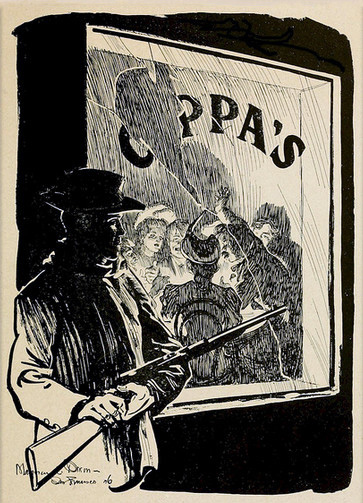
coppa'sMaynardDixonSimpleLifeinBohemiaWhen Coppa moved to Pine Street, a new row of cats appeared, but now marching in the opposite direction. Maynard Dixon also contributed several new images. One of his shows Coppa unfurling a scrolled menu to a crowd that includes regulars who were violinists, writers, poets, and artists. On another wall Dixon commemorated Coppa’s “Last Supper” at his old location, celebrated soon after the fire and necessitating official approval and protection from a marshal who stood guard outside. Another notable feature of the Pine Street murals were two works by a woman, painter and jewelry designer May Mott-Smith.

coppa'sredpaint

Coppa’s second Black Cat closed in 1913, after which Joseph and his son Victor launched Neptune Palace, a more commercial cabaret restaurant. In 1916 Joseph returned to a bohemian theme with The Red Paint, a short-lived restaurant on Washington Street that went out of business at the start of Prohibition, stopping the flow of “red paint,” i.e., wine. It too had murals, never completely finished and lacking the inspiration of those at the earlier Black Cats, despite Maynard Dixon’s participation once again. Many in the old gang had moved to Carmel by the Sea and things were not the same.

coppasaug231933In 1922 Coppa opened yet another restaurant, at 120 Spring Street, offering “old-time dinners,” possibly so-called because they were paired with illicit wine. Joseph was often arrested in raids by prohibition agents, and Victor once escaped by running out the back door. It’s possible the restaurant was officially padlocked for a time because in 1933 it “re-opened,” with the unveiling of a painting by the ever-faithful Maynard Dixon of a nude woman dressed only in shoes, stockings, and a large-brimmed hat with her legs crossed atop the table, toasting an obese man opposite her [see 1933 advertisement]. The same image was used on the cover of the restaurant’s menu at its final location, 241 Pine. That closed in December 1939, marking the end of Joe Coppa’s long culinary career.

Joseph’s wife, Elizabeth, who had been the dining room manager and cashier, died in 1938. After his retirement he took up painting, focusing on portraits of men such as business magnates, Italian dictator Benito Mussolini, and poet George Sterling.

© Jan Whitaker, 2015

12 Comments

Filed under atmosphere, Offbeat places, restaurant decor