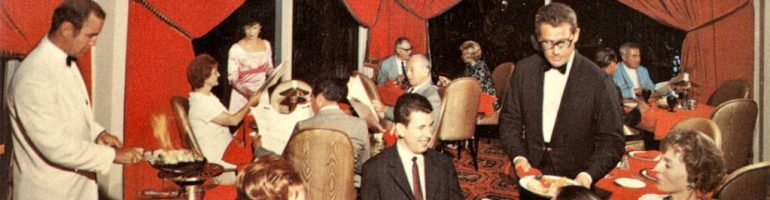

Popcorn isn’t a meal, and a movie theater isn’t usually (with a few exceptions) a restaurant, but it’s summer and my mind is straying. I became curious about how popcorn got so popular with movie goers.
Turns out that popcorn in theaters was a topic destined to become a popular topic with journalists. Columnists were attracted to it, and newspapers often raised the question of popcorn eating in their “people on the street” surveys.
There seemed to be quite a lot of people who strongly disliked listening to popcorn crunching in theaters. And before popcorn boxes and tubs were introduced they also complained of the rattling of paper bags that popcorn was served in.
The earliest complaints I found began in the teens. But long before people began complaining about popcorn in theaters, they complained about peanuts. As early as 1865 a story titled “The Peanut Nuisance” appeared in a New Orleans paper. Of course the theater would not have been showing movies then, but the complaint foreshadows the popcorn debate. The theater goer wrote: “. . . we hold that no gentleman will eat peanuts in a theater. No man can be a gentleman who, for a little self-gratification, will annoy and disgust all those around him.”

Popcorn came to theaters in the early 20th century. Already by 1916 the Majestic theater in Monticello IN was popping and buttering corn with a newly invented “beautiful” electric Butterkist popcorn machine [shown above] that stood proudly in its lobby. The Monticello Journal remarked that the theater was now “in line with the progressive picture houses of the big cities.”

It didn’t take long for complainers all over the country to register their opinions. A letter to the editor of a newspaper in Stockton CA announced that the writer disliked the “rattlings, scrunching and smacking” so intensely that they could barely restrain themselves from “having a violent fit.” By the 1920s commentators were calling popcorn eating at the movies a “craze.” Still, negative reactions filled papers across the country for decades, finally beginning to die down in the 1960s.
Some theaters also disdained popcorn. The Loew’s theaters took the initiative in prohibiting patrons from eating popcorn in their theaters. Not only did the theaters not sell it, they asked anyone bringing it inside to check it. The name of the owner was written on the package and it was returned after the showing.
The official response to complaints about popcorn in theaters included exploring the possibility that popcorn drew rats. The Wichita KS city council, for example, asked the health department to investigate this risk in 1939. No evidence that popcorn threatened health was found.

Even without rats as an excuse, some officials took the route of outlawing popcorn in movie theaters. In the late 1940s there were attempts to pass state laws to ban popcorn in movies in Oregon and Wisconsin. They went nowhere.

Theaters insisted that they needed the revenue produced by their refreshment counters — where popcorn was the big seller. In 1946 a theater in San Diego admitted that one week their candy counter took in more money than the movie that was playing. By the early 1950s concession sales were seen as essential for economic health, all the more so as television became common. A story reported that an accountant representing theater owners told the House Ways and Means Committee in 1953 that “only popcorn and candy had kept the movies in business during the last two years.”
The popcorn wars came to an end. If some people disliked popcorn crunching they kept it to themselves.
Public attention turned to what kind of movies stimulated popcorn sales most successfully. Gangster and cowboy movies and musical comedies were said to rate highly unlike “the serious and thought-provoking types.” Elvis movies were said to sell the most popcorn in 1956 and 1957. The Exorcist was the winner in 1974 and Jaws was said to be the “popcorn picture” of all time. Some psychologists were of the opinion that the hand-to-mouth activity was soothing.
© Jan Whitaker, 2025

 It's great to hear from readers and I take time to answer queries. I can't always find what you are looking for, but I do appreciate getting thank yous no matter what the outcome.
 Restaurant-ing through history