Tag Archives: Indiana restaurants

Bob’s Bar-B-Q

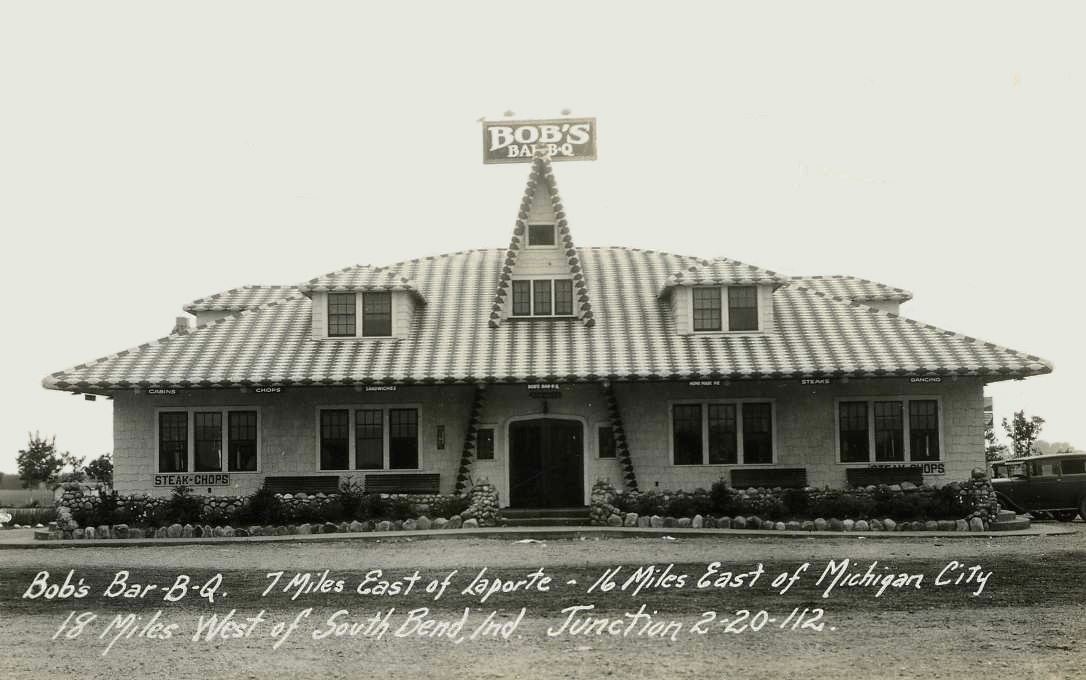
I’ve been exploring my postcard and ephemera collection and picking out favorites to see what I can find out about them. Judging from the geographical identification on this card – indicated by highway numbers and miles from towns, it clearly was a roadside enterprise catering to car and truck traffic on Route 20 in Indiana.

What I didn’t know is how very popular it was, not just with truckers and long distance drivers but with people living in the vicinity. Memories of it has inspired filmed interviews with former patrons who hung out there in their teens.

Bob’s initially opened in 1927, with a smaller building and was enlarged as shown above in 1932. In addition to getting business from traffic on Route 20, it also served as a stop for buses, with 10 to 15 stopping there daily. With the addition, the restaurant could host 150 patrons.
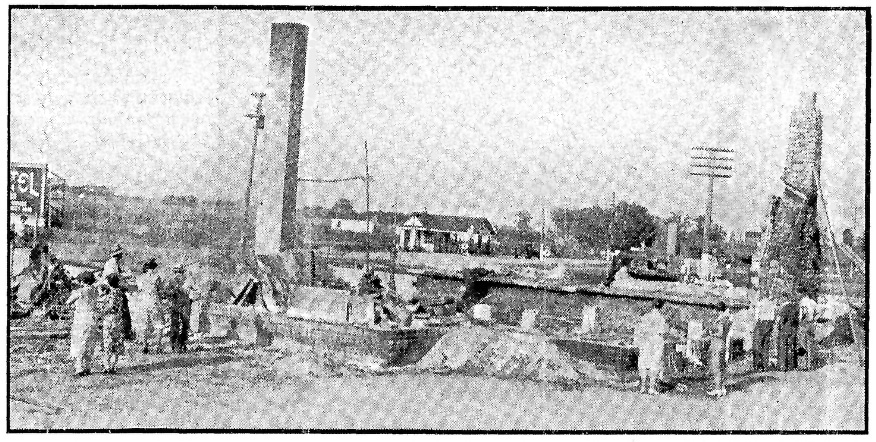
It belonged to by Robert Wiley and his wife Adah who worked there as a waitress. In 1933 it was totally destroyed by fire.

The Wileys and some relatives who lived with them were lucky to escape, although Adah was seriously injured. The Bob’s sign perched precariously on top of the central peak fell on Bob, but he was not badly hurt.
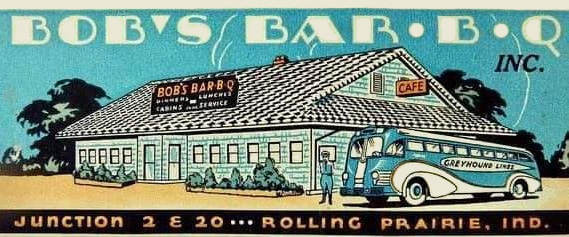
The Wileys were eager to replace the building quickly because it was on Route 20 where traffic was then headed toward Chicago’s World’s Fair. It soon reopened in a new building, shown above on a matchcover.

At some point tourist cabins were erected on land behind the restaurant. They were for travelers, but also housed restaurant waitresses.

With the new building in operation, the business continued to grow, But World War II presented new obstacles, namely difficulty in finding staff and a full range of food. At its busiest the restaurant had a staff of 40 but was down to 9 when it closed for the duration of the war. The South Bend newspaper declared it had been “one of the best-known highway restaurants and tourist camps in the middle west.”
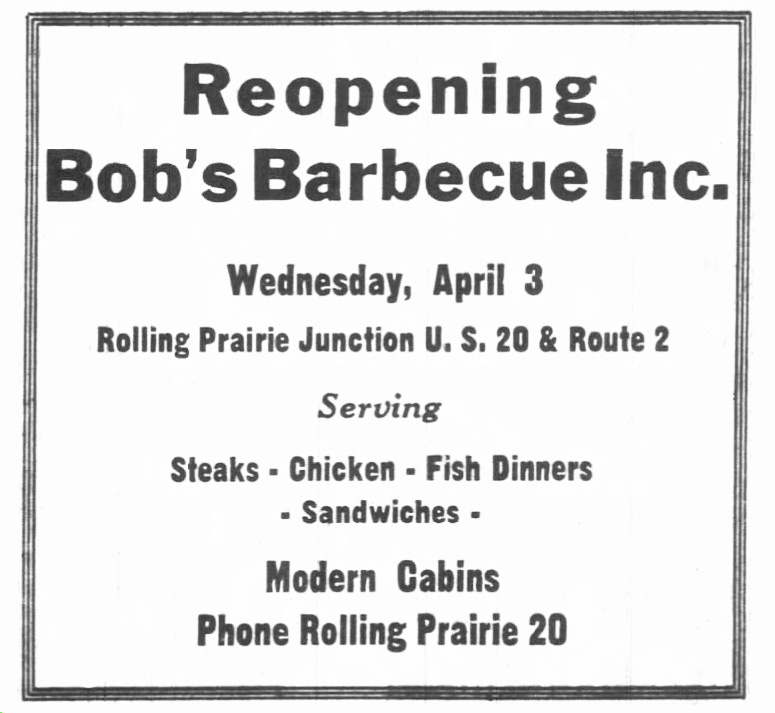
When the restaurant closed Robert Wiley became a La Porte county deputy sheriff. Adah died in 1946. He remarried and reopened the restaurant in April 1946.

The highway set the tone for the restaurant in a number of ways. Obviously it brought travelers of all kinds, including some criminals on the run, and a jewel thieves who pulled off a daring heist in the parking lot. But stranger still — to me at least — was putting venison on the menu after a deer was killed on the highway.

Bob’s closed sometime in the 1960s.

© Jan Whitaker, 2026
3 Comments

Filed under patrons, roadside restaurants

Restaurant as fun house: Shambarger’s

Shambarger'sAI came across this restaurant while looking through lists of winners of Holiday Magazine awards. I was intrigued to learn that Shambarger’s, in the small town of Redkey, Indiana, was one of only five restaurants in that state to win such an award in 1972.

As I learned more about Shambarger’s I had mixed reactions: fascination at its creator’s unstoppable spirit, surprise that it had won prestigious awards, and gratitude that I had never been compelled to sit through a 5- to 6-hour dinner and vaudeville show there.

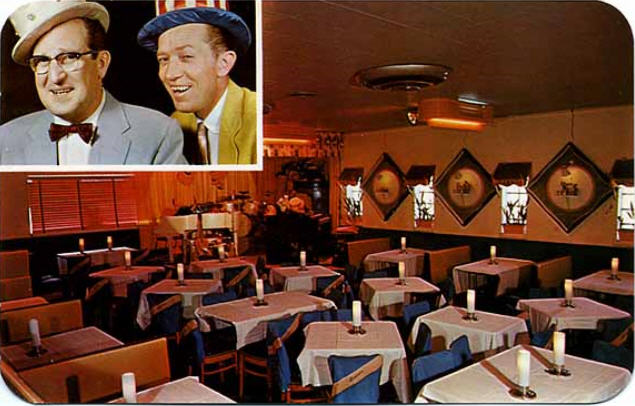
BeaconSupperClubDenverFor Shambarger’s fell into a category I call the fun house restaurant, once occupied by hotspots of enforced jollity such as Greenwich Village’s Village Grove Nut Club or the Beacon Supper Club in Denver whose owners put on funny hats to make people laugh [pictured]. La Nicoise in Washington, D.C. had waiters on roller skates.

Shambarger’s, adjacent to a railroad track, resembled an abandoned building on the outside, a junk shop on the inside [see painting below by Clyde Thornburg, 1971]. Its proprietor John Shambarger “performed” most of the seven-course dinner preparation in front of 50 or so guests who made reservations many months in advance, often traveled some distance, and paid about $100 a person in today’s dollars.

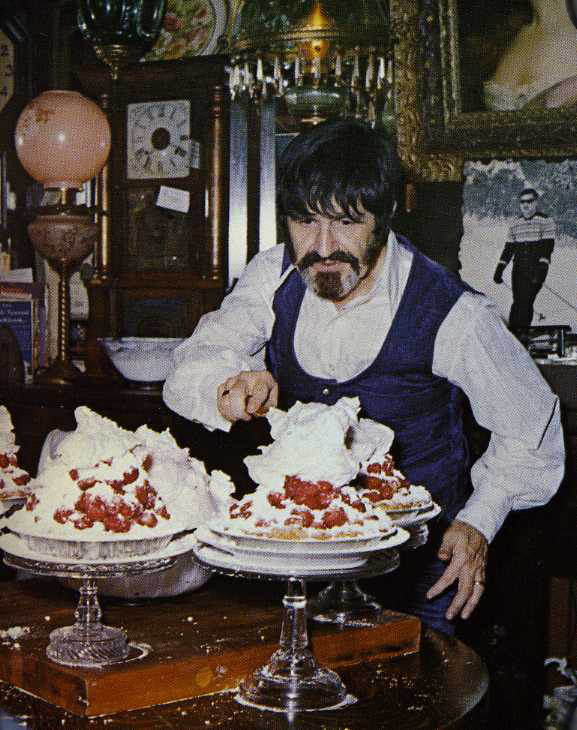
Shambarger'sClydeThornburg1971Making ten or more costume changes an evening, as a pirate, Tiny Tim, a Hawaiian dancer, etc., John chopped and mixed while singing, pattering, or loudly playing records keyed to each dish. Sometimes he told jokes, kissed women diners, or screamed ‘Aaayyyyy’ in people’s ears in concert with a Spike Jones record.

And all this without cocktails! No alcoholic drinks were served, except in later years when dinner began with punch bowl of “Bloody Redkey” made of tomato juice spiked with a Budweiser six-pack. Burp.

Holiday magazine’s volunteer judges in the 1960s and 1970s had a weakness for French cuisine. Which was what Shambarger’s provided, sort of. The menu was actually as jumbled as the decor of old clocks, menus, mirrors, lamps, and a moose head wearing a hat. It always included a main dish of Imperial Prime Ribs of Beef Flambee (in rum) and a dessert of sky-high strawberry pie (see above), but the first five courses varied. In one 1968 account they included – in a sequence that is perplexing – chicken soup, fresh fruit cup, corn fritters rolled in powdered sugar, shrimp, and guacamole with John’s special dressing.

Recipes for Shambarger’s guacamole and “Antique Salad Dressing” are furnished in the Holiday Magazine Award Cookbook (1976). I like guacamole and do not think it needs a dressing, especially not one made of cottonseed oil, vinegar, chopped onions, loads of sugar, catsup, concentrated lemon juice, and apple butter.

According to newspaper accounts, Redkey’s townspeople rarely ate at Shambarger’s, but they were always intrigued by the influx of well-dressed visitors from afar. In the words of Jayne Miller, who grew up in the area and now heads up Historic Redkey, Inc. (and provided information and images for this story), the locals knew that “magic” took place inside Shambarger’s humble structure.

The restaurant had its fans and its detractors, but enough of the former to keep Shambarger’s in business under John’s management from the 1960s through the early 1980s.

© Jan Whitaker, 2013

55 Comments

Filed under Offbeat places, proprietors & careers