
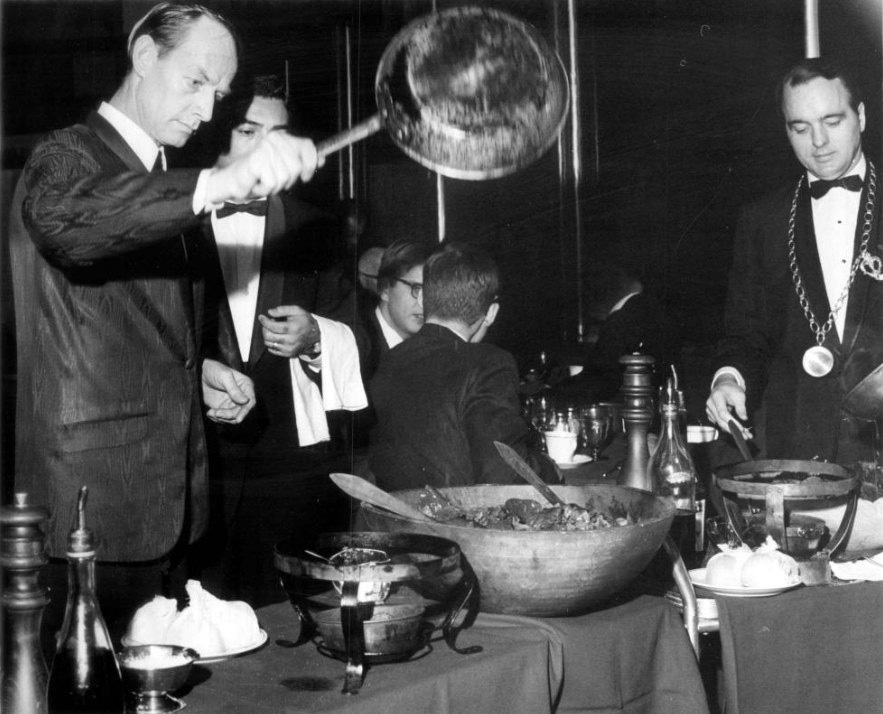
In the mid 1950s Geril and Gosta Muller arrived on the west coast. They were born in Denmark and had graduated from a Hotel and Restaurant School in Copenhagen in 1943. Following that Geril had served royalty at a Royal Gun Club. [Gosta (left of then-president Nixon) and Geril, 1971, at Chez Cary]
After a few years in Reno NV, they would swiftly work their way to the top of the emerging luxury restaurant pyramid in Southern California, managing and eventually owning award-winning restaurants there.

In Reno, the brothers worked at a motel restaurant called The Bundox (meaning boondocks). After a few years Geril went on to San Francisco to work as manager of the Pink Chateau restaurant in the Continental Motel. It may be significant that the Pink Chateau featured steak cooked on a “flaming dagger,” because flaming food would be a featured attraction at their next engagement in Orange CA. There the brothers firmly established their reputations for creating and running fine restaurants. [above: River House Motel, home of The Bundox]

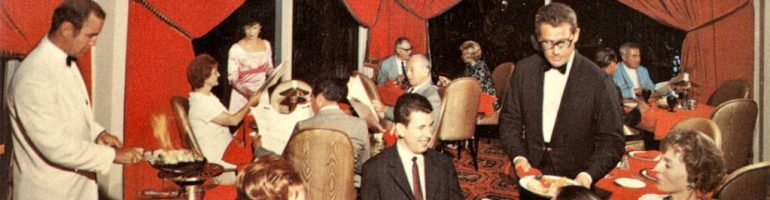
In 1965 the Mullers helped establish Chez Cary, named for owner Cary Sinclair. The Chez, as it became known, set a model for an exquisitely posh and precious style of “continental” restaurant-ing not found much outside San Francisco and Los Angeles at that time. Orange’s residents may have been well off but they were not used to dressing up for dinner. A suit and tie was a requirement at Chez Cary where princely male waiters threatened to outdress their wealthy customers. [1967 cartoon of Geril wearing tuxedo]
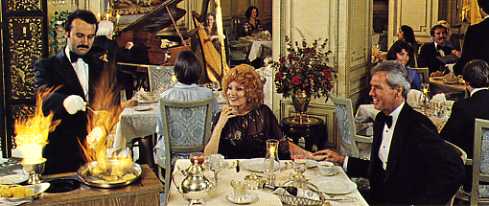
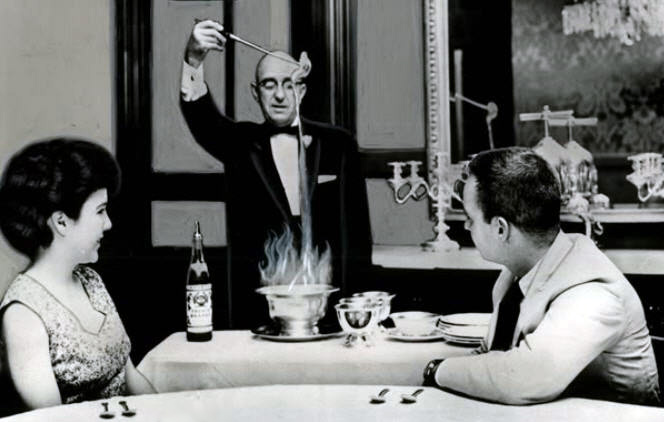
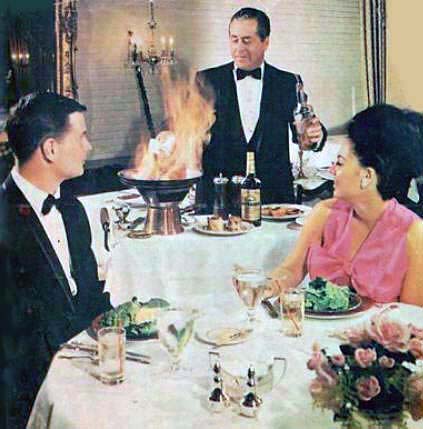
The brothers decorated the restaurant lavishly with red velvet upholstered swivel chairs, crystal chandeliers, silver candlesticks, fine china, and old world decorative objects. Geril rounded up a talented kitchen and dining room staff. And, of course, there was quite a lot of tableside theatrics, with salads tossed and dressed, sauces poured, and meats and desserts flamed.
There was a ladies’ menu – i.e., one with no prices — since madame couldn’t possibly be the one paying the bill. And there were ladies’ footstools under the tables. Why the footstools? I don’t know, but they seemed to impress reviewers.
In 1966 the restaurant reviewer from the Long Beach newspaper observed that the bill for a dinner with his wife came to $18 plus tip. But, he wrote, it was the sort of restaurant where guests were not supposed to care what the total came to. He gave it his highest rating: AAAA. While the brothers were at Chez Cary, acting as managers and maitre d’s, the restaurant won four Holiday Magazine Awards, an accomplishment generally attributed to the Mullers.

The Mullers remained at Chez Cary until 1973 when they opened their own restaurant, Ambrosia, in a Newport Beach location formerly occupied by a restaurant called Karam’s [shown above]. Their ability to win awards continued at Ambrosia [below: cartoon of Geril with a Holiday award, 1975].

Ambrosia strongly resembled Chez Cary in luxurious decor and smooth operation. According to one report the restaurant “served so many flaming dishes that at one point it had to get special permits from the town’s fire department.”

Evidently patrons found Ambrosia very comfortable. Five-hour-long meals were not unheard of. By the 1980s the typical tab for two had risen to $150. [Above, Ambrosia in Newport Beach]
But, alas, ten years after opening Ambrosia the building’s owner threatened to double the rent. The brothers hatched a plan to relocate Ambrosia to an elaborate and expensive new restaurant complex they built in Costa Mesa called Le Premier. But Ambrosia didn’t succeed in its new location, closing a mere two years after opening in 1983. Geril bitterly observed that Costa Mesa was not a good location for a first-class restaurant, saying there weren’t “enough well-traveled people in Costa Mesa” and “Anything exclusive will not work there.”
Despite declaring bankruptcy, the Mullers did not give up the struggle to revive Ambrosia. Another restaurateur had adopted the name Ambrosia and the type style the brothers had used. They sued him, hoping to get back the name. Then they bought the restaurant in Newport Beach that had taken over their former location there – 30th Street Bistro — planning to open a new Ambrosia once they won the suit. Sadly for them, they did not succeed.
© Jan Whitaker, 2024



 It's great to hear from readers and I take time to answer queries. I can't always find what you are looking for, but I do appreciate getting thank yous no matter what the outcome.
 Restaurant-ing through history