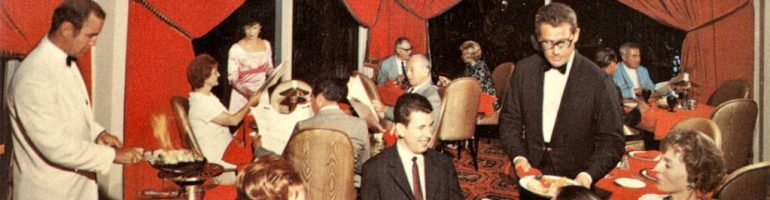
 Of course he wasn’t the only “sociopath” ever to become a restaurateur, but Michael Romanoff was very likely the most flamboyant. He was clever, spoke with a British accent, and dressed impeccably. His sense of style never left him. Imprisoned in NYC’s Tombs in the 1920s, he reportedly made quite an impression by strolling in the exercise yard with a walking stick. This story could be false, though, because not only did he twist the facts perpetually but so did some of the journalists who covered his bizarre 30-year career as a con-man.
He came to the attention of the press in 1910 when he presented himself as the grandson of England’s premier Gladstone in order to obtain two cameras on credit. He was unmasked as a former juvenile delinquent named Gilbert E. Gerguson. By the early 1930s he had used at least 17 aliases, including his favorite, Prince Michael Romanoff, younger brother of the former czar of Russia, Nicholas II. Although his “real” name is widely accepted as Harry F. Gerguson, I suspect it was actually Michael Romanoff, from Brooklyn. U.S. immigration authorities, however, were convinced he had been born outside this country and deported him every chance they got, about 10 times.
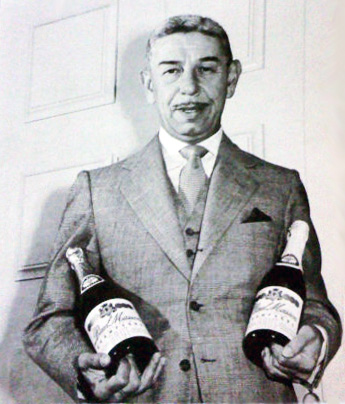 He claimed to have spent seven years of his life in jail. At times, when not sponging off rich patrons, stowing away on luxury ocean liners, or successfully passing bad checks, he was penniless and went hungry. He may have spent time in a mental hospital and attempted suicide at least once. Although he was sometimes described as a former pants presser, oil field worker, and buttonhole maker, it was not his style to hold a regular job although he once managed a farm in Virginia for over a year, possibly his longest gig.
 He never apologized for his lifestyle. Quite the contrary. In 1933 he declared, “For years I have been supplying adventure, by proxy, to those who have desired it. I have given more enjoyment, I think, than I have received.” By then everyone knew he was no prince, but he defended himself by saying, “At least I have the attitude of a prince – I have lived courageously and have, I think, put up the stock of princes.” Well, the stock of princes wasn’t terribly high in the 1930s and, courageous or not, he engaged in some shady activities.
His life improved immensely when he became a frankly fake prince rather than a fraudster trying to pass for Russian royalty. And where better to be what he called a “real phony” than Hollywood? He opened a restaurant there around 1940 which quickly became one of Hollywood’s famous haunts. By then he was 47 or 50 years old, depending upon which birthdate you accept. According to various newspaper stories, the restaurant’s capital was put up by director Darryl Zanuck, writer Robert Benchley, and others. In 1951 it moved to South Rodeo Drive in Beverly Hills, and somewhat later spread into San Francisco and Palm Springs.
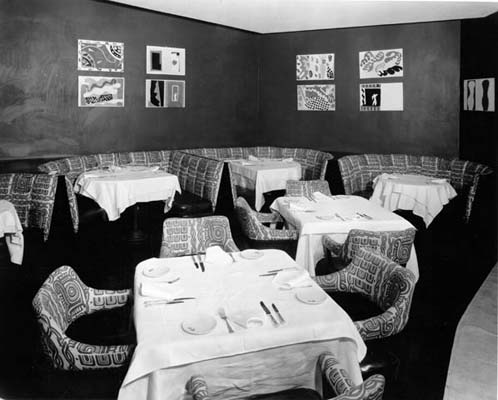 The Hollywood Romanoff’s was a celebrity den where Mike entertained his guests — sometimes by snubbing them. How much time he spent supervising staff or bothering himself with mundane chores such as buying provisions or going over the books is unclear, as is the quality of the cuisine. By one account it was so-so but was upgraded to “above-average” in the late 1950s. An undated menu shows numerous dishes with Stroganoff and Romanoff suffixes. He made a good income, but by December 1962 business had fallen off to such a degree that the Beverly Hills Romanoff’s closed. I have not been able to determine the fate of the other two locations.
Mike’s story was clearly movie material, yet it seems that two announced films (“Ellis Island,” “The Incredible Romanoff”) never appeared. He had small parts in numerous films, sometimes playing a butler, aristocrat, or himself as restaurateur. In 1958 Congress voted to grant him permanent resident status and he became a naturalized citizen.
© Jan Whitaker, 2010


 What could be more starkly different from the somber coffee shops of today with their earnest and wired denizens than the beatnik coffeehouses of the 1950s? Could Starbucks be anything but square to the beat generation?
 Although the word beatnik came into usage around 1958 (inspired partly by Sputnik), the phenomenon of dropping out of the “rat race” to lead an existentialist, non-consumerist life was part of the aftermath of World War II akin to the “Lost Generation” after World War I. The first coffeehouses sprang up in Greenwich Village in the late 1940s, but the beats weren’t averse to hanging out in cafeterias either — their “Paris sidewalk restaurant thing of the time.” When coffeehouses began levying cover charges for performances, beatniks tended to drop out of them too.
 The heyday of the coffeehouse was the late 1950s into the early 1960s. Few did much cooking so they weren’t restaurants in the true sense, but many of them offered light food such as salami sandwiches (on exotic Italian bread) and cheesecake, along with “Espresso Romano,” the most expensive coffee ever seen in the U.S. up til then. Of course the charge for coffee was more a rent payment than anything else since patrons sat around for hours while consuming very little. Other then-unfamiliar food offerings included cannolis at La Gabbia (The Birdcage) in Queens, Swiss cuisine at Alberto’s in Westwood CA, Irish stew at Coffee ’n’ Confusion in D.C., les fromages at Café Oblique in Chicago, “Suffering Bastard Sundaes” at The Bizarre in Greenwich Village, and snacks such as chocolate-covered ants and caterpillars at the Green Spider in Denver.
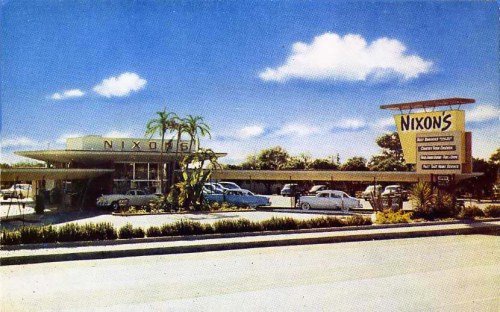 Since the 35th anniversary of Richard M. Nixon’s 1974 resignation from the presidency was commemorated this past weekend, it’s as good a time as any to focus on his brother Donald’s brief career as a restaurateur in Southern California. In the short span of five years in the 1950s, Don managed to go out of business while doing some serious damage to brother Richard’s political fortunes.
 The chain of five Nixon’s restaurants began modestly in 1943 when the Nixon family’s grocery store, established in 1922 by father Francis Nixon in Whittier, added a coffee shop. Although Don was involved in running the coffee shop, his first real business venture took place in 1952 when he opened a drive-in on East Whittier Blvd. (shown above). Two years later he opened Nixon’s Family Restaurant, also on East Whittier, home of the “Nixon Burger” whose unfortunate, opportunistic name would be used to taunt Richard Nixon during his two terms as President. Next Don opened a drive-in near Disneyland, in Anaheim, and a restaurant and bakery in Fullerton. In 1957, despite the Hughes loan and proceeds from the sale of Nixon’s Market to a supermarket chain, Don Nixon put all five restaurants up for sale to settle the chain’s debts.
 In the early 1950s middle- and upper-income people in cities of 25,000 or more were surveyed about their restaurant habits. People with lesser incomes and those living in rural areas and small towns were excluded because they were considered to be infrequent restaurant patrons. Thirty-five percent of those surveyed reported eating a restaurant lunch or dinner, or both, four to seven times a week. About one-third of the respondents also volunteered complaints, some of which follow:

 It's great to hear from readers and I take time to answer queries. I can't always find what you are looking for, but I do appreciate getting thank yous no matter what the outcome.
 Restaurant-ing through history