Category Archives: Uncategorized

Dining at the speakeasy

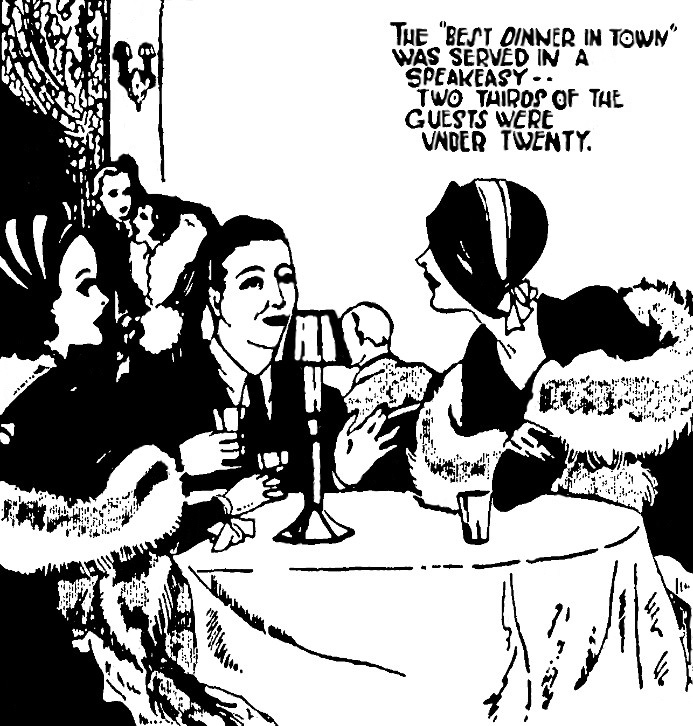
Speakeasy restaurants had an unexpected and lasting effect on patrons’ dining and drinking preferences after national Prohibition was repealed in 1933.

Many speakeasies didn’t serve food, but those that did were mainly located in cities and on urban outskirts. In cities, many were run by people from Italy or France, from cultures that generally did not demonize alcohol and saw wine as a normal accompaniment to dinner.

Deluxe restaurants of the earlier 20th century had closed when they lost their revenue stream from liquor, marking the end of an era of restaurant going. Their haughty formality and giant dining halls became a thing of the past. Since they had the most to lose if caught, hotels tended to observe Prohibition. But they suffered badly as guests abandoned their dining rooms for more accommodating eating places. It turned out they also liked the ambience they found in speakeasy restaurants.

Speakeasies in New York were said to have excellent food, largely because their profits allowed them to hire away the city’s best chefs from other spots. Another problem for restaurants and hotels that observed Prohibition was that they had to raise their prices to make up for the lost revenue from drinks. At the same time, speakeasy restaurants were able to lower their prices because they were making so much from drinks.

Some restaurants played it both ways. They were not speakeasies — no guards at the door, no secret password — but they were very, very careful about serving forbidden liquids only to known and trusted guests. New York’s Colony was one that tried this method, not entirely without peril. In 1925 it was padlocked by Prohibition agents for 30 days.
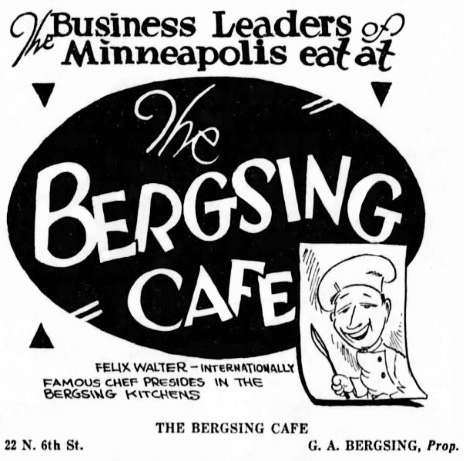
Another example of a respectable offender was the Bergsing Café in Minneapolis, described by the authors of Minnesota Eats as a “gentle speakeasy.” Patrons could be sure their reputations would not suffer if they ate there. As the 1929 advertisement shown above proclaims, it was popular with business leaders who evidently were not bothered by the practice of serving drinks to certain customers.

By contrast, the roadhouse known as the Hollyhocks Inn, in nearby St. Paul MN, was a true speakeasy. Although it drew a society crowd, they rubbed shoulders with serious gangsters. In fact, a co-owner of the inn was convicted of plotting with a gang to kidnap brewery head William Hamm and sharing in the $100,000 ransom. At his trial he was asked if he had run a speakeasy, drawing laughter from spectators when he answered, “I don’t know what you mean by a speakeasy.”

Federal agents sometimes went to great lengths to get into speakeasies. In New York three agents presented themselves as vaudeville players gossiping about fellow performers at a spot on West 46th street. They were admitted and made an arrest.
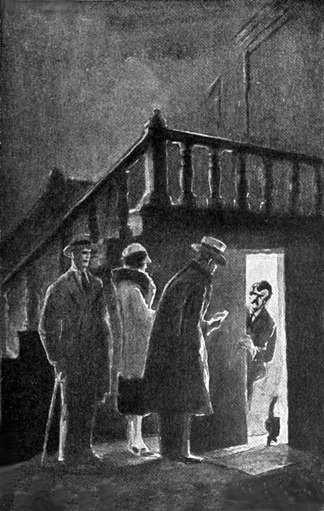
New York had so many accommodating restaurants and law-breaking customers – many of them tourists – that for many Americans in small towns the city became seen as Sodom and Gomorrah. This widened the cultural gap. As historian Lewis Erenberg put it, it created “the sense that New York was not America.”

Aside from Greenwich Village, New York’s speakeasies tended to be located on side streets, particularly in residential brownstones west of Eighth avenue in the Forties. A Brooklyn restaurant proprietor reported in the trade magazine Restaurant Management that probably half of the eating places there made “their money on other things [than] food.”

Of course, New York, where there were an estimated 25,000 speakeasies, was scarcely the only city that violated the Volstead Act. Most American cities were also said to have thousands of speakeasies in the 1920s. For instance, Chicago had the South Side and Towertown, its Greenwich Village type of area. Even Pittsburgh – where the word speakeasy first came into use in the 1880s – was well supplied. On the other hand, Los Angeles was said to be lacking in speakeasies because most Angelenos did their drinking at home.

By the 1930s many speakeasy owners were plagued by gangsters who tried to muscle in for a cut. Some proprietors hoped that Prohibition would end and they could open legitimate restaurants that would be patronized by the clubby following they had developed. One of the features of the speakeasy that they hoped to capitalize on in the future was what a Life magazine story characterized as “an intimacy in the restaurant business that it never had before.” The writer Heywood Broun thought that speakeasies had been “a civilizing influence” that had helped “allay the feverish pace of American life.” They were, he thought, friendlier, with their small, quiet dining rooms, good food, accommodating waiters, and moderate charges. His concern was that the end of Prohibition would destroy that.

Others correctly felt that the public would still value small and intimate places. The Childs chain, which began to serve wine and liquor after Repeal, noticed that its booths, which had once been unpopular, were now sought after. They attributed the change to “the speakeasy influence.” Restaurant Management magazine reported in 1934 that cocktail lounges with bright ultra modern decor were being rejected by women, who preferred warmer Colonial American styles and soft lighting. Cozy Midwestern supper clubs, often located on the outskirts of town where they could avoid raids during Prohibition, showed a staying power after Repeal.

Speakeasies, it appeared, had indeed changed the public’s dining and drinking habits. Rather than lone men standing at bars, bartenders were seeing men and women at tables enjoying leisurely 5:00 o’clock cocktail hours. Diners were more knowledgeable about food and wine, and showed more enjoyment in dining out, in contrast to what one writer described as “the hurried days of eat, drink and move on to another place.”
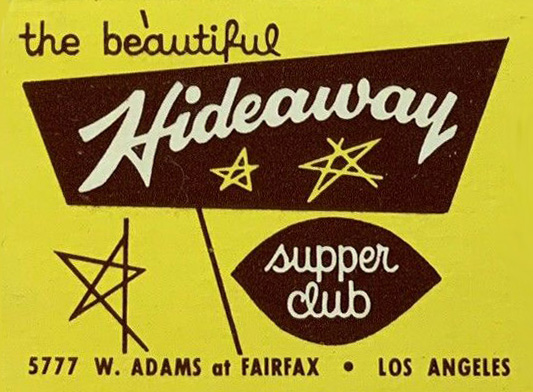
The fondness for speakeasies also lived on long after WWII in numbers of restaurants and bars with names such as Keyhole, Hideaway, and of course Speakeasy.

© Jan Whitaker, 2023

5 Comments

Filed under Uncategorized

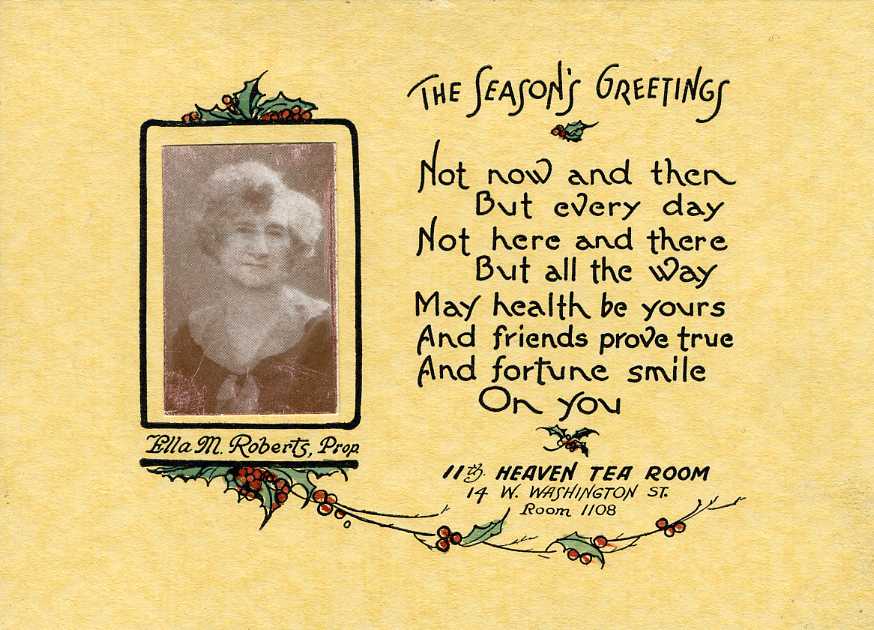
Holiday greetings from 11th Heaven

A while back I found two small Christmas cards from the 11th Heaven Tea Room, run by Ella Roberts.

The name was evidently inspired by the tea room’s location on the 11th floor of the Browning Building, an oddly narrow building for its height, located in the Chicago Loop. The building, designed in “Moorish Gothic” style by architect Harry S. Wheelock, was constructed in 1899 and razed in 1990.

I have been able to find out almost nothing about the tea room or its owner, who had an unfortunately (for me) common name. In April of 1931 she ran three brief newspaper advertisements in the classified section saying, “Home cooked dinner, 50c; hours 10 to 4. Phone Dearborn 2673.”.

How long did she stay in business? Was her tea room a victim of the Depression? Was the 11th floor a curse, despite the building’s four elevators?

Regardless, I echo Ella’s messages: may the world treat you right, have a gorgeous appetite, and call again.

Addendum:

Thanks to Gary Allen, author, food blogger, and researcher extraordinaire, I now know more about the proprietor of Chicago’s 11th Heaven Tea Room.

Ella M. Roberts was a hard-working, seasoned businesswoman who had owned her own grocery store as far back as 1910. Her first husband had been a confectioner and it’s possible she had worked with him. By 1910 she was divorced; she remarried and in later censuses she was described as widowed. In 1920 she was still running the delicatessen, i.e., grocery. By 1930, at age 71, her occupation was listed as tea room proprietor, but no longer in the 1940 census. She lived to be 96.

Following on Gary’s research I learned that Ella’s three children were stage actors in the early century. In 1912 her daughter Maude Le Page created quite a stir and became a minor celebrity when she stood up in the balcony of a Chicago theater and loudly proclaimed that she would sell herself to a man for $1,000 so that she could escape working in a deli (!) and publish her poetry. She then enjoyed a whirl as a newspaper columnist writing on the hard life of working girls, explaining why they liked cheap thrills and frills, why they should be paid better, and why they were tempted to trade sex for money. In 1930 she lived with her mother and worked as a hand letterer for a card company. I have to wonder if she designed her mother’s Christmas cards.

9 Comments

Filed under Uncategorized

Dining with “Us Mortals”

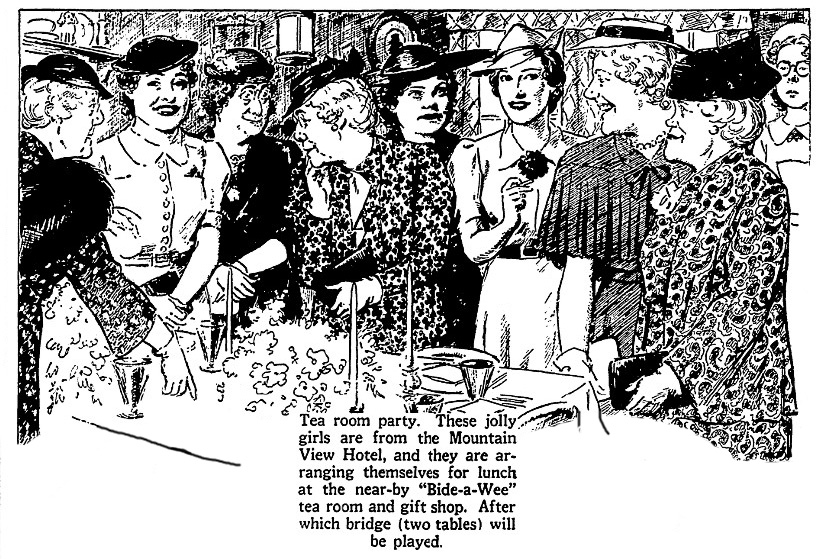
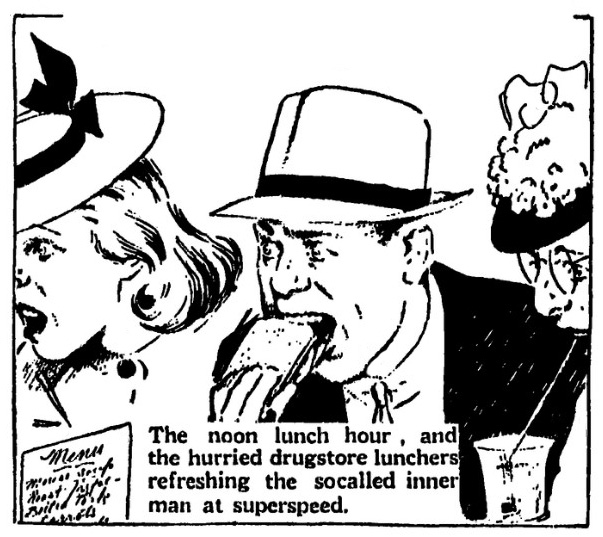
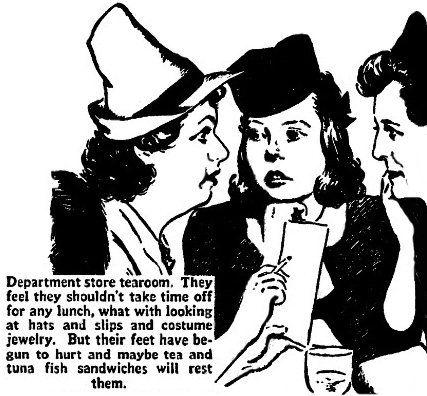
From 1917 until 1955, W. E. Hill (William Ely Hill) created weekly panels of cartoons for newspapers under the overarching title “Among Us Mortals.” They featured ordinary people going about their business in public settings – always in ways that revealed their foibles. Clearly he was a sharp observer of people who possessed a wry sense of humor. His project – a “romance of the commonplace” – has been compared to that of Charles Dickens. I began “collecting” his images when I noticed that his observations often took place in restaurants.

Summer People, 1937

The Age of Hurry, 1939

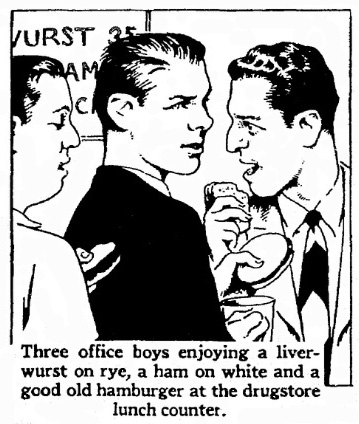
Quick Lunches, 1941

Summer Tea Room, 1946

A Waiter’s Headaches, 1955

Where They Lunch, 1955

Where They Lunch, 1955

7 Comments

Filed under Uncategorized

Ceilings on display

Most people wouldn’t think of ceiling treatments as significant elements of restaurant decor, but they have been in many cases, as I have touched upon in an earlier post. In the 19th and early 20th centuries, fancy restaurants borrowed palatial European ceiling treatments with molded plaster ovals and rectangles framing paintings of classical scenes.

Such ceilings were, of course, in the minority. Most restaurants kept it simple with plain wood, plaster, or acoustic tile. A common treatment was to expose part of the building’s structure, its ceiling beams. Over time, of course, most buildings were no longer constructed with wooden beams. Steel beams don’t convey quite the same thing, and are usually covered up. But, as one company that makes faux beams for restaurants writes, “A drab ceiling design can easily detract from the experience.”

This realization led some eating places to attach fake beams. Although they are meant to convey an impression of sturdiness, in at least one case that impression was tragically false. In 1993 a decorative beam that had been attached with too-short nails came loose from the ceiling in a newly opened Taco Cabana in Las Vegas. It injured 14 people and the restaurant closed.

Cover-ups. If beams are meant to reveal structure, many restaurants have tried instead to hide structure. As I researched this topic I was surprised to discover that collapsing ceilings are not entirely rare. This led me to wonder about one of the more common types of ceiling decor, billowing swaths of cloth. Was this merely a simple way to hide an unsightly or crumbling ceiling? Cloth ceilings certainly lacked the elegance borrowed from European palaces with rococo relief work and frescoed scenes, but they were undoubtedly much cheaper.

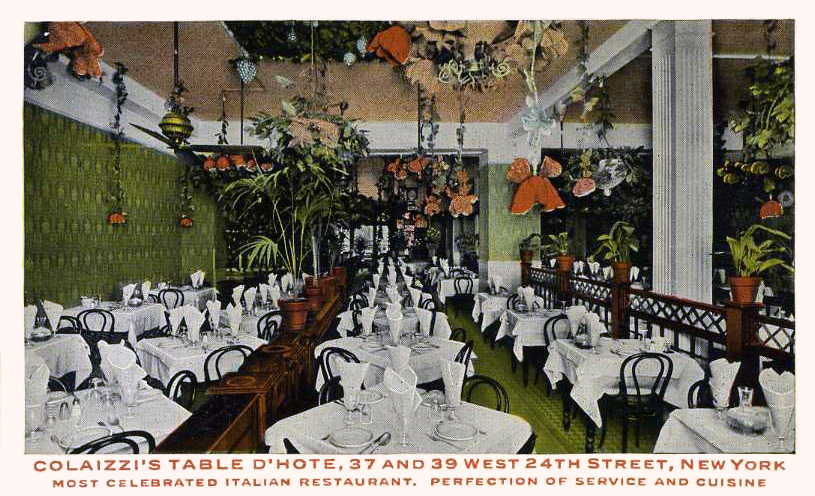
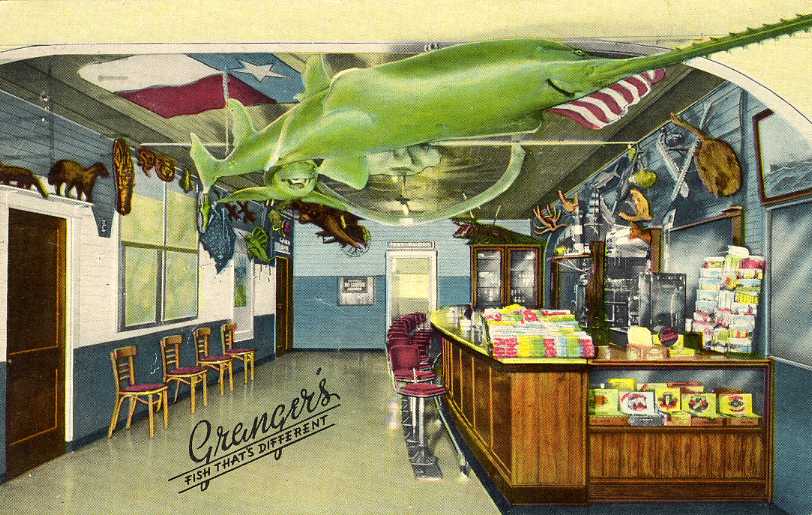
Hanging things. Objects dangling from ceilings may also simply be meant to add interest. They have ranged from faux flowers (Colaizzi’s), to enormous swordfish at a Texas fish restaurant (Granger’s, Sabine Pass TX), or grids of bamboo poles with Japanese glass float balls in Polynesian themed eateries. Maxwell’s Plum featured large animals in its street-front café. But none of these suspended objects could match those at Eddie Rickenbacker’s of 1980s San Francisco where the owner suspended his collection of vintage motorcycles.

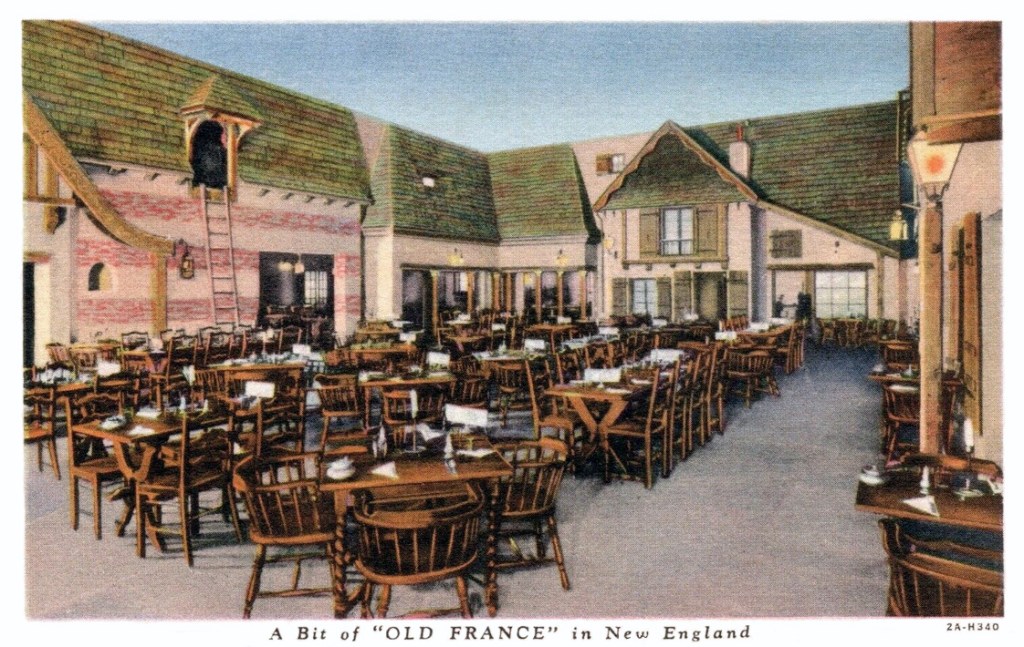
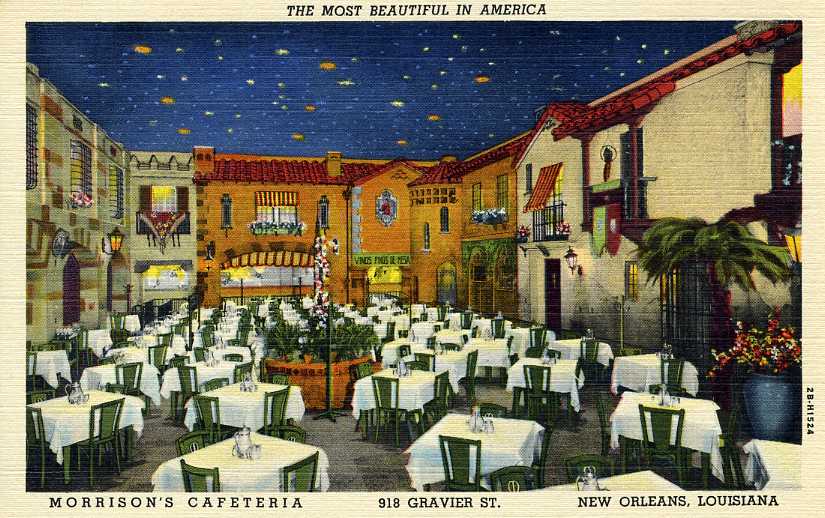
Blue skies smiling above. In the 1930s it became popular to design a dining area to look as though it was located in a courtyard of a village, open to a starry sky above. This may have been a way of dealing with windowless interiors. In Los Angeles, the Paris Inn recreated a scene with the Eiffel Tower at one end, streetfront building alcoves along the sides, with tables under a starry sky between. The Child’s chain recreated Old France in Boston in the 1930s, while Morrison’s Cafeteria in New Orleans featured a Spanish pueblo. Blue sky ceilings had staying power. At El Fenix Restaurant of Casa Linda in Dallas in the 1950s guests were invited to “Dine in the Delightful Atmosphere of Old Mexico” where a large fake palm tree rose up incongruously from a checkered linoleum floor.

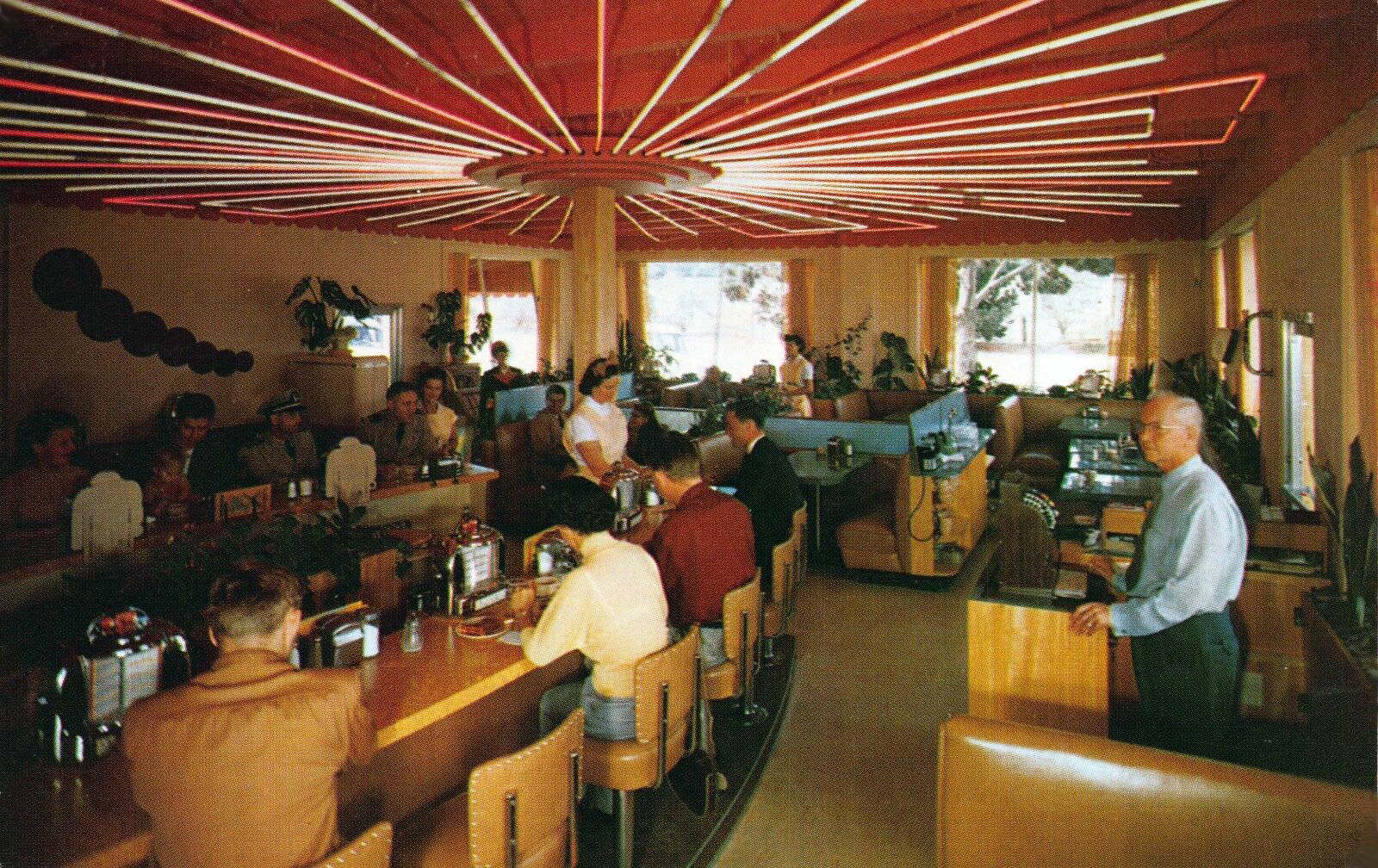
Lighted glass. When it comes to lighted glass ceilings, Maxwell’s Plum springs to mind immediately, with elaborate glass ceilings in both its NYC and San Francisco locations. But neon rods in a sunburst pattern could also be striking, especially when you consider that they were part of a drive-in’s decor. Of course California drive-ins, such as Dutch Youngman’s in Monterey shown here, were often more elaborate than those in the rest of the country.

There were certain hazards with a lighted glass ceiling, as I discovered at a restaurant in St. Louis.

© Jan Whitaker, 2020

10 Comments

Filed under Uncategorized

Maitre d’s

As the name suggests, “maitre d’hotel” (hotel master) tended to be used most often in hotels. In a large enterprise a maitre d’hotel would supervise multiple headwaiters, each of whom had charge of service in one of its multiple dining spaces. Those could include a formal dining room, a supper-room, a grill room, banquet rooms, and/or a café lounge. Over time, the positions of maitre d’hotel and headwaiter were collapsed into one, yet both terms remained in use.

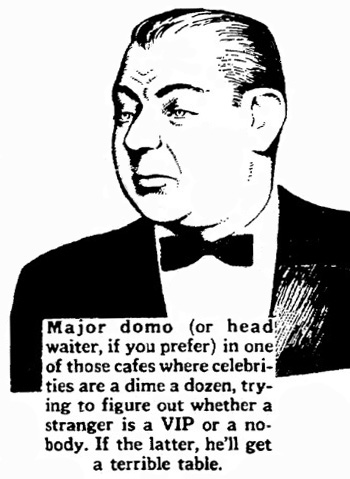
The man (99.9% of the time) playing that role became the public face of a restaurant or hotel dining room. Like celebrities, he was often known by one name only. A counterpart of the chef who ruled the kitchen, he ruled the front of the house. In addition to being completely in charge of the dining room and its service, he might hire, train, and supervise the entire waitstaff as well as plan private dinners and banquets, take reservations, admit and seat guests, make recommendations and take orders, and prepare special dishes at the table.

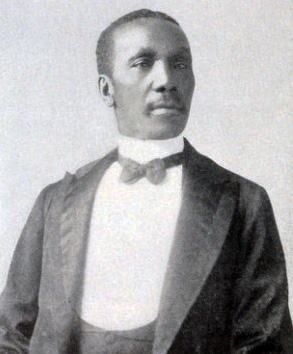
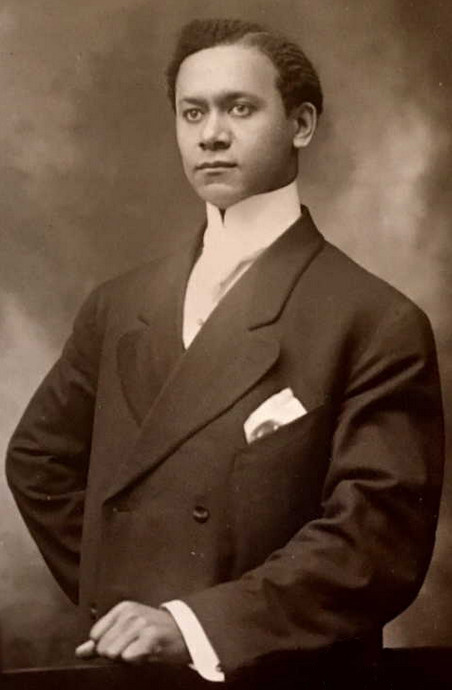
Whether called maitre d’hotel or headwaiter, historically the person filling this role was an imposing physical figure, large, tall, and very well dressed. In this country during the 19th century the role was most often filled by a Black man, usually working in an American-plan hotel where meals were included in the cost of lodging. [L. D. Houston, shown here in 1904, worked in New York and for a time in Hong Kong where he went to escape U. S. racism.] Dressing the part was essential. During the 1930s Depression a nightclub performer in Paris entertained his audience by describing a headwaiter as “The only man in the place whose clothes fit.”

The maitre d’hotel (shortened to maitre d’ over time) or headwaiter could have a wide variety of duties depending upon the size of the dining facilities. An expensive, full-service restaurant that was French or international might have captains, waiters, wine stewards, and busboys in addition to a maitre d’. In the 20th century, a popular maitre d’, having reached the pinnacle of the waiting profession while working for someone else, might look for partners or backers and become the host of his own restaurant.

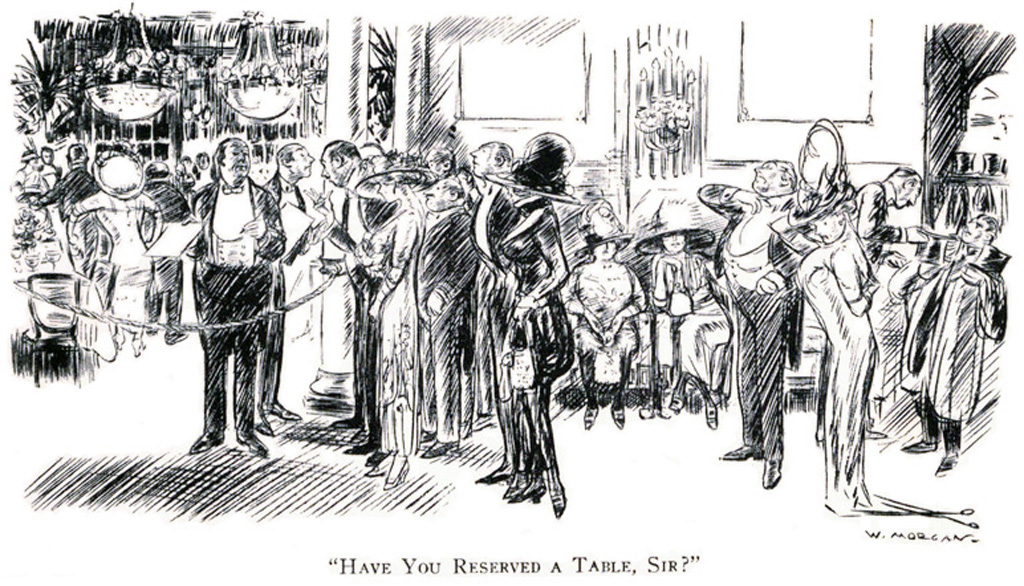
A prominent example of someone who worked his way up from waiter to owner/maitre d’ was the late Sirio Maccioni of New York’s famed Le Cirque. Other well known maitre d’s — who stayed at their posts for about 50 years each — were “Oscar” and “Hoxter.” Oscar Tschirky of the Waldorf was said to be the first to rope off a doorway, while Stansbury Hoxter of Boston’s Parker House was known for his smile and his infallible memory. [Portrait of Stansbury Hoxter courtesy of his great, great, great nephew James Bell.]

Although some maitre d’s who had immigrated from Europe arrived with hotel school training, usually the headwaiter/maitre d’ reached his position after considerable time working his way up the dining room hierarchy. He may have begun as a busboy or waiter, then advanced to captain of a group of waiters, and finally to headwaiter. Along the way he would have proved his ability to judge a guest’s social status, underwritten by his astute understanding of human behavior. It was expected that he not only remembered regular guests’ names and faces, but also knew their favorite dishes.

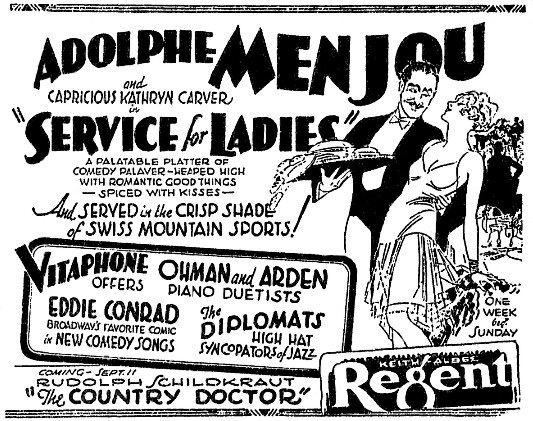
Although many Americans probably never encountered a maitre d’, he became a figure in popular culture. In 1927 the debonair Adolphe Mange played one in a silent-era rom-com.

While it’s true that favored guests at luxury restaurants appreciate the services of a maitre d’ who saves them “their” table, treats them with great care, and knows their likes and dislikes, many Americans have not reacted well to what they regard as haughty judges of their social rank who may treat them poorly or even turn them away. Despite the geniality of well-liked headwaiters, to many people the overall impression created by this personage is a feeling of cold formality. According to a 1940 opinion piece in a restaurant industry journal, diners did not like bowing nor “that type of waiter service that constantly rearranges your bread-and-butter-plate and water glass . . . and then frequently walks by your table to see if you are eating properly.”

That may be why in more recent times even an upscale, expensive restaurant probably does not have a formally dressed maitre d’ greeting guests. That role is more likely to be filled by a younger person, frequently a woman, who probably does not run the entire dining room nor hire the staff. She may nod her head as she hands guests a menu but does not bow.

© Jan Whitaker, 2020


5 Comments

Filed under elite restaurants, proprietors & careers, restaurant customs, Uncategorized, uniforms & costumes, waiters/waitresses/servers