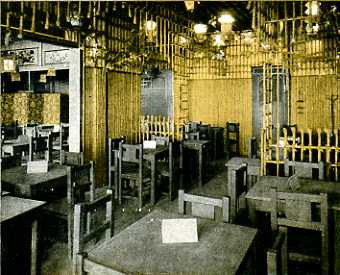
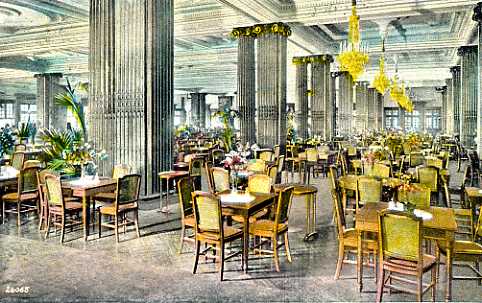
 Schrafft’s began as a candy manufacturer in Boston but over time morphed into a well-known restaurant chain. In 1898 Frank G. Shattuck, a salesman for the Schrafft company from upstate New York, opened a candy store at Broadway and 36th in New York. His sister, Jane Shattuck, was largely responsible for the introduction of light lunches into the stores. The first to serve food was the Syracuse store in 1906 where a “Japanese Tea Room” (shown here) was boldly advertised as “the daintiest luncheon spot in all the State.” By 1909 Jane also introduced meals to the second NYC Schrafft’s, at 54 West 23rd Street in the heart of a thriving shopping district. By 1927, when there were 25 units, most located in NYC, the Wall Street Journal estimated that around 75% of Shattuck’s business was in the restaurant trade, with the rest candy-related.
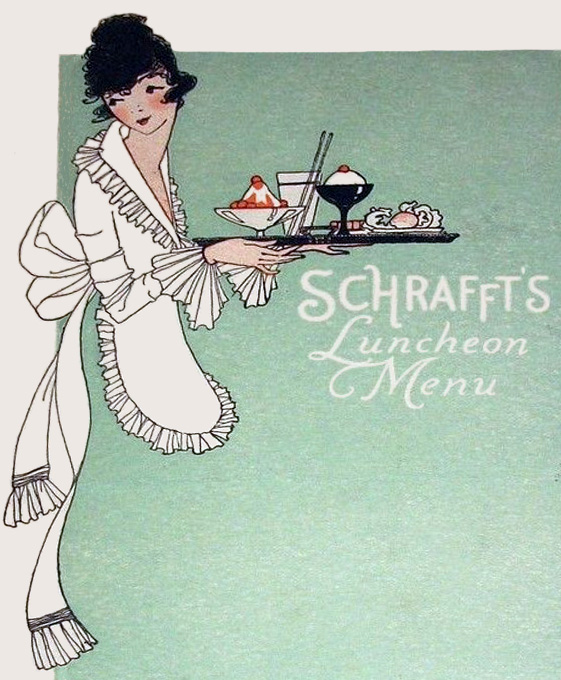 Schrafft’s was known for reproducing an air of gentility typical of the upper middle-class WASP home. Cooks, supervisors, and even some executives were women. Menus of the 1920s and 1930s included many salads, more desserts than entrees, and non-restaurant-y vegetable selections such as creamed cauliflower and fried eggplant. Frank claimed Schrafft’s cuisine was inspired by his mother’s cooking. Repeated efforts to overcome connotations of a “women’s restaurant” and attract men met with disappointing results despite customers such as James Beard. Women dominated even after some units began to serve cocktails in 1934.
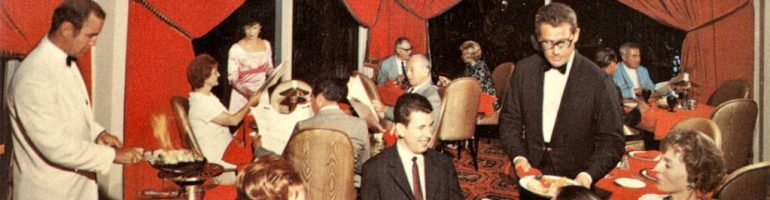
 Rent cuts in the depression encouraged chain expansion and by 1937, when Frank died, there were 43 Schrafft’s, most in metro NYC but a few in Boston and Philadelphia. At its peak there were about 50 units in greater NYC. In 1961 the chain played briefly with the idea of selling frozen dinners on the roadside. In the late 1960s the Schrafft’s candy company was sold to Helme Products while Pet, Inc. took over the restaurants. Pet made a renewed effort to renovate Schrafft’s image and attract men. At the Fifth Ave location (between 45th & 46th) the soda fountain was removed and a bar installed. The second floor, men-only dining room was given dark wood paneling, zebra-stripe carpeting, and named “The Male Animal.” The 1970s saw confusion as a Schrafft’s opened in Los Angeles (sporting a Chinese room and an Elizabethan room), new ownership took control, and numerous NYC locations were shut down. In 1981 the candy company ceased while the few restaurants remaining were in various hands.
© Jan Whitaker, 2008






 It's great to hear from readers and I take time to answer queries. I can't always find what you are looking for, but I do appreciate getting thank yous no matter what the outcome.
 Restaurant-ing through history