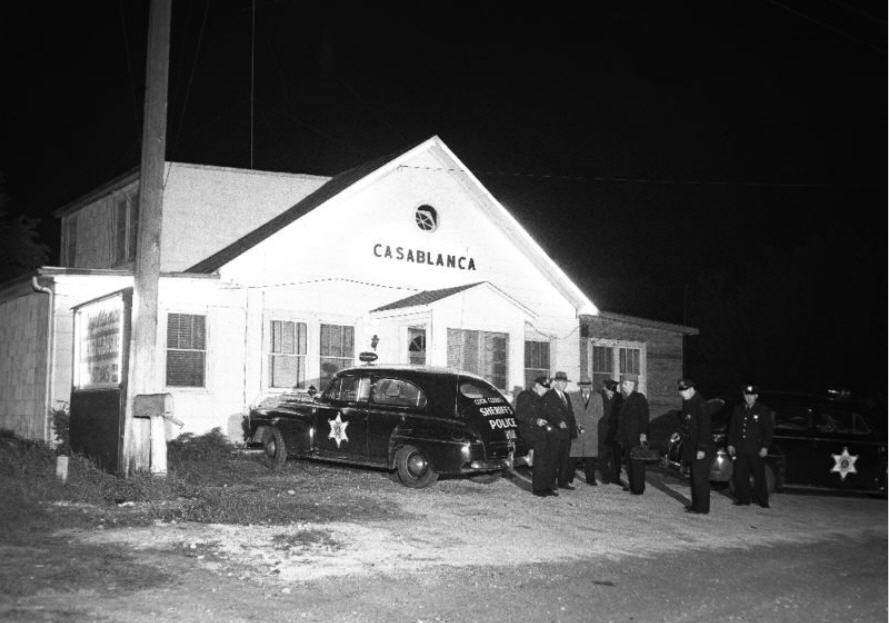
 Is Casablanca one of the unluckiest names a restaurant could have? Granted, there is a fair amount of mayhem surrounding restaurants and cafes generally, at least judging from newspaper stories, but places with this name seem to have attracted more than their share of violent crime.
There is a fascination with the dark side of restaurants, witnessed by interest in revelations of filth, chaos, and bad tempers in the kitchens, not to mention the popularity of such topics as gangster affiliations. This post is inspired by a reader living near Palatine IL outside Chicago, the location of the old Casablanca referred to in an earlier post on roadhouses. He wrote that he would “love to hear about the old-school ‘joints’ that used to pepper the ‘quiet’ suburbs.”
He is not alone. When I recently posted a photo of an old no-tell motel, the Coral Courts, on my hometown’s Facebook page, interest was notable. Likewise someone’s FB post recalling a horrid massacre at a roadhouse called Cousin Hugo’s just outside the borders of that formerly dry and ultra-proper suburb attracted comments like a magnet.
The Casablanca on Rand and Dundee Roads in Palatine was begun by Loretta Cooper, daughter of Polish immigrants in Chicago. She may have opened it in the early 1940s, but under another, unknown name. She would have been about 25 years old and already 7 years into her restaurant career. She started her first cafe, the Star Tavern in Chicago, around 1935 when she was only 18. Being underage she needed her older brother to act as the nominal manager.
 Loretta proved to be a “survivor” in the restaurant business, owning a number of establishments over at least a 30-year period. She didn’t run the Casablanca for long, though, because by 1943 she had taken over the old Eddie’s Castle Café on Evergreen in Arlington Heights IL and renamed it Loretta’s Castle Café. It stayed in business until the late 1960s when the building was demolished. She and her husband Edward also ran a place in Arlington Heights called Cooper’s.
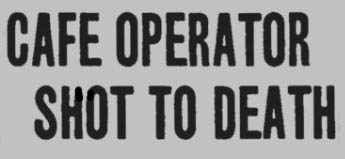
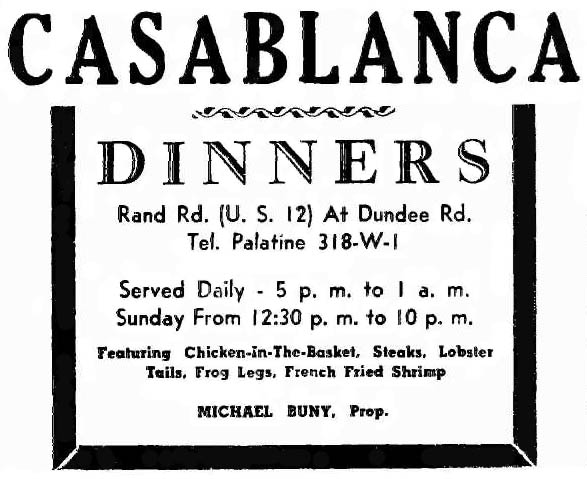 Loretta sold the roadhouse to Michael Buny around 1944 and he renamed it Casablanca after the Humphrey Bogart film that had come out two years earlier (thanks to his family member for this piece of the story). In May of 1949 he was killed in a holdup. When two hooded men entered the roadhouse one night with shotguns, he attempted to foil them by sneaking outside through the kitchen and getting a gun, evidently planning to ambush them when they left. He was shot by lookouts watching from the getaway car. Although the police rounded up suspects who went on trial in the early 1950s no convictions were secured. Years later one of the suspects was apprehended for home repair fraud.
Michael Buny’s wife and daughter ran the Casablanca after his death. In 1951, about two years after her father’s slaying, daughter Darlene was shot in the shoulder as she struggled with a tall scar-faced robber who broke into the café one night. It’s uncertain how long she kept the Casablanca going after that.
Quite by coincidence, I assume, a nightclub restaurant opened on Dundee Road in Palatine in the 1980s called Bogie’s, with decor inspired by the film Casablanca. Local history would have made for a riskier theme.
© Jan Whitaker, 2011


 It's great to hear from readers and I take time to answer queries. I can't always find what you are looking for, but I do appreciate getting thank yous no matter what the outcome.