Category Archives: restaurant advertising

Newspapers & restaurants

Newspaper workers, especially reporters and pressmen, made up a significant part of urban restaurant patrons in the 19th century and much of the 20th. Early on most of them were men, dropping in at all-night eateries of which there were many. Such eating places tended to choose locations close to the newspapers which were often grouped together in areas of a city referred to as “newspaper row.” [Above: advertisement for a Kansas City MO restaurant, 1940]

In his book Appetite City, about New York’s restaurant history, William Grimes notes the importance of newspapers in building nationwide interest in that city’s restaurants. He observes: “From the 1830s on, New York spawned so many papers and journals that their employees and writers constituted a sizable market, concentrated for the most part along Park Row. Moreover, journalists tended to regard oyster stands, saloons, food markets, and cafes as good copy. As the city grew and restaurants of every description proliferated, journalists turned out colorful slice-of-life stories for local and national consumption.” [Above: early 20th century postcards of newspaper rows in NY and San Francisco]

The restaurants that the newsmen patronized in the 19th century tended to be of two kinds. Either they were no frills, quick-eat places of the kinds newsboys favored, or they were places popular with artists, actors, and other free-wheeling sorts. For their evening meals, when newsmen were on their own time, they were said to enjoy the latter type of places where “there was no style, but plenty of ‘atmosphere’” such as the German “Kitty’s” on Park Place in New York with its Weiner Schnitzel and noodles.

One of New York’s best known hangouts was Bleeck’s [pronounced Blake’s] Artist and Writers, where reporters from the New York Herald were said to dominate. From its beginnings in 1925 until 1934, part of which time it was run as a so-called club in order to avoid the liquor ban, it barred women. Finally they were admitted, inspiring the unfunny comment from an old-time member, “There’ll be mayonnaise on the steak next week.” [Above: newspaper men play game to determine who will pay for drinks at Bleeck’s, 1945]

Another thriving New York restaurant with multiple locations, Crook & Duff, had a restaurant in the basement of the Times building for decades. Other magnets for newspaper folks included Jack’s, Hitchcock’s beanery, and Stewart’s in Sheridan Square. Childs’ in the Madison Square Garden building was a gathering spot for columnists, drama editors, critics, and press agents.

What might be called the Jewish newspaper row in New York was on the lower east side, which over time housed papers such as the Yiddish Daily Paper, Truth, The Day, Morning Journal, and The Forward. The Forward was located on East Broadway near the Garden Cafeteria, a gathering place for activists, intellectuals, and newspaper people, among others.

Of course New York was not the only city where newspapers, their employees, and restaurants were linked.

In Chicago, Schlogl’s, an old 19th-century restaurant, served as the newsmen’s club, watering hole, and dinner spot in the 20th century. Also known as Ye Olde Cheshire Cheese Tavern of America, it was located near the Chicago Daily News where its big round table hosted Carl Sandburg, Edgar Lee Masters, Ben Hecht, Thornton Wilder and other writers who worked for papers. But there were numbers of other places feeding reporters and printers, such as King’s, run by Mary King in the old Herald building. One of her daughters became a newspaper editor.

Boston had Thompson’s Spa. But as early as the 1870s, the editor of the newly founded Boston Globe established a lunch table at a nearby restaurant that endured for decades, hosting judges, lawyers, journalists, and business men. By the 1880s, Boston’s newspaper row was filled with dairy lunches and “temperance lunch rooms.” Other favorite day and night spots with the newspaper crowd were the various locations over time of Mrs. Atkinson’s, where baked beans and brown bread, corned beef hash, pies, and doughnuts were in demand for nearly 40 years. From the 1880s until 1919 Vogelsang’s was not only an eating place for newspaper men, but also for Democrats, making it a source for contacts and stories as well as for meals. [Above: Gridley’s in Boston’s newspaper row, early 20th century]

For decades in the teens and 1920s, and probably the late 19th century as well, Washington D.C. newspaper men enjoyed the French restaurant run by Count Jean Marie Perreard. He was known for his Bastille Day parties, where a tall Bastille made of boxes would be built in a corner to be attacked by guests at midnight.

St. Louis had Thony’s, where 19th century newsmen mingled with merchants and bankers while enjoying oysters brought from New Orleans on steamboats. Other newspaper men such as Eugene Field, an editorial writer in the 1870s, enjoyed the Old Beanery.

In the 1870s, Philadelphia newspaper workers almost certainly would have been found at the Model, which fed about 2,300 a day, joining a crowd that included the “sons of toil.” In the 1890s the quick lunch places grouped around the city’s big stores and newspaper offices would also have drawn them and it’s almost certain that later they would have flocked to the Horn & Hardart Automat opening in 1902. But the anti-alcohol emphasis of the city may have discouraged clubbiness.

Frequent employee patronage of eating places was only one way that newspapers influenced the restaurant world. Not only did the papers report on restaurants and carry their advertising, over time their role in promoting, evaluating, and rating them grew. Eventually there were formal reviews, and also gossip columns whose one-sentence quip about a well-known celebrity spotted in a restaurant was often enough to build the restaurant’s desirability and familiarity with readers across the U.S.

In the mid-20th century food columnists gained prominence. In 1962 Craig Claiborne began regular restaurant reviews for the New York Times. New Yorker James Beard [above] covered not just his city but the nation, running columns in many papers. When columns featured recipes, they almost always praised the restaurants that supplied them. And as has been observed by others, newspapers across the country were inclined toward favorable reviews for restaurants that were regular advertisers.

Restaurants began to turn to newspaper advertising in the 1920s, considering that the best way to attract customers. Almost certainly the most frequent advertiser nationwide in that decade was the low-priced Waldorf System with 94 units spread across 28 cities. Waldorfs were not fancy, but according to their ads they were extremely clean, with each unit undergoing inspection four times every 24 hours.

With the diminishment of newspapers, restaurant gatherings also ended by the later 20th century as did men’s clubs generally.

© Jan Whitaker, 2025

1 Comment

Filed under patrons, restaurant advertising

More about odd restaurant names

When I started looking up strange business names for restaurants I was thinking this was something in the past. I was so-o-o-o wrong. It’s impossible to say how many there are – or how many there have ever been, but now I’m convinced that they are as popular as ever, probably even more so than in the past. [Denver Post comic strip, 1997]

This was strongly confirmed when I discovered a current online ad for a business that is dedicated to helping people find the right name for their new restaurants. It lists over a hundred novelty restaurant names that were operating at the time the site was created. Some are clever, some are ultra-corny, and some are borderline objectionable. I don’t think any of them would draw me in because of their names alone.

In the past – probably beginning in the 1950s, odd restaurant names were still unusual enough that newspaper columnists would write about them. It was considered newsworthy or at least unusual enough to attract readers. That focus would tend to be ridiculous today because it’s no longer much of a novelty to have a strange or comical name.

Also, it now seems quaint that in 1957 a columnist for a paper in Washington thought that the restaurants opening in a Sheraton Hotel were “unusual.” They were Café Careme, Ye Olde Cheshire Cheese, and Indian Queen Tavern. Today they don’t seem unusual at all.

As I look over my notes and an earlier post on restaurant names, I realize the attraction to whimsical names began in the early 20th century, with tea rooms prominent among them. Aside from them, most of the restaurants that adopted funny names were casual eateries, not formal or expensive restaurants. That is probably the case today too. [Above: 1921 advertisement from a Norfolk VA newspaper]

Places that made fun of themselves could have a strong attraction, with Ptomaine Tommy’s, dating back to 1913, being a prime example.

In one notable case, an odd name caused problems for its owner. A restaurant in Detroit was losing customers in 1970 because it was named Mercury Fish and Chips. Trouble was that this was the time when mercury was being discovered in fish in Lake Erie and other lakes. She was losing about a fifth of her business because of this. The name was not even meant to be cute but had a name that mainly indicated it was a fish restaurant. She had kept Mercury in the name because that was the name of the very popular restaurant that preceded hers and she thought it would be a draw.

In another case, the strange restaurant name Le Garbage, as well as its location 200 feet from a sanitary landfill in Pennsylvania would have seemed to be a guarantee of failure. But it was a very popular truck stop with its customers, trash haulers. They found it all funny, including the joking observation about food being brought in fresh daily.

A popular trick name for a restaurant is The Bank, which allows related naming for everything on the menu from main dishes such as Money Bags and The Stick Up, and side dishes under the heading Loose Change, as in a 1970s menu of an Indiana restaurant.

It’s almost needless to say that odd, funny, or even puzzling restaurant names are meant to draw attention, stand out in the crowd, and perhaps lure curious customers. With the increase of restaurants over time, it may seem more necessary than ever to have a name that is comically appealing. But, how well does this actually work? Hard to say.

Clearly there are some who enjoy them while others are going to avoid them, reasoning that the emphasis is on cutesiness rather than cuisine.

© Jan Whitaker, 2025
5 Comments

Filed under restaurant advertising, restaurant names

Famous in its day: Fanny’s

Lately I’ve been browsing through The Ford Treasury of Favorite Recipes from Famous Eating Places published in 1950. [illustration from Ford Treasury]

Among the 245 restaurants featured in the book, one stood out. Only Fanny’s gave no recipe. Instead, the ingredients of its salad dressing were simply listed. They were oil, tarragon vinegar, chutney, brown sugar, salt & pepper, mustard, fresh tomatoes, tomato paste, orange juice, ground pecans, garlic, onions, celery, and parsley.

The reason given was that the recipe was a valuable asset for which the owner Fanny Lazzar had been offered as much as $10,000. It was a “secret” recipe which, along with the restaurant’s spaghetti sauce, was closely guarded. The trademark had been registered in 1946.

Through the years the amounts said to be offered for the recipe increased mightily. In 1958 it was up to $250,000 according to the book Who’s Who — Dining and Lodging. (Oh, and it just happened that Fanny Lazzar was on the Advisory Board of Directors of the Who’s Who Historical Society that published the book.)

Fanny Lazzar of Fanny’s Restaurant serving her customers, A. Victor Abnee Jr. and Col. Robert Heuck, October 23, 1962 in Evanston, Illinois.

The more I learned about Fanny Lazzar and her restaurant, the more I began to realize how much effort she put into promotion. She admitted that she needed to have a full house regularly since she had no bar. Evanston was a dry town until 1972, although patrons brought alcohol to Fanny’s with no fear of a police raid. [Note wine glasses on the table in the illustration]

Fanny had started the restaurant in an industrial area in Evanston, Illinois, in 1946. She was a divorced mother of two boys facing the challenge of creating an upscale restaurant in a downscale neighborhood. She approached the local newspaper, the Evanston Review, asking if she could start a weekly column. She was told that restaurateurs did not have columns, so she bought a want ad instead. Almost accidentally, that provided a tremendous boost to her business.

Her Evanston Review advertisement was sent on to The New Yorker magazine by a professor at Northwestern University. The magazine included the entire, lengthy classified ad under the heading “Anticlimax Department (Fried Chicken and Violets Division).” It began with a quotation from John Milton (“‘They eat, they drink and in communion sweet, Quaff sweet immortality and joy”) and then told a story about visiting her uncle and aunt in Italy when she was 6. She spent time lying in the grass and smelling violets. Her aunt called her in to eat, and insisted that she do so even though she said she wasn’t hungry. Her uncle intervened and said she could go back and enjoy the violets. Next her classified ad launched into promoting dinner at her restaurant, suggesting that her “fine spaghetti” with its “rich meat and all butter sauce” would restore “SOMETHING that seemed lost.” Then it gave the restaurant’s hours on Sundays and the prices per various pieces of chicken, for example one chicken leg, 75c.

Marshall Field III, grandson of the department store’s founder, saw the New Yorker’s teasing putdown (did he recognize it as such?) and decided to give the restaurant a try. After his visit he introduced wealthy friends to it, including J. L. Kraft, Oscar Mayer, Richard Sears, and the presidents of Montgomery Ward and the First National Bank of Chicago. Fanny’s was well on its way to becoming a society restaurant. Although her first year in business had ended in the red, she was beginning to build a following.

Over the 40 years she ran the restaurant, Fanny invested in many, many advertisements, as well as producing 40 years worth of weekly promotional columns in the Evanston Review and the Chicago Tribune. Her paid advertisements appeared monthly for years in the Rotarian magazine. Despite being on the so-called wrong side of the tracks, Fanny’s location was not entirely a bad one. The Rotarian’s headquarters were only six blocks from the restaurant and it was close to Northwestern University and not so far from Ravinia’s summer music festivals. [above, an enlarged view of the restaurant, possibly in the 1960s]

She endlessly boosted the restaurant, repeating over and over that it had been honored by foreign governments and the Butter Institute of America, visited by famous celebrities, and written about in more than 165 newspapers and magazines. In her first column in the Tribune in 1955, she reiterated her triumphant claims: written up in 15 national magazines in the first two years; recommended by three of Europe’s finest restaurants in her fifth year, including the Tour d’Argent in Paris; and that she personally still prepared a garlic bread so fine that nobody had ever succeeded in copying it.

It’s likely that all her patrons and many others in the Chicago area, the country, maybe even the world knew Fanny’s saga: spending the first year serving industrial workers in the neighborhood, shoveling her own coal, and sleeping fewer than four hours a night. How she spent a full year each developing her salad dressing and her spaghetti sauce. And how she hired chef Bobby Jordan to fry chicken after he told her he had been “sent by the Lord.” And how she met her second husband, Ray Lazzar, while dining at the Pump Room where he was captain of the waitstaff.

Her success enabled her to live well and to become a local philanthropist. But she seemed to reveal her continuing insecurity after a student at Northwestern University gave the restaurant a poor review in the student newspaper in 1980. He wrote that Fanny’s was “overrated,” decorated to “look like it’s a rich man’s garage sale,” and that the spaghetti sauce was “just a tinge above Ragu,” while the salad dressing tasted “just above vinegar and oil with food coloring in it.” [above: a latter day match cover]

She responded by taking out a full-page ad in the student paper in which she reiterated her success, even going so far as to list in capital letters two columns with names of “GREATS” who had patronized her restaurant. She called her critic a “gross ignoramus” and concluded the long letter saying, “your bungling efforts at reporting a WORLD FAMOUS RESTAURANT WERE NOT ONLY WITHOUT TRUTH, BUT ODIOUS AND ABSURD.”

Two years later the school’s new restaurant columnist decided to give the restaurant another test. He was in agreement with the 1980 review and complained about soggy iceberg lettuce, greasy “orange-flavored” salad dressing and chicken that wasn’t “nearly as crisp as the Colonel’s.”

It’s hard to know if the restaurant had declined or if the student critics were poor judges of quality.
Ray Lazzar died in 1984, which was surely a blow, and the restaurant closed as of the end of July in 1987 at which time Fanny was 81 years old.

© Jan Whitaker, 2025

2 Comments

Filed under elite restaurants, proprietors & careers, restaurant advertising, women

Notable restaurant mottos

In 1925 a restaurant industry publication presented advice on crafting a slogan that would draw customers. The article advised against simply saying “Where to Dine” because that really didn’t signify anything special to the public. The author then gave better examples of slogans that were “clever and appropriate.”

As a negative example, the article might have pointed to Teck’s Quick Lunch in Kansas City [shown above]. This card showing “A Place to Eat” dates from 1907. I can’t help but wonder what about it was “So Different.”

Most of the article’s examples were not especially convincing as model slogans. For instance, the list included a Buffalo restaurant with the motto “Is Different.” The author also approved of the slogan of the Everest Lunch in Newark: “If You Eat the Best, Eat Here.” To me this cried out for a rewrite. Clearly, a better version would have been “If You Want the Best, Eat at Everest.”

The article inspired me to look at old postcards for examples of mottoes. Usually the restaurants that used them were not elegant and sophisticated, but rather everyday lunch counters, cafeterias, and roadside places.

Superlatives dominated. One of the most popular was the word “unique,” or even better (and more ridiculous), “most unique.” Those that merely claimed to be the most unique in a limited area, such as “Most Unique Terrace Between New York & Buffalo” (Camillos Spiedi Bar in Endicott NY), were surpassed by those that were the most unique in the entire country or beyond. For example, the Bank Café in San Pedro CA declared itself “The most unique café in the world.”

Sometimes I wondered if a slogan was a joke – for instance, when the Coffee Cup in Wolcott NY claimed it was “Known from Coast to Coast.”

Parking arrangements were a feature that often merited acclaim. Morrison’s Cafeteria in Ocala FL said for some unexplained reason that they had “America’s most unique parking lot.” Earlier Rhode Island’s Stork Club — the “Most Popular Night Club in New England” – asserted it was “The only club with bell hop parkers.”

Other very specific claims were made with regard to air. Chicago’s North American Restaurant of the 1920s was, it said, “The Best Ventilated Restaurant in Chicago.” Later, air conditioning came to be notable, but some places made a big deal of it, such as Hap Miller’s Truck Town Restaurant in York PA which was “Scientifically Air Conditioned,” while the Studio Club in Westchester NY was “Delightfully Air Conditioned.”

As was true of the 1925 examples, some sent an ambiguous message. The 1920s list included a Montana mining town eatery that claimed “Our Prices Encourage Thrift.” Although they surely meant that they had low prices, it could easily be taken to mean the opposite. Likewise, the motto of the Square Shooters Eating House in Wyoming, “An unusual restaurant for respectable people,” is puzzling. Unlikely place for them to patronize? Or, if the motto was meant to attract respectable people, what about it was so unusual that they would like it?

Other mysterious or odd slogans included:
– a Pennsylvania Dutch restaurant in PA that claimed “State Tested Water 100%.”
– Coleman’s Restaurant in North Carolina with “Chicken in the Easy Way.”
– Granger’s in Texas with its “Fish That’s Different.”
– Houston’s Weldon Cafeteria that announced it was “The South’s newest and most modern Two line Cafeteria.”
– Columbus Ohio’s Jai Lai Restaurant, with its slogan “In All the World . . . There’s Only One!” evidently referring to its kitchen costing half a million.

Many of the restaurant mottos of the 20th century bordered on the absurd. Today they seem comical.

In a land of superlatives, my favorite was New York City’s Penguin Restaurant with the slogan “The Second Most Charming Restaurant in the Whole World.”

© Jan Whitaker, 2025
6 Comments

Filed under restaurant advertising

Building a myth: Bookbinder’s

As a Philadelphia Inquirer story observed when the legendary Bookbinder’s on Walnut Street closed for the first time, in 2002, its popular appeal had been based not only on seafood and steaks but also on the restaurant’s ability to play on its history.

Eventually, in the 1940s, the myth led to a claim that it was founded in 1865. Not everyone took the claim seriously, but that still leaves the question of why the restaurant invented it. The motivation was somewhat mysterious considering that Bookbinder’s was in fact very long-lived compared to most restaurants in the U.S., which do well to last five years. It’s curious to me that the actual founding date in the 1890s wasn’t good enough, but it may have been that its actual beginnings didn’t seem like much compared to the long patriotic history of Philadelphia.

An 1895 newspaper story reported that Cecilia Bookbinder, wife of Samuel, had bought the building on 125 Walnut Street for $5,000. Since 1884, it had been operated as an oyster and chop house by a man named Attila Beyer. It appears, however, that the devious Beyer may not have actually owned the building when he sold it to Cecilia, having already used it as collateral for a loan on which he was about to default as he left for California.

Perhaps due to monetary claims by Beyer’s creditors, the Bookbinders evidently lost ownership of the building and didn’t regain it until 1906, nevertheless operating the restaurant all the while, possibly at first under the simple name Merchant Restaurant. The restaurant was in Philadelphia’s long-established insurance district where business people flooded the local eating places at noon.

Somewhat before the myth of an 1865 founding was adopted, 1875 was advertised as the restaurant’s start date. For instance that was the date given in a 1940 Life Magazine advertisement for Hines ketchup shown here; it is also indicated by the poster on the wall.

A family rift may partially explain the adoption of an exaggerated founding date. Bookbinder’s on Walnut street adopted the name “Old Original Bookbinder’s” about 1935 or 1936 after Samuel C. Bookbinder, son of the founders, opened a rival Bookbinder’s on South 15th Street [shown above, 1935]. He had been in line to inherit the Walnut Street restaurant but was disinherited upon his conversion from Judaism to Catholicism in order to marry a Catholic woman. The false founding date and the name “Old Original” were likely ways to distance the Walnut Street restaurant from its new competitor. [Note that the 1936 advertisement below had not yet revised the fictitious founding date.]

As a result of the family split, Harriet Bookbinder took over the Old Original, operating it with her husband Harmon Blackburn. He was a successful corporate lawyer, and a collector of Americana, including the Lincoln memorabilia, old theater playbills, and Carrier & Ives prints that adorned the restaurant’s walls.

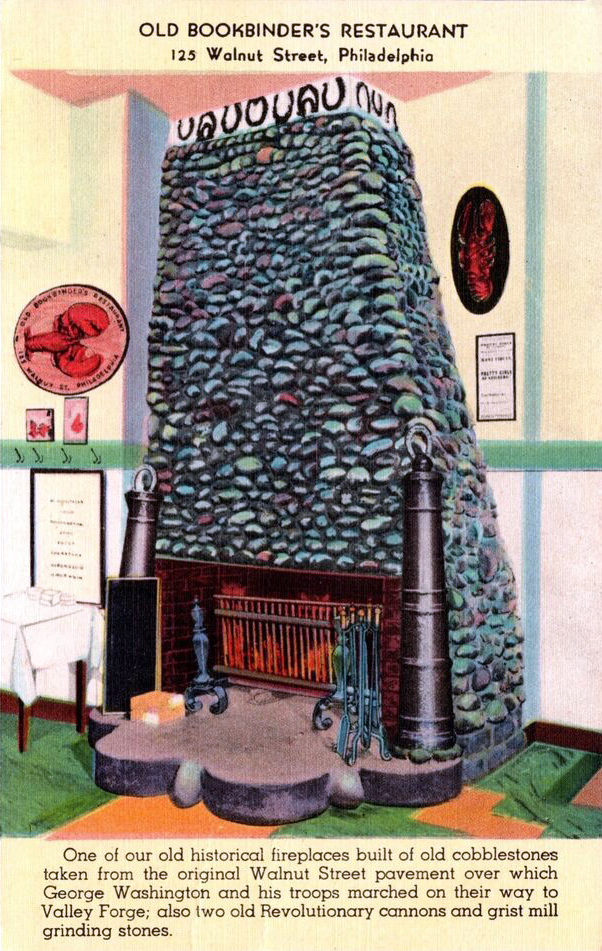
Obviously the building occupied by Old Original Bookbinder’s itself looked aged, and the memorabilia contributed to a sense of age. Other historical attractions were the fireplaces made of old cobblestones taken from Walnut Street. The fireplaces probably dated back to 1915 or 1916 when the city was removing cobblestones from streets. A 1916 advertisement promised “A Beefsteak Dinner in the ‘Maine Woods’” cooked at that room’s fireplace, with steaks and chops grilled in the fireplace and served with oysters, radishes, celery, and hot biscuits baked on the hearth.

When Harriet died in 1944, her husband ran the restaurant for a year and then donated the business to the Federation of Jewish Charities. Along with the building, the furnishings and equipment, the donation included “all food and liquors on hand, the good will and everything in the till.” John and Charles Taxin bought it, with John running it until its final bankruptcy and closure.

In the 1940s and 1950s Old Original Bookbinder’s was regularly recommended in books featuring the country’s favorite restaurants, such as Duncan Hines Adventures in Good Eating. In 1947 “The Dartnell Directory for America’s Most Popular Restaurants named it the country’s most popular eating place of the 2,300 restaurants it recommended.

In 1965 the restaurant celebrated its 100th anniversary as Bookbinder’s — a mere 30 years prematurely.

By the 1970s, the cobblestone fireplaces remained, but some rooms had been redecorated and modernized. Time was catching up with Bookbinder’s then, as new kinds of restaurants with inventive cuisine such as Le Bec-Fin came on the scene. Citing an estimated 300 new restaurants opening in Philadelphia in the early 1970s, a 1978 issue of trade magazine Restaurant Hospitality observed that traditionally conservative Philadelphia was now “vying with New York and San Francisco as the Eating Capital of the United States.”

Nevertheless, in 1986 Restaurant Hospitality rated Old Bookbinders the nation’s 7th highest-grossing restaurant, with annual sales totaling $10.6M and an average dinner check of $33. It was well-known nationwide and particularly popular with tourists, all the more so since it was near historical points of interest.

But nothing lasts forever. Both Bookbinder’s closed in the first decade of the 21st century.

© Jan Whitaker, 2024

12 Comments

Filed under popular restaurants, proprietors & careers, restaurant advertising, restaurant decor

Black-owned drive-ins

Despite the documentary absence of postcards, I’ve discovered that there were others — after a lot of searching. And I’m glad, because in nostalgic American culture, drive-ins are seen as deeply and exclusively white.

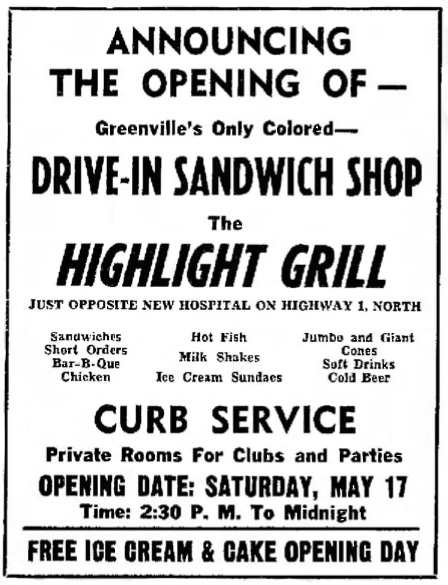
Most I’ve located got their start in the 1940s and 1950s, the same years that white-owned drive-ins made their first appearance many places, particularly warmer climates. More people in those years, especially after WWII, had cars and a little extra money to spend. [Highlight Grill, Greenville MS, 1952]

The earliest reference I’ve found was to The Drag, on Lyons Avenue in Houston. In an advertisement for its sale in 1941 it was described as a “famous colored drive-in.”

Black drive-ins were most likely to be found in Southern cities before the Civil Rights Act of 1964 made Jim Crow segregation illegal and all public restaurants had to serve everyone regardless of race. Although they could be found in Northern cities, it seems they were more likely to be in good-sized Southern cities such as Chattanooga, Memphis, and Nashville TN, Louisville KY, Little Rock AK, and Birmingham and Tuscaloosa AL.

Altogether I’ve run across 54 Black-owned drive-ins in this country, which is not many but surely an undercount. I have not found any in the Northeast. Nor in the land of drive-ins, Southern California, where they dated back to the 1930s. No doubt there were some, but probably fewer than elsewhere.

It was mainly in the 1960s that they began to show up in the yearly Green Books that advised Black travelers on places to stay, eat, fill up with gas, etc., in unwelcoming parts of the U.S. – i.e., most of it. (I cannot be 100% certain that every drive-in listed in the Green Books had a Black owner since sometimes white-owned restaurants that welcomed Black customers were also listed.) [Shown here, a Green Book advertisement from the 1961 edition.]

Many, maybe most, of the drive-ins served barbeque. For example, Nichol’s Drive-In in East St. Louis IL specialized in hickory-smoked Beef Ribs, Snoots, Pork and Chicken. It mentioned Soft Drinks, but a number of Black drive-ins served beer. Selling beer to underage customers seemed to get some of them into trouble.

I noticed that when a new Black-owned drive-in opened, it was usually greeted with enthusiasm in Black newspapers. White newspapers, on the other hand, often only reported on them in association with disorderly incidents and legal violations.

When a Black-owned drive-in was proposed for a location near a white residential area, it was unlikely the plan would be approved. (The same held true for Black-owned drive-in movie theaters.) In 1951 a Black man seeking official approval to build a drive-in restaurant in Memphis faced a hostile lawyer representing whites who opposed it. The opposition’s lawyer referred to the drive-in as a “Negro night club,” and when the applicant’s lawyer objected, maintained that a drive-in was “the same thing.”

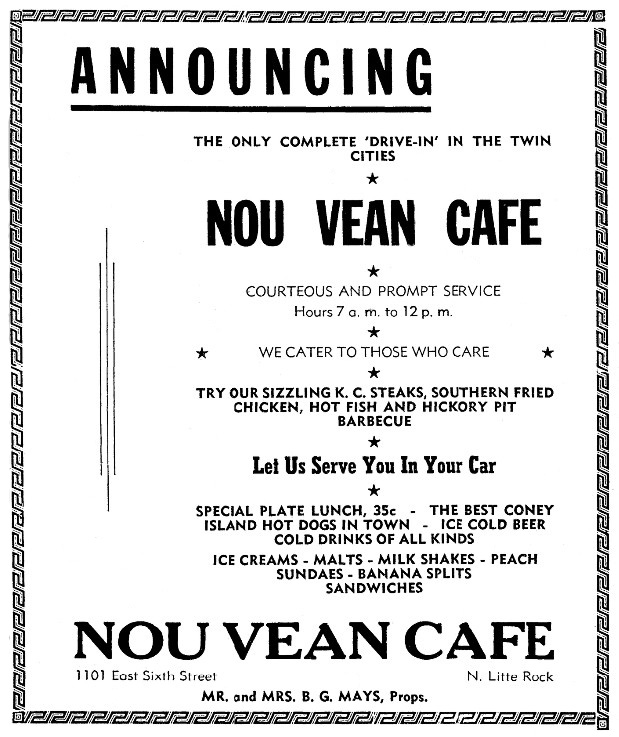
The drive-ins that seemed to fare the best were those owned and run by prominent figures in Black communities. In the 1940s Little Rock’s Nou Vean Drive In was owned by Barnett G. Mays, a realtor, developer, and liquor store owner. He encountered numerous roadblocks throughout his business career, but seemed to press onward despite them. In Milwaukee a drive-in called Robbys appeared to have a promising future when it opened in the late 1960s. It was named after the son of owner J. C. Thomas, a community leader who was also a realtor, operated two billiard parlors named Ebony Cue, and published a newspaper called Soul City Times. [Above: Nou Vean, 1945; Below, Robbys 1969]

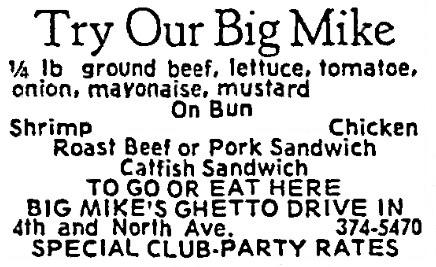
However, drive-ins generally – both Black and white – met major competition in the late 1960s when fast-food chain restaurants spread across the country. In Milwaukee Robby’s as well as Big Mike’s Ghetto Drive-In faced off with national chains and lost.

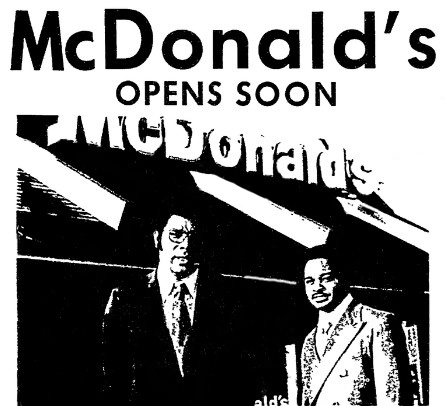
Big Mike’s owner Mike Watley, a social activist and close associate of comedian Dick Gregory, explained that he could not compete with a national corporation. With lower sales volume, he paid higher prices for food, a situation intensified by being given less financial support. His meat supplier, he said, capped his credit at $100, while white customers could run up their bill to three or four thousand. Although Watley blamed his failure on competition from a “white-owned corporation,” the nearby McDonald’s franchise was owned by two Black men, one of them Wayne Embry, a former player with the Milwaukee Bucks. Their McDonald’s venture was quite successful. [Above: Big Mike’s, Milwaukee, 1969; Below: Wayne Embry, left, and his partner, 1971]

Independent Black-owned drive-ins have not totally disappeared, however. In Longview TX White’s Drive-In, established in 1952 in conjunction with the White’s motel, has recently been re-opened by younger members of the family.

© Jan Whitaker, 2023

13 Comments

Filed under drive-ins, food, guides & reviews, racism, restaurant advertising, roadside restaurants

Image gallery: restaurant matchcovers

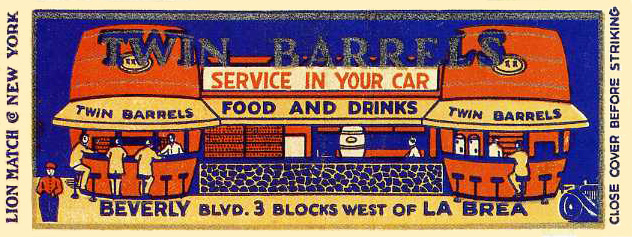
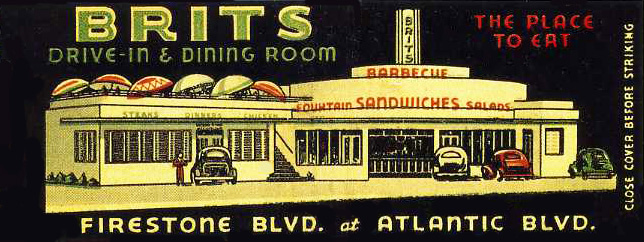
Colorful matchbooks advertising restaurants became popular in the 1930s and remained commonplace into the 1950s. Every time customers lit a match they were reminded of the restaurant. As a catalog of the Match Corporation of America put it in referring to matchbooks with 20 matches: “20 Lights, 20 Reader-exposures . . . twice that if inside printing is used.”

Usually matchcover collectors remove matches from their covers, but the exceptions are the feature matchbooks. In that case, the printed matches are as much of an attraction as the covers, as the above examples show.

Many feature matchbooks were a product of the Lion Match Co. in Philadelphia. The company also made contour matchcovers which incorporate die cuts as shown here.

This batch shows the simple type of matchcover. The two taller ones are salesman’s samples — which are considered worthless by serious collectors. However, I value them just as highly as others because I am primarily interested in graphics.

These full-length matchcovers were perfect for horizontal restaurants, particularly for diners and Western roadside places.

Stock matchcovers such as these would have cost restaurant proprietors less since they involved no original artwork on the part of the manufacturer. It’s likely that they were used mainly by cafes and basic eateries. Though I know nothing about The Patio in St. Louis, I somehow doubt that waiters there wore tuxedos.

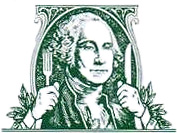
While I was investigating the subject of restaurant matches, I happened upon an amusing incident involving a restaurant’s matchcover design and the Secret Service. In 1977, shortly after the opening of George’s-on-Washington, a Houston TX barbecue place, the Secret Service showed up and confiscated 15,000 matchbooks bearing an image similar to that on the $1 bill. The grounds were that they violated federal counterfeiting laws. However when the owners challenged the seizure in court a U.S. District Judge ruled that the logo did not violate federal law and ordered the matches returned.

In the 1980s numerous American match-producers, which had been doing less and less business with restaurants and in general, failed. One exception was Universal Match that did a big business with Las Vegas hotels and eating places.

Although some restaurants use matchbooks today, designs are usually simple and (sigh) tasteful. Michael Greer, a home decorator who published a 1962 book called Inside Design, would be relieved. He was very particular about small items around the house such as a pink toothbrush in a fancy gold bathroom or an “antagonistically colored soap.” And he laid down the following rule regarding matchbooks: “Restaurant matchbooks are name droppy to leave around if the restaurant is elegant or in another country, demeaning if it is not.” For your own good, do be careful!

If you are interested in viewing more restaurant matchcovers, you might find this site’s 11,278 examples entertaining.

© Jan Whitaker, 2023

5 Comments

Filed under restaurant advertising