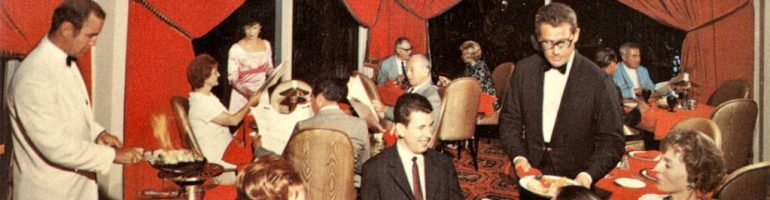
Appetite City
 As someone who has spent years researching the history of restaurants I can give no higher praise than to say “I couldn’t have done it better myself.” That is my appraisal of William Grimes’ Appetite City: A Culinary History of New York (Farrar, Straus and Giroux/North Point Press), a book I highly recommend to anyone interested in the history of both restaurants and New York City. And, though I might have matched the book’s exhaustive research, I doubt I could have written it so engagingly. I appreciate Grimes’ level gaze and ability to sidestep the hype that has always surrounded New York restaurants, even as far back as 1825 when a journalist insisted that New York rivaled Paris with its “consummate institutions for cultivating the noble science of gastronomy.” Grimes’ response: “New York a rival of Paris? Hardly.” Though its star would rise throughout that century and the next, there were plenty of dips along the way. In the late 1960s and early 1970s the city was depressed and “cultural energy no longer radiated” from it. California restaurants became the locus of culinary innovation. Inevitably, though, many of its leading chefs migrated to New York as almost everyone who wants to make their mark does at some point.
Readers will find everything they are looking for in this book. All the leading restaurants and restaurant types are covered, in text and illustration: from Delmonico’s to the Automat, speakeasies and lobster palaces, beaneries and night clubs, oyster bars and world’s fairs eateries, from the 1820s to the present. I particularly enjoyed the book’s final chapter in which Grimes discusses his five years as a restaurant critic for The New York Times, during a “frenzied restaurant boom fed by a robust economy” (1999-2004) when “the dining scene was a complete free-for-all, as chefs dipped into Pacific Rim and Nuevo Latino with equal enthusiasm…” If I find anything missing in the book it is a characterization of New York restaurants which identifies how they have been, and are, different from those in the rest of the U.S., and the world — perhaps an impossible task, but worth a try. And something that applies to all capital/global cities that I would have liked to see would have been an attempt to separate the local dining spots (where the natives eat) from those that rely heavily on visitors to the city. But these are minor omissions in a valuable and thoroughly enjoyable book.
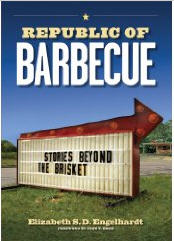 Republic of Barbecue
The Republic of Barbecue: Stories Beyond the Brisket (University of Texas Press) takes us far beyond New York City and its trendiness and glitz. Here we are introduced to more than one expects from a purely local tradition in cooking, eating, and restaurant-ing.
The book is by Professor Elizabeth S. D. Engelhardt of the American Studies Department at the University of Texas at Austin and 11 graduate students. With cameras and tape recorders the crew explored Central Texas eateries to create an oral history of barbecue and answer the question, “What does barbecue tell us about who we are?” Proprietors tell in 23 first-person narratives how and why they barbecue. These are supplemented by essays by the authors which explore the area’s history as well as subjects such as gender and race.
So the book sprawls, intentionally. As Engelhardt says, the idea is not to solidify Texas barbecue mythology but to find its complexities. Myth would have it that Texas barbecue is about beef and sausage; cowboys; rich and poor sitting side by side; eating off of butcher paper without utensils; slow cooking over mesquite and post oak in brick pits; no sauce; and only bread or crackers as sides. They find all of these things are real, but they also trace historical roots to Southern cotton culture rather than Western cattle culture; find decades of exclusion of blacks and Mexicans as customers; discover pork, chicken, turkey, goat, and mutton alongside beef; and find varied practices such as some barbecuers using sauce, some cooking on rotisserie pits fueled by propane instead of wood pits, and some cooking the meat for only three hours rather than twelve or more.
The book is well illustrated and, though somewhat repetitive and a bit inconclusive, filled with fascinating essays and narratives. I enjoyed reading about what to drink with barbecue – Big Red and Dr. Pepper sodas, and Shiner Bock and Lone Star beers. I appreciated Gavin Benke’s “Authenticity” which explores issues such as the restoration of butcher paper for the feel of the “real barbecue” experience, Eric Covey’s “Keep Your Eye on the Boll,” which examines barbecue in the context of a cotton-growing economy, and Remy Ramirez’s essay on her Mexican-American grandparents. The book is nicely produced and a pleasure to read and a must-have for anyone interested in barbecue or restaurant history and culture.
© Jan Whitaker, 2009


 I always find it difficult to judge menus from the 19th century because our eating habits, food preferences, and food resources have changed considerably since then. It is difficult to decide whether any given menu is fine, average, or poor. The following menu was designed by a hotel steward (stewards were in charge of expenses) for a banquet in 1893. Almost certainly wines would have been served with the seven courses (which are Soup, Fish, Roast, Punch, Entree, Dessert, and Coffee).
 As the decade starts there are over 19,000 restaurant keepers, a number overshadowed by more than 71,000 saloon keepers, many of whom also serve food for free or at nominal cost. The institution of the “free lunch” has become so well entrenched that an industry develops to supply saloons with prepared food. As big cities grow, the number of restaurants swells, with most located in New York, Pennsylvania, Illinois, Massachusetts, and the Midwest where young single workers live in rooming houses that do not provide meals. Southern states and the thinly populated West, apart from California, have few restaurants.
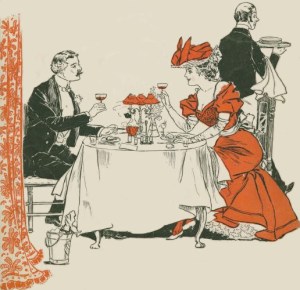 Near the decade’s end, the “Gay 90s” commence and those who are able and so inclined pursue the good life, which increasingly includes going to restaurants for the evening. It is still considered somewhat disreputable to do this, so some people go out to dinner only when visiting another city.
 1893 A drunken man fires five shots into
 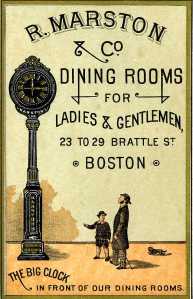 1895 Competition from cafés and restaurants in Massachusetts has just about wiped out the old boarding houses where renters had all their meals supplied. One reason is that people prefer restaurants because they get to choose what and when they eat. – Boston’s Marston restaurant, established by sea captain Russell Marston in the 1840s, opens a women’s lunch room on Hanover Street.
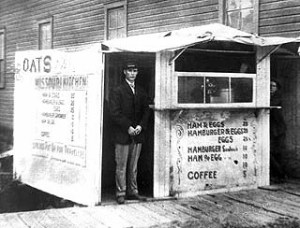 The restaurant business didn’t get much respect until it was sharply disconnected from drinking and put on a business-like footing in the Prohibition era of the
 In the 1850s the great landscape architect Frederick Law Olmsted, designer of New York’s Central Park, traveled through the South to investigate the institution of slavery. His observations were published in three volumes which were influential in turning readers against slavery. Around 1857 he traveled to Memphis, Tennessee, where he stayed at the Commercial Hotel. Although it was considered a first-class establishment, things did not go well for Frederick in the dining room as his journal entry for March 20, below, reveals. Among the dishes appearing on the not-too-elegant menu were “Beef heart egg sauce,” “Calf feet mushroom sauce,” “Bear sausages,” “Fried cabbage,” and, for dessert, “Sliced potatoe pie.” Better than whole potato pie, I guess.
 During the war (1941-1945) the creation of 17 million new jobs finally pulls the economy out of the Depression. Millions of married women enter the labor force. The demand for restaurant meals escalates, increasing from a pre-war level of 20 million meals served per day to over 60 million. The combination of increased restaurant patronage with labor shortages, government-ordered price freezes, and rationing of basic foods puts restaurants in a squeeze. With gasoline rationing, many roadside cafes and hamburger stands close.
 1941 When the restaurant in the French pavilion at the New York World’s Fair closes, its head Henri Soulé decides he will not return to a Paris occupied by Germans. He and ten waiters remain in New York and open Le Pavillon. Columnist Lucius Beebe declares its cuisine “absolutely faultless,” with prices “of positively Cartier proportions.” – Chicago cafeteria operator
 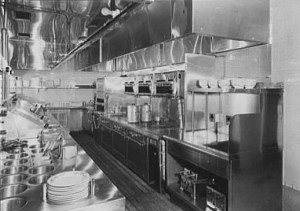 1946 Like health departments all across the country, NYC begins a crack down on
 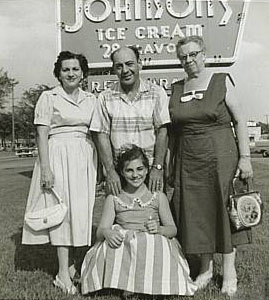 1949 Howard Johnson’s, the country’s largest restaurant chain, reports a record volume of business for the year. HoJos, which has not yet spread farther west than Fort Wayne IN, plans a move into California.
 In the mid-19th century there was only one American restaurant with a worldwide reputation,
 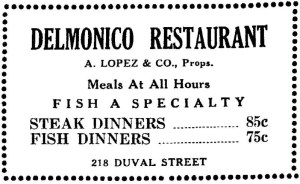 From the 1870s up to the 1930s, but not so much after that (except for New Orleans?), I’ve found Delmonicos in Los Angeles, Denver, Colorado Springs, Tombstone, Phoenix, Helena, Portland OR, El Paso, Dallas, Walla Walla, Mobile, Memphis, Winona MN, Leavenworth KS, Detroit, Key West (1931 ad pictured), Pittsburgh, Buffalo – and more. Proprietors names ranged from Gutekunst to Garibotti to McDougal.
 In the early 1950s middle- and upper-income people in cities of 25,000 or more were surveyed about their restaurant habits. People with lesser incomes and those living in rural areas and small towns were excluded because they were considered to be infrequent restaurant patrons. Thirty-five percent of those surveyed reported eating a restaurant lunch or dinner, or both, four to seven times a week. About one-third of the respondents also volunteered complaints, some of which follow:

 It's great to hear from readers and I take time to answer queries. I can't always find what you are looking for, but I do appreciate getting thank yous no matter what the outcome.
 Restaurant-ing through history