Category Archives: miscellaneous

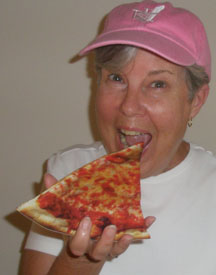
Good eaters: me

Taking a departure from my usual focus on the remote(r) past, I’m writing about the three New Orleans eating places I went to on Monday of this week, the fifth and last day of my trip. On days one through four I ate at: Herbsaint, Lil Dizzy’s, Galatoire’s, The Upperline (twice), Lüke, Bayona, and – something totally different – Restaurant des Familles in Crown Point.
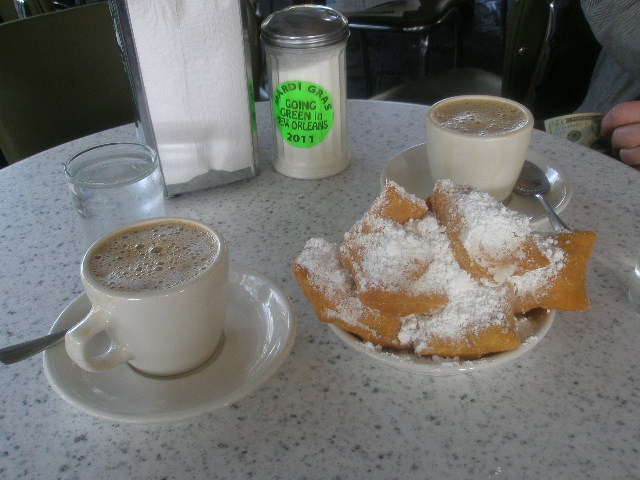
8:50 a.m. Café du Monde. Last chance for beignets, hot, delicious, and smothered in powdered sugar, most of which I tapped off, leaving behind a plateful of sugar a quarter inch deep. I’d just been reading about mid-19th-century coffee stalls in London and realized that the Café du Monde was one of them. In London they were patronized by street vendors and market men and women and I’m sure that was once true in NO also. Today it’s mostly tourists. The outdoor “porch” dining room was packed when we arrived — early, we thought — and by the time we left there was a block-long line. The Asian woman who served us barely spoke English and we wondered if she was related to the Vietnamese shrimpers we saw south of the city.

12:20 p.m. August. Less than four hours later, time to eat again, now at one of NO’s premier restaurants where I had the three-course $20.11 prix fixe ‘lunch.’ Not only was this the biggest bargain of the trip, it was clearly the finest all-round meal.
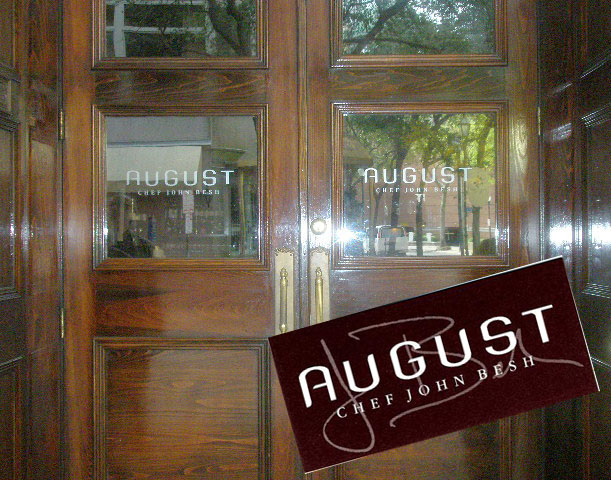
August’s dining room is high ceilinged, paneled, lots of browns, with all the hallmarks of an expensive, first-class restaurant such as oversized florals, spotless linens, heavy silverware (the knife swiftly restored to parallel position when I knocked it askew). Our waiter was nattily attired in a dark business suit while his crew wore white shirts, black ties, and long white aprons. I was dressed in an India-ink striped tunic stitched with mercerized Coates & Clark thread, lightly finished in a bath of Argo starch, over pants noir of Georgia cotton.
Yes, that gives you an idea of August’s pretentious menu language. But, getting past that, the meal’s presentation was exquisite and everything tasted wonderful, including my “pâté de champagne of La Provence pork with pickled wild mushrooms and seasonal marmalades” and the “creamy McEwen grits” which underlay my “slow-cooked veal grillades.” Breadstuffs arrived neatly pocketed in folded napkins. We started and finished with freebies: an “amuse bouche” of fish custard served in an eggshell; chocolate caramels and peanut brittle with the check. Did I forget to say house-made?
Funny moment: while we were eating a Sysco delivery truck pulled up outside the front window. I asked waiter #2 where it was making deliveries and he almost choked as he quickly swore, “Not here, not here!” I believed him.
6:30 p.m. Cochon. Though I really didn’t eat that much at lunch I began to doubt my capacity as dinner approached. In fact I was not up to the task, which may explain why I was less than enchanted with Cochon. As the name implies Cochon specializes in pork and associated pig products. It has a smoky aroma, bare floor and tables in light wood, an exposed brick wall, and a young crowd casually dressed. Where we sat we had an unfortunate view of kitchen workers taking smoke breaks alongside the dumpster. Plus obnoxious neighbors. Bummer. I ordered smoked brisket with horseradish potato salad but must confess I was not in the mood for the overload of salt and fat on the plate.
As we left Cochon I realized I was burning out on restaurants (only temporarily) and wanted to get back to my favorite homefood, fresh grilled fish and tri-color salad.

© Jan Whitaker, 2011
Leave a comment

Filed under miscellaneous

Conference-ing

Admittedly the “-ing” gimmick doesn’t work so well with that word, but it’s for a good cause. I want to let readers know about a fantastic event taking place in NYC February 18 and 19 that I will be participating in. It is the regional conference of the International Association of Culinary Professionals (IACP), sponsored by The Culinary Trust.

The two days have a lot packed into them: Two plenary addresses to choose from, two receptions, restaurant dinners and lunches (additional charges), and multiple panels organized by thematic track. The four tracks are:

Food Writing (with me on one of the panels)

The Food of New York (me again, talking about NYC’s restaurant history)

School Food

Farm to Table

Read more about the IACP conference. To get more details about each panel, click on the “Register here” button. (You will not be required to register immediately, but I hope you will.)

1 Comment

Filed under miscellaneous

Top posts in 2010

Leave a comment

Filed under miscellaneous

Variations on the word restaurant

Although I have found the word “restaurant” used as early as 1830, it wasn’t until about 1850 that it became common in the United States. Before that there were a variety of related words which can be seen developing into the present-day usage.

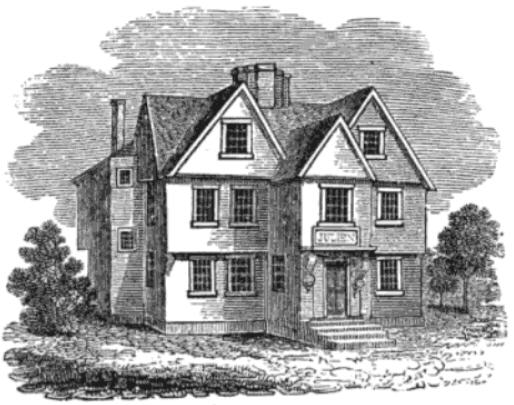
The first, in this country, was restorator, introduced as far as is known by Jean Baptiste Gilbert Julien in Boston (his restorator pictured below). A newspaper announced in July of 1793 that he had “established a HOTEL, in Leverett’s Lane, opposite the Quaker Meeting House, under the denomination of The RESTORATOR – by which it is to be understood a Resort where the infirm in health, the convalescent, and those whose attention to studious business occasions a lassitude of nature, can obtain the most suitable nourishment.”

The word restorator is an Anglicized version of the French word restaurateur. Restaurateur, in France of the late 18th century, meant an eating place where health-restoring soups (called “restaurants”) could be consumed. These were not just any kind of soups but what might almost be called liquid meat. M. Julien revealed in 1794 that he made his of “Good lean Beef, Veal and Fowls [and] Turtle flesh.”

Shortly after Julien began his restorator others did the same. Dorival & Deguise opened in Boston in 1796, promising to dress their victuals “in the American and French Modes.” They too furnished “Brown” and other soups. At the same time Claret & Mitchell opened a restorator in Charleston SC. By 1800 eating places calling themselves by this name were to be found in Philadelphia, Portsmouth NH, Salem MA, and Portland ME.

But very soon a variation, restorateur (also, less commonly, restaurator), began to crop up which more closely resembled the French word restaurateur, which also came into use then. The first mention of this I’ve found was in 1803, in Charleston, the State Coffee-House and Restaurateur Hotel. Meanwhile Boston clung to restorator, which appears occasionally as late as the 1860s.

Restaurateur soon began to take on a double meaning, applying both to a place and a profession, as in a somewhat ambiguous 1807 advertisement for “Charles Benoit, Restaurateur, who has moved to no. 1 Murray street [NYC], where he will run an Ordinary every day at 2 o’clock which he will keep ‘in the Parisien manner.’” By the 1830s restaurateur clearly denoted a profession.

One of the first uses of restaurant with reference to an eating place, if not the first, is on the occasion of the opening of Delmonico’s “Restaurant Francais” in 1831. I’ve also seen the word used to refer to eating places in New Orleans (1836), Washington (1838), and, amazingly enough even Boston (Ford’s Restaurant, 1843).

About the same time that the word restaurant was first adopted, another variation came into use minus the N: restaurat. The earliest use of this word I’ve seen is in 1821 in NYC, but also in New Orleans in 1837 (and 1863), Galveston in 1842, St. Louis in 1844, Houston in 1848 (and 1865), and San Antonio in 1853. Sometimes a period follows, suggesting the word might be an abbreviation for restaurateur. An encyclopedia published in NY in 1831 gives this explanation:
— Restaurateur, Fre., a cook, in France, who keeps victuals already dressed, to be served in the house or abroad, at the person’s request, of which he presents you a list for your choice, called carte du jour, a bill of fare.
— Restaurat, the house where the establishment of restaurateur is kept.

Was it because of restaurat’s ending – RAT — that restaurant won out?

© Jan Whitaker, 2010

5 Comments

Filed under miscellaneous, restorators

Between courses: a Thanksgiving toast

As I wrote last year – and as everyone knows — Thanksgiving is not a big day for most restaurants and they tend to be closed. This holds true especially for ethnic restaurants which don’t ordinarily serve anything resembling the traditional American-style turkey dinner.

For those who work in Chinese restaurants the day is a grand romantic holiday. Jennifer 8. Lee, author of The Fortune Cookie Chronicles: Adventures in the World of Chinese Food, explains why. Few Americans eat Chinese food on Thanksgiving and for this reason, writes Lee, “it’s the only day that the nation’s Chinese restaurant workers can consistently get off.” And this means they are able to plan weddings for this day. Lee continues, “Each year, tens of thousands of people, almost all Chinese restaurant workers or former workers, flood into Chinatown on Thanksgiving for hundreds of weddings. Banquet halls are booked more than a year in advance, instead of just a month or two, as is standard for the rest of the year. The marital marathon of multiple simultaneous seatings starts before noon and stretches well into the night.”

I highly recommend Lee’s book. She explores the history of restaurant staples of Chinese restaurants in America, past and present, such as chop suey, General Tso’s chicken, fortune cookies, and soy sauce — even take-home cartons. What I found of greatest interest, though, were her stories of Chinese Americans and newly arrived Chinese who operate restaurants, and who work long days cooking, serving, and delivering Chinese food.

This Thanksgiving I am going to toast the Chinese restaurant workers who are enjoying their wedding day or their anniversary, or just a rare day off.

© Jan Whitaker, 2010

3 Comments

Filed under miscellaneous, restaurant customs

Spotlight on NYC restaurants

This month, at noon on October 27, I will moderate a panel of authors who have written about the history of New York restaurants. The event takes place at the 92nd Street Y in Tribeca (92YTribeca) which is downtown at 200 Hudson Street.

The title of the panel, “Appetite City: The History of New York’s Restaurants,” clearly refers to panelist William Grimes’ book APPETITE CITY: A CULINARY HISTORY OF NEW YORK. Grimes, of the New York Times, was the paper’s restaurant critic from 1999 to 2003. He also curated the New York Public Library’s exhibit of historic menus in the 2002-2003 show “New York Eats Out,” which I was lucky enough to see.

Mark Kurlansky, best-selling author of COD, SALT, and many other books, will also be on the panel. His THE BIG OYSTER discusses oyster cellars and other historic restaurants in New York, while his FOOD OF A YOUNGER LAND also contains essays on restaurants. He will be signing the latter book as well as EDIBLE STORIES, his new novel which should debut in time for the October 27 panel.

David Sax will talk about Jewish delicatessens past and present that he researched and visited when writing his book SAVE THE DELI. His blog of the same name is a lively and humorous spot dedicated to, as he states, “the preservation of the Jewish delicatessen, a hallowed temple of salted and cured meats.”

I’m expecting an enjoyable hour with lots of good discussion, followed by me eating lunch at Café 92YTribeca. Care to join me?

4 Comments

Filed under miscellaneous

Taste of a decade: 1870s restaurants

Marked by a deep Depression with high rates of unemployment and business failure, the destruction of Chicago by fire, and the world’s most popular international fair to date, the 1870s are a tumultuous time for the burgeoning restaurant trade. On the one hand many restaurants fail, yet the field widens as new types and markets emerge. Despite a 14% unemployment rate, the appeal of dining out grows as many of the nearly 10 million visitors to Philadelphia’s Centennial Exposition experience restaurants for the first time. Some of the fair’s restaurants set up permanent businesses when it ends.

The temperance movement introduces innovation with cheap coffee houses that demonstrate how to serve the masses on a strict budget without profits from alcoholic drinks. Under financial pressure American-plan hotels, which formerly provided limitless amounts of food with the price of a room, shut down their dining rooms, expanding the number of customers for outside restaurants. Better restaurants open special rooms and sections for unescorted women in response to growing demand. A Civil Rights Act is passed in 1875 that outlaws discrimination in public accommodations but it is disregarded and has little impact.

Experiencing reduced incomes, middle-class people wish for inexpensive eating places that are clean and have decent food. The NY Times comments, “Gentlemen who a few months ago would spend a dollar or so for a lunch and bottle of ale, now would be satisfied with a piece of roast beef and a glass of lager or cup of coffee…”

The country is primarily rural. As the decade begins only two cities have more than 500,000 population. The big wave of immigration has not yet begun, and many restaurants are run by Irish, English, and German immigrants from earlier decades. Refrigerated railway cars make it easier than ever before to ship dressed meat, oysters, seafood, fruits, and vegetables to all parts of the country, bringing luxuries to the tables of restaurants in out of the way spots.

Highlights

1870 After dealing in spices, coffee, wholesale liquors, and real estate, and running a beer hall, ball room, distillery, dry goods store, and country hotel, Hanoverian baron Christian Wolfgang von Dwingelo, a refugee of the failed German revolution of 1848, opens a restaurant on William Street in NYC.

1871 Amidst the smoldering ruins of the Great Fire, inventive Chicagoans put their culinary operations on wheels and tour about the city supplying long lines of hungry patrons with fried fish, sausages, coffee, and pie. In a sense these are the first American “diners.”

1873 Harvey & Holden in Washington D.C., which claims to be the largest oyster house in the nation, serves premium oysters from Maryland and Virginia every day from 6 a.m. until midnight. The restaurant is moderately priced, except for black patrons who allege they are charged extortionate prices.

1874 The enterprising Frederick Kurtz, operator of four “Old-Established and First-Class Restaurants” in lower Manhattan advises his customers that he has “reduced the Prices of his Bill of Fare to the most reasonable rates, To Suit the Times.”

1875 At Thompson’s in Chicago, about one third of the patrons are women. Unlike most restaurants, no liquor is served here.

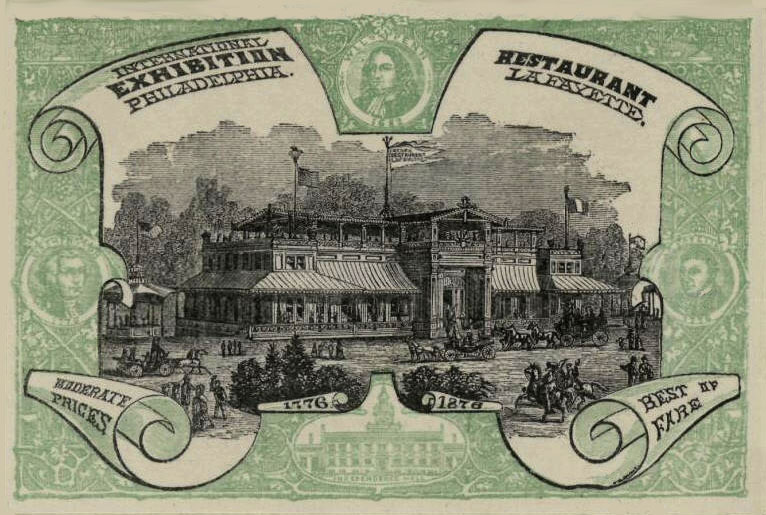
1876 The Centennial Exposition in Philadelphia is well supplied with restaurants, among them a re-creation of the world-famous Trois Frères Provençeaux [Three Brothers from the Provinces] which closed in Paris four years earlier. One commentator prays it will influence America’s tough-steak-and-weak-coffee cookery.

1876 Edmund Hill of Hill’s Dining Rooms in Trenton NJ visits the Exposition for the seventh time and has dinner at Lauber’s German Restaurant with a refrigerator salesman. He writes in his diary, “There must have been a thousand persons there at the time I was eating.”

1877 After an editorial appears in the Boston Globe stating a need for decent, inexpensive restaurants, a reader writes in to complain about how “Dirt and democracy seem somehow inseparable” and the only clean restaurants are unaffordable ones such as Delmonico’s.

1878 At the Oyster Bay Restaurant on Alpine Street in Georgetown, Colorado, oysters are served “in all styles and at all hours.”

1879 Journalist and author Lafcadio Hearn starts a cheap restaurant in New Orleans called The Hard Times where all dishes cost 5 cents. He writes to a friend that he is “going to succeed sooner or later, even if he has to start an eating-house in Hell,” but rapidly goes out of business all the same.

© Jan Whitaker, 2010

Read about other decades: 1800 to 1810; 1810 to 1820; 1820 to 1830; 1860 to 1870; 1890 to 1900; 1900 to 1910; 1920 to 1930; 1930 to 1940; 1940 to 1950; 1950 to 1960; 1960 to 1970; a href=”https://restaurant-ingthroughhistory.com/2013/09/24/taste-of-a-decade-1970s-restaurants/”>1970 to 1980

6 Comments

Filed under miscellaneous

Between courses: only one?

The gruff waiters and rowdy patrons found in cheap restaurants of the 19th century provided rich inspiration to story tellers. No story was more popular than the “Lone Fish Ball” which was published in newspapers before being turned into a favorite college song around 1854 (attributed to a Harvard professor of Latin), translated into Italian, and even performed in Tableaux Vivants.

The latter form of entertainment, where actors silently act out scenes, was a singularly odd one since the story is all about words uttered by a waiter and their mortifying effect upon a hapless patron.

In the 1840s, the decade in which the event allegedly took place, it was the custom of waiters in cheap eating houses to shout orders to cooks while standing at the tables. New patrons unfamiliar with this practice were invariably embarrassed when their orders were revealed to a roomful of none-too-polite patrons.

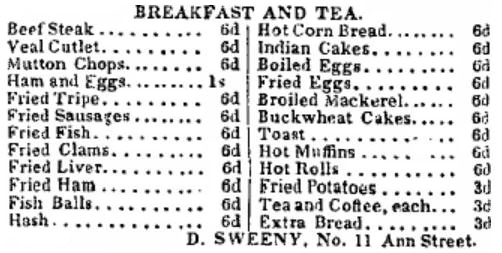
According to the tale, a young man who is short of money enters a cheap restaurant (sometimes identified as Daniel Sweeny’s Old Established Eating House in New York City) and realizes he has only enough money (6 cents) for a half order of fish balls – i.e., one fish ball – and a cup of tea. He timidly whispers his order to the waiter, hoping his oafish neighbors won’t overhear it, whereupon the waiter bellows it forth, emphasizing the word ONE. The oafs snicker.

He receives his order and again whispers to the waiter, “A piece of bread, sir, if you please.” Then, as the song goes:

The waiter roars it through the hall,
We don’t give bread with one fish-ball.

Now the entire house breaks out in laughter and the humiliated patron slips out.

© Jan Whitaker, 2010

3 Comments

Filed under miscellaneous

Taste of a decade: restaurants, 1900-1910

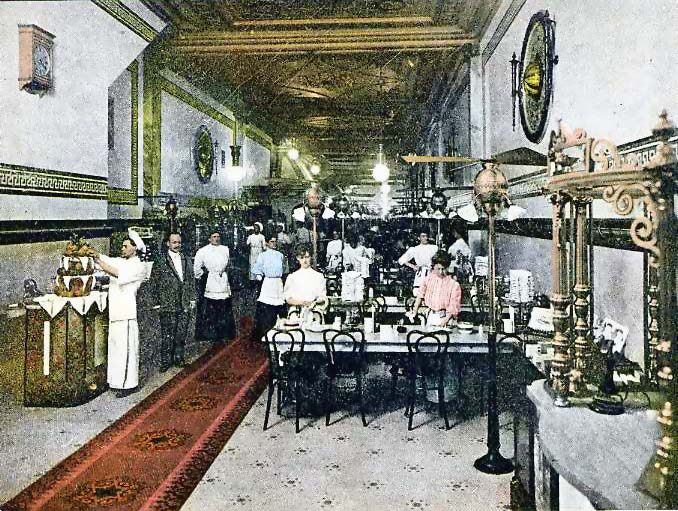
It is the dawn of the modern era of restaurant-ing. Patronage grows at a rate faster than population increases and the number of restaurant keepers swells by 75% during the decade. Leading restaurant cities are NYC, Philadelphia, Chicago, San Francisco, and Boston. Inexpensive lunch rooms with simple menus and quick service proliferate to serve growing ranks of urban white collar workers, both male and female. Women patronize places they once dared not enter, climbing onto lunch counter stools and venturing into cafes in the evening without escorts.

Diners worry about food safety and cleanliness. Cities mandate restaurant inspections. Meat preservatives used by some restaurants to “embalm” meat that has spoiled come under attack. Restaurants install sanitary white tile on floors and walls to demonstrate cleanliness.

Cooks and waiters unionize. Restaurant owners follow suit, advocating the abolition of the saloon’s “free lunch,” combating strikes, and targeting immigrants who operate “holes in the wall.” As Italians and Greeks open eating places some native-born Americans complain that foreigners are taking over the restaurant business.

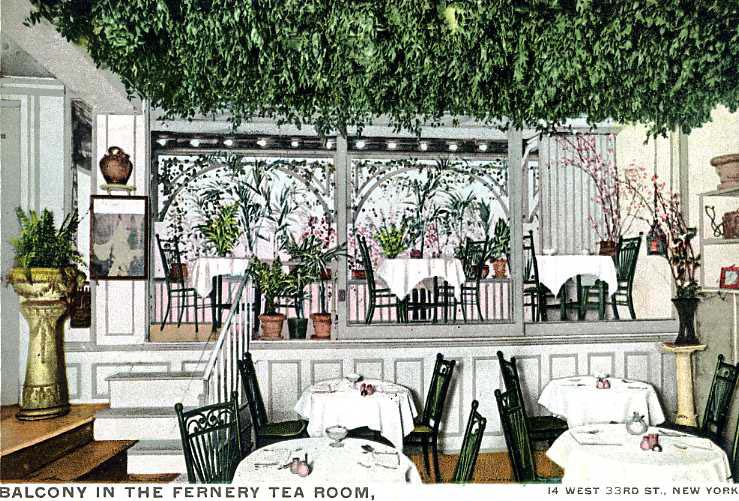
New types of eating places become popular such as cafeterias, vegetarian cafés, German rathskellers, tea rooms, and Chinese and Italian restaurants. Dining for entertainment spreads. Adventurous young bohemians seek out small ethnic restaurants (“table d’hotes”) which serve free carafes of wine. Many restaurants introduce live music. The super-rich are accused of “reckless extravagance” as they stage elaborate banquets. The merely well-to-do hire chauffeurs to drive them to quaint dining spots in the countryside.

Highlights

1901 As restaurant patronage rises “foody talk” is everywhere. A journalist overhears people “shamelessly discussing the quantity and quality of food which may be obtained for a given price at the various restaurants.” Hobbyists begin collecting menus and Frances “Frank” E. Buttolph deposits over 9,000 menus in the NY Public Library.

1902 Restaurants automate and eliminate waiters. In Niagara Falls a restaurant devises a system of 500 small cable cars which deliver orders to guests. The Automat opens in Philadelphia, inspiring the city’s Dumont’s Minstrels to create a vaudeville act called The Automatic Restaurant which features “Laughing Pie” and “Screaming Pudding.”

1903 “Where and How to Dine in New York” lists restaurants with cellars where men’s clubs play cavemen and eat steak with their hands. – Hawaiians croon in San Francisco restaurants; ragtime bands play in NYC’s Hungarian cafés; and at McDonald’s (“a touch of Bohemia right in the heart of Boston”) a “Young Ladies’ Orchestra” serenades patrons.

1903 In Denver, where a large part of the population eats out, a cooks’ and waiters’ strike closes large eating places. Strikes break out in Omaha and in Chicago, where a newly formed union rapidly gains 17,000 members. Restaurant owners replace black servers with white women in Chicago, while in Omaha they replace white waiters and cooks with black men.

1905 Five hundred guests of insurance magnate James Hazen Hyde don 18th-century costumes and enjoy a banquet at Sherry’s. Two floors of the NYC restaurant are transformed into a royal French garden and supper is served at tables under wistaria-covered arbors set on a floor of real grass.

1906 Afternoon tea is so fashionable that NYC’s Waldorf-Astoria supplements the Waldorf Garden space by opening the Empire Room from 4 to 6 p.m. – Italian-Americans Luisa and Gerome Leone start a small table d’hote restaurant in NYC near the Metropolitan Opera.*

1908 Johnson’s Tamale Grotto is established in San Francisco with “A Complete Selection of Mexican Foods to Take Home.” – In Washington, D.C., the Union Dairy Lunch advertises that they have passed inspection with “Everything as sanitary and clean as your own home.”

1909 The Philadelphia Inquirer features a story about stylish yet practical “restaurant frocks,” showing a coral pink dress and matching hat ideal for traveling in dusty, open automobiles while visiting rural roadside inns and tea rooms.

* Later known as Mamma Leone’s.

© Jan Whitaker, 2010

Read about other decades: 1800 to 1810; 1810 to 1820; 1820 to 1830; 1860 to 1870; 1890 to 1900; 1920 to 1930; 1930 to 1940; 1940 to 1950; 1950 to 1960; 1960 to 1970; 1970 to 1980

6 Comments

Filed under miscellaneous

On the menu for 2010

I’ve been writing about the history of restaurants for about 18 months now. I thought it would get easier but instead it’s become harder. Each post takes me longer to write. Partly it’s because I keep learning more about our American restaurant past and partly it’s because I realize that readers are taking my blog seriously and I’ve got to be sure about what I say. I’m always tempted to go back and add to old posts but manage to fight off that impulse fairly well unless I learn of a blatant error.

One thing that’s been a lot of fun is hearing from people whose relatives ran or worked in some of the restaurants I’ve featured. This has been true of Toffenetti’s, the Maramor, and Don Dickerman’s Pirate’s Den.

Onward! I haven’t even come close to running out of ideas and I have an ever-growing storehouse of fabulous images. Here are some of the topics I have in mind for 2010:

• Hidden history: Afro-American women restaurant cooks and proprietors

• More tastes of a decade, beginning with 1900-1910

• Linen supply and the mob, a topic I never did get around to in 2009

• A question that intrigues me: when did chocolate desserts become big restaurant items?

• Failed fast food chains – supposedly chains offer operators a hedge against the high mortality rate of restaurants, but consider how many entire chains have vanished

• Portraits of restaurant towns, beginning with Portland OR – this is turning out to be a lot harder than I expected

• The influence of France and fantasies about Paris upon American eating places

• Confectionery-based restaurants

• Sherry’s, as a leading example of the former topic

• Sociopath turned restaurateur: Mike Romanoff

• Anatomy of a restaurateur: Colonel Harland Sanders

• Good eaters: newspaper reporters

• The role of gossip columnists in building the restaurant business

• Chinese restaurants-cum-nightclubs of the 1920s and 1930s

• Austrian-American restaurateurs, a little explored ethnic group

• Crazy restaurant equipment patents

• Speakeasies as eating places

Ooh – have I ordered too much? Is my appetite bigger than my capacity? We shall see. Best wishes to all for a delicious and satisfying new year.

8 Comments

Filed under miscellaneous