Category Archives: cafeterias

Bumbling through the cafeteria line

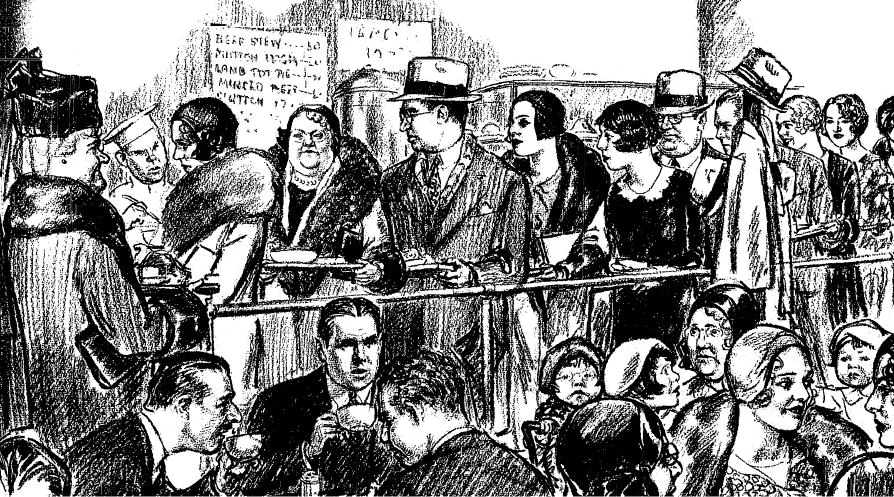
In 1931 the American humor magazine Life (not to be confused with the later photojournalism magazine of the same name) published “The Cafeteria,” an essay that described an inexperienced patron’s befuddlement in composing a meal item by item while being propelled forward by an ever-moving line. (The illustration by W. E. Hill is also from 1931.)

The essay, from which I have selected sentences to shape into a “poem” similar to Charles Green Shaw’s The Bohemian Dinner, was written by John C. Emery. It’s likely that at the time he wrote about his cafeteria experience he was a 27-year old editor with Railway Age, a trade journal located in Chicago. Chicago, it happens, was a city with plenty of cafeterias. In its early stages cafeterias were identified with women while men were notoriously resistant to them.

Turns out Mr. Emery had an interesting biography. As a naval commander during World War II, he was in charge of expediting air cargo. Following the war he founded Emery Air Freight, which began as a freight forwarder that leased space on existing airlines and grew into a major corporation. Alas, I know nothing about his further adventures in eating out, but I doubt he continued to go to cafeterias.

The Cafeteria
The trays.
The cutlery.
The selection of a knife, a fork and two spoons.
The selection of two pieces of bread and a roll.
The after-thought selection of another roll.
The sudden realization that you have a lot of bread.
The hesitancy to put any of it back, under the eagle eye of a waitress.
The great variety of salads.
The quick selection of one kind.
The immediate regret that you did not take another kind instead.
The inclination to make a change.
The nudge of a tray in the hands of a woman in line behind you.
The decision to move along.
The bowl of soup.
The meat order.
The potatoes.
The string beans.
The beets.
The realization that your tray is getting pretty full …
The decision to forego dessert.
The tempting pies.
The urgent desire for a piece of pie.
The selection of a piece of pie.
The difficulty of finding space for it on your tray.
The check, amounting to $1.32.*
The vast surprise.
The realization for the first time that you have enough food for about three hungry men.
The search for a table.
The unloading of your tray.
The vast array of dishes.
The growing conviction that other patrons are laughing at you.
The discovery that you forgot to take a napkin.
The consumption of every bit of food before you.
The gorged feeling.
The sluggish return to the office.
The surreptitious nap.

© Jan Whitaker, 2012

* Equal to about $18.90 in 2010 dollars, probably about double what he usually paid for lunch.

3 Comments

Filed under cafeterias, miscellaneous

Famous in its day: Miss Hulling’s Cafeteria

In 1978 two of the nation’s top grossing independent restaurants were New York’s Tavern on the Green and Mama Leone’s, according to Restaurant Hospitality magazine. At the first, guest checks averaged $14.50, while at Mama Leone’s the average was $13. A big aspect of both restaurants’ business was alcohol, accounting for 30% of revenues in the case of Warner LeRoy’s Tavern on the Green.

Meanwhile, a sturdy favorite in downtown St. Louis, the venerable Miss Hulling’s, home of chicken livers, creamed spinach, and carrot marshmallow salad — with a negligible drinks business – had a check average of $2. Yet it still managed to rank #58 out of the 500 restaurants in the survey.

Miss Hulling’s was the creation of Florence Hulling, who came to St. Louis around 1907 as a teenager from rural Illinois to work as a private cook. After a few years in domestic service she went to work for the Childs restaurant chain. Eventually she was promoted to manager, a rare status for a woman at that time. Childs closed in 1928 and she and her sister Katherine took over management of the cafeteria in the Missouri Hotel. When it closed in 1930 Florence bought the failed restaurant on the opposite corner and named it the Missouri Cafeteria.  It would stay in business there for the next 62 years [shown just before razing].

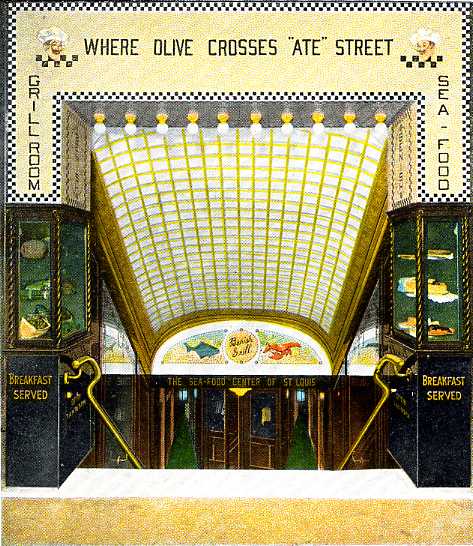
Florence married Stephen Apted in 1931 and in 1934 the Apteds opened a second cafeteria at 8th and Olive, calling it Miss Hulling’s, a name that would eventually apply to the Missouri Cafeteria as well. The Olive Street restaurant occupied a basement site that had previously held the Benish cafeteria [entrance shown] and before that – I think — Lippe’s, a restaurant operated by Detlef van der Lippe.

How well I remember a job I once held chauffeuring an alcoholic boss to Miss Hulling’s, his regular eating place and virtually his true home when he wasn’t bunking in the office of his advertising agency. I suspect he was not the only St. Louisan who relied on Miss Hulling’s for more than just food.

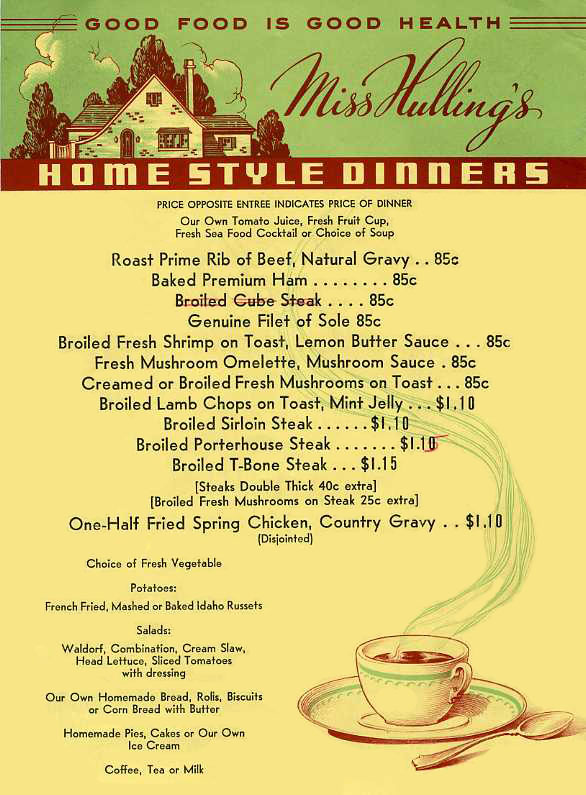
A 1939 Miss Hulling’s menu reveals the kinds of homelike dishes featured there. In addition to those shown, a mimeographed attachment lists a number of dishes not found much in restaurants now. Among the choices are Stuffed Baked Veal Hearts and Braised Ox Joints. If a complete dinner was ordered, for about 50 cents, the diner also got soup or salad, bread and butter, a vegetable such as Creamed Kohlrabi or Fried Egg Plant, a beverage, and a dessert such as Peach Rice Pudding. (See Miss Hulling’s Sour Cream Noodle Bake and her German Chocolate Cake on my Recipes page.)

In the 1940s and 1950s Miss Hulling’s was just the kind of place that earned high ratings from Duncan Hines and Gourmet’s Guide to Good Eating, the latter reporting, “Everybody in St. Louis swears by Miss Hulling’s. Food is exceptionally delicious, clean, and of high standard.” The cafeterias served their own ice cream and baked goods, used fresh fruit for pies, and prepared food in small batches.

Through succeeding decades the Miss Hulling’s enterprise, headed by the couple’s son Stephen J. Apted, grew large. It acquired Medart’s (turning it into the Cheshire Inn), and opened numerous restaurants in the metro area, among them The Cupboard and the Open Hearth, as well as running food services at two hospitals. Headquarters, including a bakery, were at 11th and Locust above the two-floor cafeteria. At the same location were the more formal dining spot Catfish and Crystal, His Lordship’s Pub, and a bakery and ice cream shop. In 1993 the entire operation at this site was closed down, the same fate having befallen the Olive Street cafeteria some years before.

© Jan Whitaker, 2012

107 Comments

Filed under cafeterias, popular restaurants, proprietors & careers, women

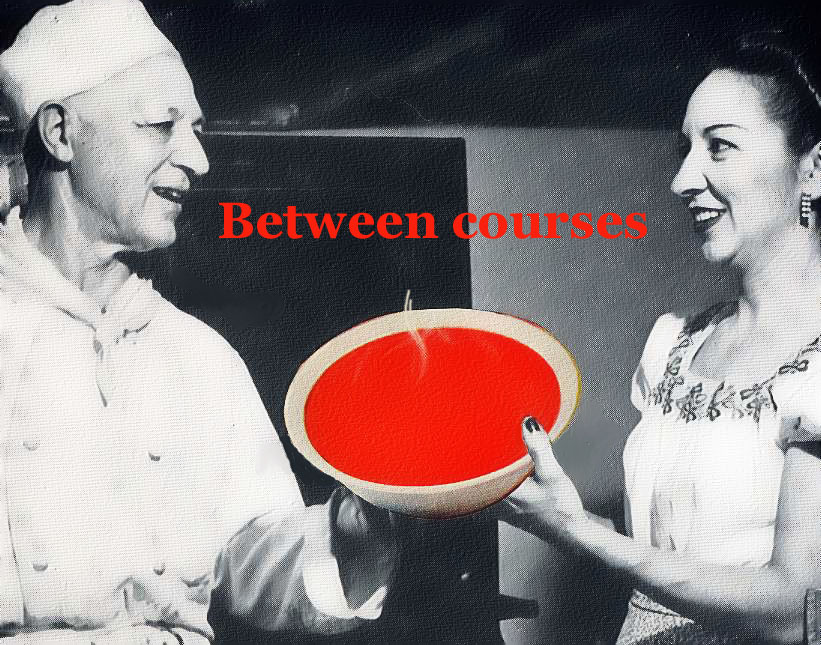
Between courses: dining with reds

In July of 1928 the Communist Party in the United States opened a public cafeteria on the ground floor of their headquarters in New York City, home also to The Daily Worker. The headquarters, known as the Workers’ Centre, was at 26-28 Union Square East and also contained a cooperative barber shop in which the barbers did not accept tips.

The restaurant was called Proletcos Cooperative Cafeteria. Proletcos was said to be a name created by a garment worker who combined the first two syllables of PROLETarian with the CO of cooperative, then added an S.

It’s not surprising that Communists would select a cafeteria as their preferred format for a restaurant. There is something socialistic about cafeterias, with their self-service and no-tipping customs. They were widely adopted in industrial plants and among working women’s organizations of the 1890s. Two home economists created a chain of cooperative cafeterias in NYC in 1920, called Our Cooperative Cafeterias, which dispersed an annual rebate to customers who were members. Evidently it was unrelated to the Communists’ project. Proletcos, whose prices were about average for a cafeteria, gave a 10% discount to its 600 shareholders. Its workers were guaranteed an 8-hour day and good working conditions.

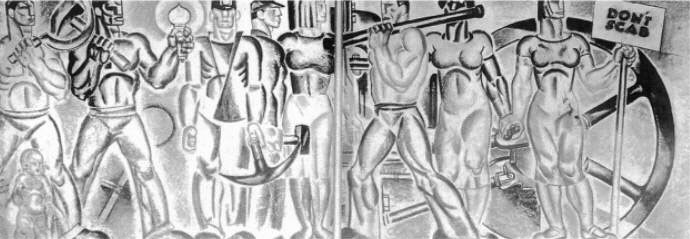
Proletcos was enlarged in November of 1928 and was able to serve nearly 6,000 meals a day. Artist Hugo Gellert, a lifelong Marxist and co-founder of The New Masses magazine, created a mural for the expanded and refurbished restaurant in which sturdy workers and Communist heros such as Sacco and Vanzetti, John Reed, and Vladimir Lenin, all 10 feet tall, loomed over the dining room (pictured). According to a story in the New Yorker, the cafeteria was quite up to date, with tile floors, brass railings, and modern light fixtures.

The cafeteria had a short life lasting only a couple of years in which it served workers, many of them from the garment district, along with students who liked to hang out, drink coffee, and discuss the issues of the times. It evidently came to an end in 1930 when the CP moved its headquarters from Union Square to East 13th Street.

© Jan Whitaker, 2010

7 Comments

Filed under cafeterias, Offbeat places