Category Archives: alternative restaurants

Serving the poor

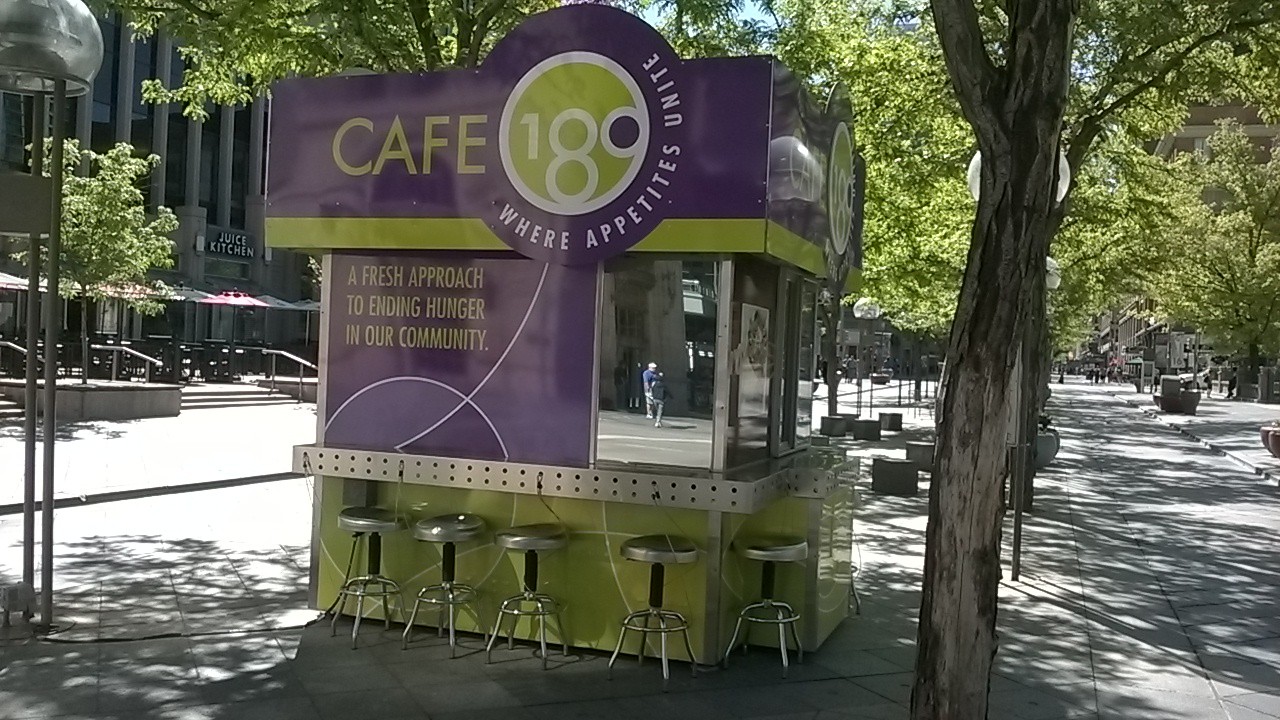
Created with Nokia Smart Cam

Recently, in Colorado Springs, I ate lunch at Seeds, a “community restaurant” devoted to making meals affordable to all. Guests are invited to pay what they can and, if that is nothing, to volunteer for an hour. A few days later, I saw another similar enterprise, Café 180, located on Denver’s outdoor 16th Street Mall.

It might seem like a new phenomenon but it’s more of an old idea with a new twist. Sellers of cooked food ranging from vendors with a cart all the way up to deluxe restaurants have long given away food to the needy.

In 1820 a French restaurateur in the City of Washington (D.C.) informed the public that he would sell the beef left over after being boiled for his special bouillon, while “to persons unable to pay it will be given gratis.”

John W. Farmer, a wealthy plumber, opened a Free Dining Saloon in New York City during the financial panic of 1857. After the first six months he announced he had served nearly 231,000 meals composed of dishes such as soup, corned beef, pork, ham, fish, bread, potatoes, cabbage, and turnips. Though hailed by the poor, especially the Irish, the New York Tribune rebuked him for failing to distinguish the deserving poor from the drunks, reprobates, and other “vile” persons “who prefer the bread of idleness to that of industry.” He carried on for several years, then opened the Farmer Institute, a reading room and lecture hall where speakers promoted an economy based on cooperation. A Cooperative Building Association that was formed as a result was quite successful.

Many free and low-price dining rooms as well as restaurant breadlines have sprung up during panics and depressions (of which there have also been many). Some have been motivated by religion or a social cause. In the 1870s a bad economy combined with the temperance movement helped make Holly Tree Coffee Inns successful. They were designed by Christian groups as alternatives to saloons, pitting “Queen Mocha against King Alcohol.” In addition to serving coffee, the self-supporting coffee houses provided low-priced food for working-class men in Hartford, Chicago, New York City, Washington, Boston, and many smaller New England towns. Quaker Joshua L. Bailey created similar coffee houses in Philadelphia.

The severe depression of the 1870s inspired others to open cheap restaurants. Some had meals for 10 cents, some for 5 cents, and some sold dishes for as low as 1 cent apiece. In New York a restaurant proprietor described only as an “old lady” was popular with newsboys for bargains like “Plate of soup one cent” and “All kinds of meat one cent.” Despite her rock-bottom prices she claimed to make a good profit.

CharityFleischman'sbreadline1913

Louis Fleischmann earned a fine reputation for the breadline he started at his New York Vienna Bakery restaurant during the Depression of the 1890s. He kept it going until his death in 1904, whereupon his son continued it for several years [shown above]. Another New Yorker, the Bowery’s Mike Lyon was also well known for his beneficence. Every morning at 5:00 a.m. he handed out food left from the night before to hundreds of women and children who gathered at his back door.

Physical fitness advocate Bernarr Macfadden also fed New York’s poor, thereby introducing what he claimed was the city’s first vegetarian restaurant in 1902. He recreated a similar penny cafeteria in 1931, selling soup, codfish, beans, prunes, bread, and other dishes for 1 cent each. He charged more for coffee because he didn’t think it was a “vital” food. Similar restaurants could be found then in Detroit and Springfield MA and probably many other cities. Max Rosoff invited the poor to eat for free in his NY Times Square restaurant after 10 pm., while Harry Rapoport, operator of a Jewish dairy restaurant on the Lower East Side was called the “Mayor of Second Avenue” in recognition of his culinary charity, especially after feeding 300 capmakers during a 7-week strike during the 1930s Depression.
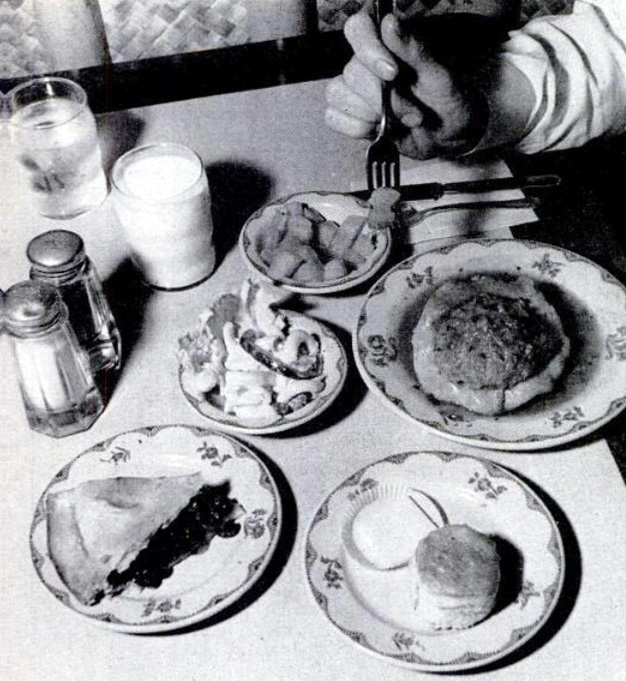
charityclifton's30centmealEqually impressive were the efforts of Clifford Clinton who not only ran a penny restaurant for about six months during the Depression but also made low-priced or nearly free meals a standard in his Los Angeles Clifton’s cafeterias. [30-cent meal shown, 1940s] Patrons were instructed they could pay what they wanted. He was patronized largely by the elderly who appreciated getting “A Tra-ful for a Tri-ful” at his odd but cheerfully upbeat cafeterias. Hot cereals ran about 8 cents while an egg was 9 cents. In 1954 he served a whopping 20,000 meals each day in his two cafeterias. During World War II he created a “Meals for Millions” foundation that funded scientists to develop an inexpensive soy-based meal distributed by wartime relief agencies to refugees throughout the world.

BTW, the lunch at Seeds was good as was the service. It’s a popular spot.

© Jan Whitaker, 2014
10 Comments

Filed under alternative restaurants, restaurant customs

Back to nature: The Eutropheon

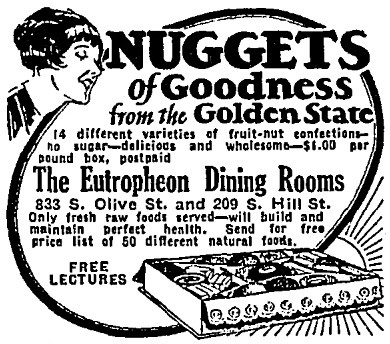
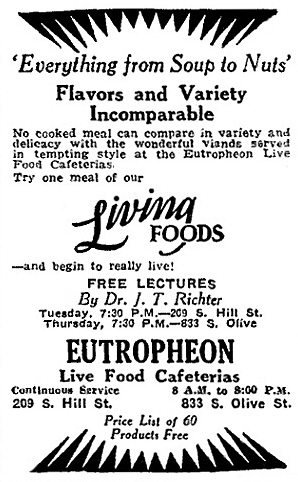
rawfoodeutrophean1928Last week’s post on a recipe from The Aware Inn, an early natural food restaurant in Los Angeles, took me back to founder Jim Baker and his adventures with the Nature Boys. I learned that some of the members of this group, who lived in the woods, dressed like Tarzan, and ate natural foods, worked at a Los Angeles raw food restaurant called The Eutropheon.

Just by its name, readers might suspect it was more about spreading the gospel of raw food diets than an ordinary money-making commercial eating place. They would be right.

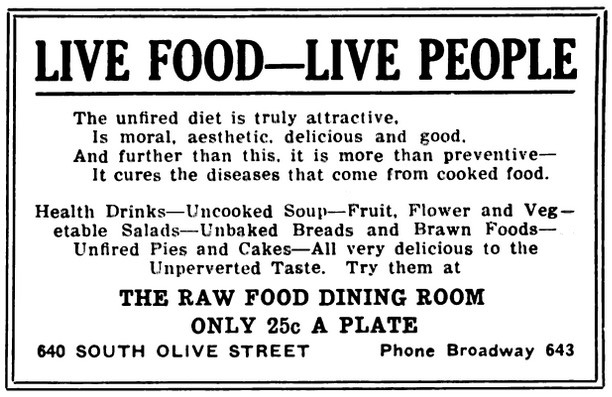
rawfoodTheNewJusticeJune11919A raw food restaurant, not yet named The Eutropheon, but very likely run by Eutropheon founders Vera and John Richter, was established in Los Angeles in 1919. It was evidently affiliated with, or at least sympathetic to, The New Justice, a short-lived publication dedicated to defending the Russian revolution [the 1919 advertisement here appeared in the magazine]. A story in the Los Angeles Times reported that the restaurant played Hawaiian music on a phonograph, distributed a leaflet called “The Truth About Russia,” and displayed a copy of the Soviet constitution along with a portrait of American socialist leader Eugene Debs. Its menu included uncooked soup, fruit and flower salads, and unbaked breads and pies.

In 1920 the Raw Food Dining Room had a new Los Angeles address, 326 W 2nd. In 1922, there was a Raw Food Dining Room, now called The Eutropheon, in Long Beach CA, as well as in Los Angeles at 927½ W 6th. How many of these were open at the same time is uncertain. There was also a Vegetarian Cafeteria on Figueroa serving “A complete line of Cooked and Raw Foods,” but this must have been run by someone other than the Richters since they were never known to serve cooked food. A Eutropheon cropped up in San Francisco in 1926, at 574 California Street. In 1928 the Richters had two Eutropheons in Los Angeles, one at 209 S. Hill and the other at 833 S. Olive.

There appear to have been very few raw food advocates in the United States, and almost no restaurants (until relatively recently), making the Richters pioneers. There were, however, some raw food enthusiasts in the US prior to The Eutropheon. Plans were laid by the Chicago Raw Food Society to open a raw food restaurant there around 1900 or 1901, but it’s unclear if it ever materialized. In 1907 a group in New York City held a raw food banquet at a hotel there. There was also a group in Cincinnati in the early 1920s.

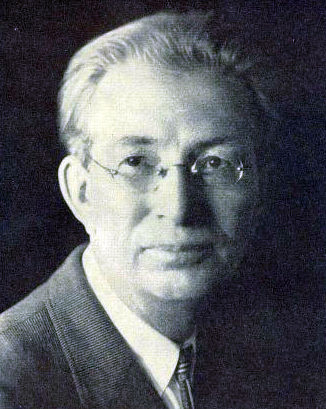
rawfoodJohntrichterJohn T. Richter, as he was known in Los Angeles, had come to the city around 1918 or 1919, opened a raw food restaurant, and began lecturing on the benefits of that diet and other aspects of natural living. When and how he met his wife Vera is unknown as is anything about her background, but she seems to be a key figure in the raw food movement in Los Angeles. Judging from her 1925 cookbook Mrs. Richter’s Cook-less Book, she may have developed many of the recipes for soups, salads, grain and nut dishes, and desserts that were served in The Eutropheon.

RawFoodVeraRichterBefore coming to California, Richter was known as Theophilus J. F. Richter. At least 20 years older than Vera, he was born of German immigrants in Illinois in 1864, grew up in North Dakota, and earned a diploma sometime in the late 1880s or the 1890s in “Swedish movement cure” in Chicago, probably from the Folke-Kjellberg Institute. He married a woman named Violet in Chicago in 1891 and they had three children. After living in Fargo for several years, the family moved to Minneapolis and Theophilus obtained a degree as a naturopathic physician. Evidently he adopted a raw food diet around 1911 after taking classes with Chicago doctor George Drews. He still gave his address as Minneapolis as late as 1917.

The Richters received quite a bit of publicity for their restaurant from Los Angeles naturopath and gymnasium owner Phillip Lovell. Lovell also had a radio show and wrote the “Care of the Body” column that appeared in the Los Angeles Times in the 1920s and 1930s espousing alternative medicine and health regimes. Declaring himself a regular patron of the Richter’s restaurants, Lovell wrote in 1928, “To my knowledge, these are the only two restaurants in the country that function without the aid of a cookstove.”

rawfoodrestaurant1926Why Lovell’s career and The Eutropheons attained success in California is an interesting question. It’s doubtful the Richters got rich but the fact that their restaurants survived for about 20 years is surprising given that raw food restaurants were found nowhere else at that time. As for Lovell, he amassed enough money to commission architect Richard Neutra to build the first steel-frame ultramodern house in the US. It was completed in 1929 and contained a full-size gymnasium. I suspect that the reason California was such fertile ground for health and fitness gurus had something to do with the large number of people, especially the elderly, who vacationed or moved there from the Midwest hoping the climate would cure their ills.

Sometime in the late 1930s it appears that the Richters turned over The Eutropheon at 833 S. Olive to Milan Geshtacoff who had once been a kitchen worker there. How long it stayed open and what the fate of the S. Hill street location was I don’t know.

© Jan Whitaker, 2014
14 Comments

Filed under alternative restaurants, food, proprietors & careers

The Swinger

JackLalanneI published a recipe for The Aware Inn’s famed sandwich “The Swinger” some time back. But now I have a new improved version, thanks to Isis Aquarian, one of the members of Jim Baker’s commune when he was a spiritual leader named Father Yod. She was one of his 14 wives, as well as the commune’s historian and archivist. (A 2012 documentary film and book about the Source family commune is available.)

This recipe, which is superior to the one I found earlier, was published in the late fitness teacher Jack LaLanne’s 1962 book Abundant Health and Vitality after 40. Isis was hunting for an authentic recipe for the sandwich and was steered in the right direction by Jack’s son Dan (shown below in a recent photo with Isis). I can see that the proportions make more sense and that the eggs, missing previously, would be needed to hold it all together.

isisANDdanAccording to Isis, Jack LaLanne was not much of a restaurant goer until Jim Baker and his wife opened up The Aware Inn. He became a frequent visitor, along with many other health-conscious Hollywood celebrities such as Ed “Kookie” Byrnes of the TV show Seventy-Seven Sunset Strip.

Jack and Jim had known each other even before Jim moved to California in 1951 and joined the Nature Boys, a group of young men including LaLanne who lived in Topanga Canyon where they slept outdoors, got good tans, and ate an organic diet.

Needless to say, to follow Jim’s recipe correctly the beef used in The Swinger should be from naturally raised cattle and free of hormones and other injected chemicals.

4 lb ground beef
2 whole eggs
1 cup chopped green pepper
1 cup finely chopped onion
1 cup diced tomatoes
1 cup cheddar cheese
½ cup finely chopped green olives

Jack says in his book to mix and “caress” all the ingredients into large patties. Cook on a grill or broil. Do not use charcoal. He also advises, “Best served rare.”

© Jan Whitaker, 2014
6 Comments

Filed under alternative restaurants, food

Taste of a decade: 1970s restaurants

1979restaurantIn the 1970s the restaurant industry and the custom of eating in restaurants grew rapidly. The decade was the gateway to the present in many ways. Despite economic woes (recession and inflation), the energy crisis, urban decline, crime, and escalating restaurant prices, restaurant-going continued to rise.

The president of the National Restaurant Association proclaimed “Dining out is a significant part of the lifestyle of this great country,” noting in 1976 that one out of three meals was being consumed outside the home.

Restaurant patronage was encouraged by all kinds of things, including relaxed liquor laws in formerly dry states and counties, which brought more restaurants into the suburbs, the spread of credit cards, more working wives and mothers, youth culture, and a me-generation quest for diversion.

New York exemplified the problems faced by restaurants in troubled inner cities. Fear of crime kept people from going out to dinner. Restaurants closed, few new ones opened, and cash-strapped survivors began to trade vouchers for heavily discounted meals for advertising. But as New York struggled, California experienced a culinary renaissance as did other parts of the country. Still, much of the U.S. wanted only steak and potatoes, and hamburger was the most often ordered menu item nationwide.

A number of restaurant formats and concepts faced senescence, but new ones came on the scene at a rapid pace. Going, going, or gone were automats, coffee shops, continental cuisine, diners, drive-ins, formal dining, Jewish dairy restaurants, and Polynesian restaurants, not to mention the rule of elite French cuisine.

Fast-food chains continued to grow, with the number of companies increasing by about two-thirds. Growth was especially strong in the Midwest which was targeted as a region susceptible to their appeal. Toledo was bestowed with Hardee’s, Perkins Pancakes, a Mexican chain, and, in 1972, the arrival of two Bob Evans eateries. Another Ohio city, Columbus, was christened a test market for new fast-fooderies while Junction City KS, bordering Fort Riley, looked like a franchiser’s fast food heaven. By contrast, greater Boston had only one Burger King and one McDonald’s in 1970.

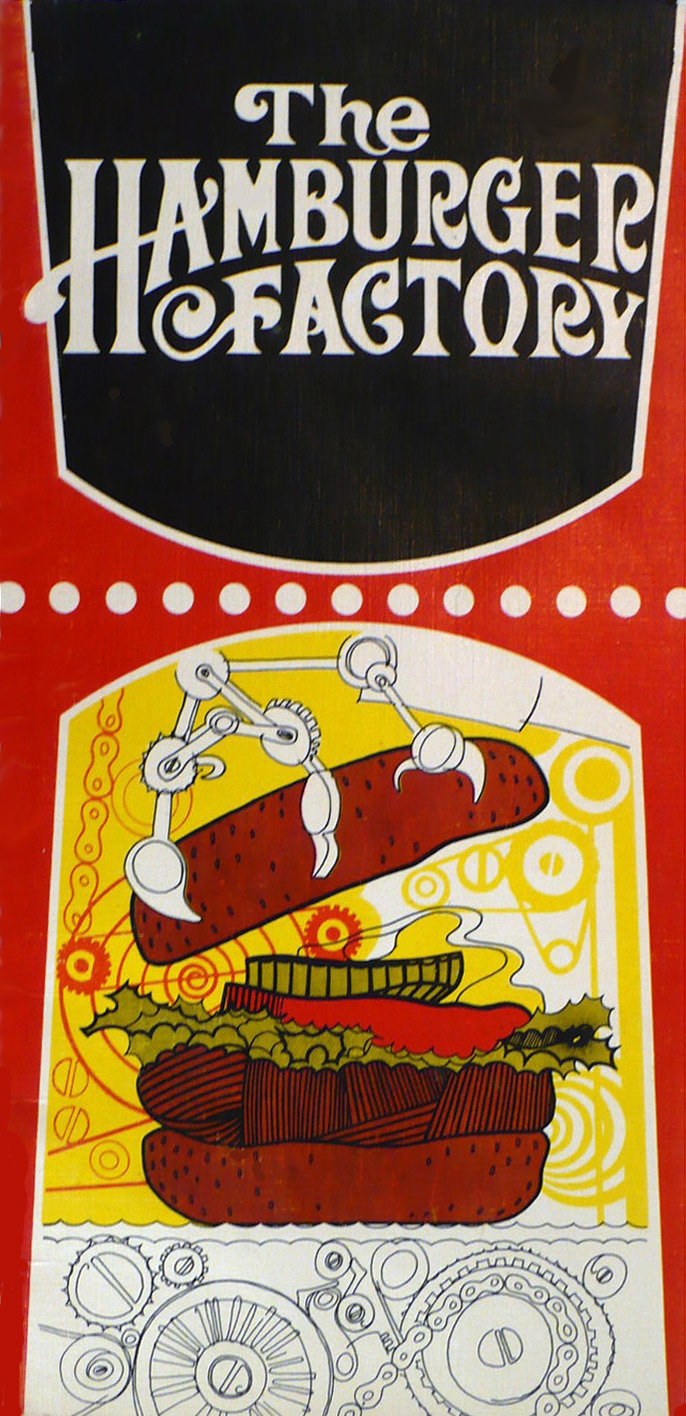
HamburgerFactoryAlong with the chains and a shortage of (cheap) kitchen help, came an upsurge in restaurants’ use of convenience foods and microwaves. In response, municipalities across the country enacted ordinances to protect consumers against false claims on menus, many of them centering on misuse of the words “fresh” and “home-made.”

Yet as the country was swamped with fast food, it experienced the flowering of restaurants specializing in ethnic, artisanal, and natural foods. Hippie and feminist restaurants stressed honest, peasant-style meals. Burgeoning interest in nutrition made salad bars popular. Bean sprouts, zucchini, and more fish showed up on menus. Diners learned that Chinese food was not limited to Cantonese, but might also be Mandarin, Szechuan, or Hunan. Once languishing behind luxurious decor, impeccable service, and famous patrons, food took center stage in deluxe restaurants as they purged Beef Wellington from their repertoire and took up the call for culinary creativity and authenticity.

Though not unknown in earlier decades, the restaurant-as-entertainment-venue came into full flourish with the proliferation of theme restaurants with unbearably cute names such as Orville Bean’s Flying Machine & Fixit Shop. To supplement a shrinking supply of old stained glass windows, telephone booths, and barber chairs, restaurant fixture companies began to manufacture reproduction antiques.

However crazy and mixed up the foodscape, America had become the land of restaurants for every taste and pocketbook.

Highlights

ChezPanissecookbook1971 – In Berkeley CA Alice Waters and friends found Chez Panisse, marking the movement of college and graduate students into the restaurant field, a career choice which is beginning to have cachet.

1972 – NYC’s Le Pavillon, considered the finest French restaurant in the U.S., closes. In Kansas City MO the first Houlihan’s Old Place, adorned with nostalgia-inducing decorative touches, opens, as does Mollie Katzen’s natural-food Moosewood Restaurant in Ithaca NY.

1972 –Dry since 1855, Evanston IL, home of the Women’s Christian Temperance Union, grants liquor licenses to two hotels and six restaurants. Their business doubles in a few months.

1973 – Los Angeles County becomes the first jurisdiction in the country to enact a “truth in menu” ordinance. During the pilot program, the scenic Sea Lion Restaurant in Malibu is caught selling the same fish under five different names with five different prices.

1974 – A Chicago food writer throws cold water on arguments about which restaurant has the best lasagne, asserting that the debaters “might have found that same lasagne in restaurants all over the country” courtesy of Invisible Chef, Armour, or Campbell’s.

1974 – Restaurateur Vincent Sardi spearheads a campaign to get New Yorkers to eat out, claiming that the city’s major restaurants have lost up to 20% of their business in the past two years, thus precipitating the closure of 20 leading restaurants.

1976 – The CEO of restaurant supplier Rykoff says whereas his company once supplied whole tomatoes it now provides diced tomatoes “because the operator just can’t afford to pay someone to cut them up.”

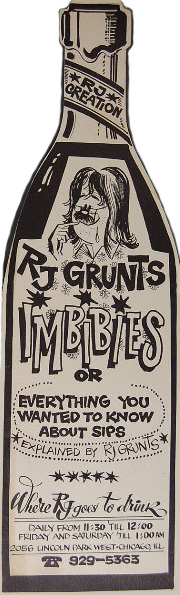
RjGrunts1970s1976 – Richard Melman’s Chicago restaurant company, Lettuce Entertain You Enterprises, operator of RJ Grunts, Great Gritzbe’s Flying Food Show, and Jonathan Livingston Seafood, opens Lawrence of Oregano and prepares to take over the flamboyant Pump Room.

1977 –Industry journal Restaurant Business publishes survey results showing that, on average, husband & wife pairs eat out twice a month, spend $14.75 plus tip, prefer casual restaurants, and tend to order before-dinner cocktails and dishes they don’t get at home. Measured by sales, Lincoln NE is one of the country’s leading cities for eating out.

1977 – Once characterized by blandness, San Diego now has restaurants specializing in cuisines from around the globe, an improvement one observer attributes in part to the new aerospace industry there.

1978 – A reviewer in Columbia MO complains, “A brick floor and pillars, old photos, Tiffany lamps, stained-glass windows and trim on the tops of the booths as well as revolving single-bladed, old-fashioned fans [is] a familiar type of decoration these days and I’m getting a little weary of the sameness of so many restaurants.”

1979 – As the year ends restaurant reviewer Phyllis Richman observes that more people are eating out than ever before, transforming once-lackluster Washington D.C. into “what is known as a Restaurant Town.”

Read about other decades: 1800 to 1810; 1810 to 1820; 1820 to 1830; 1860 to 1870; 1890 to 1900; 1900 to 1910; 1920 to 1930; 1930 to 1940; 1940 to 1950; 1950 to 1960; 1960 to 1970; 1980 to 1990

© Jan Whitaker, 2013

29 Comments

Filed under alternative restaurants, chain restaurants, food, patrons

Women’s restaurants

feministBreadandRosesBarbaraFried1976

Not all restaurants have been purely, or even mainly, commercial ventures. This was particularly true of women’s suffrage eating places and those of the 1970s feminist movement.

Although the women’s restaurants of these two periods were quite different in some ways, they shared a dedication to furthering women’s causes and giving women spaces of their own in which to eat meals, hold meetings, and in the 1970s, to enjoy music and poetry by women.

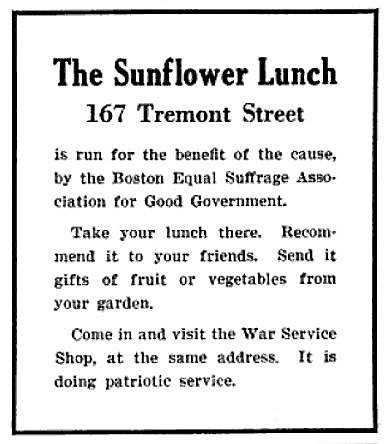
SuffrageLunchBoston1918In the 1910s most major U.S. cities had at least one suffrage restaurant, tea room, or lunch room sponsored by an organization such as the National American Woman Suffrage Association (NAWSA).

As was true of later feminist restaurants, those of the suffrage era tended to be small and undercapitalized. An exception was the suffrage restaurant financed by the wealthy socialite Alva Belmont in NYC. In terms of patronage, it was almost certainly the most successful women’s restaurant of either era. It reportedly served 900 meals per day from a low-priced menu on which most items were 5 or 10 cents and consisted of soup, fish cakes, baked beans, and home-made pie.

Suffrage restaurants admitted men and welcomed the opportunity to ply them with leaflets and home-made soups, salads, and fritters that would incline them to support the cause. An aged Philadelphia activist recalled in 1988, “I worked at a suffrage tea room. We lured men in, for a good, cheap business lunch. Then you could hand them literature and talk.” In the NYC restaurant operated by NAWSA in 1911, it was impossible to ignore the suffrage issue since every dish, glass, and napkin bore script saying Votes for Women.

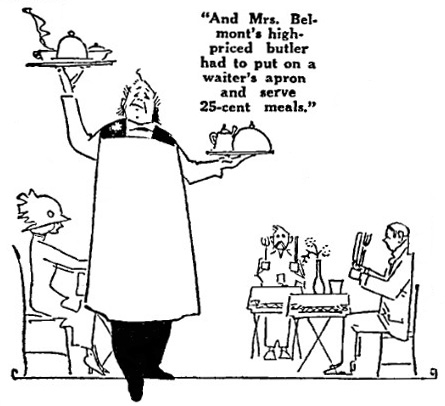
suffrageRestaurant1912Though dedicated to women’s causes, women’s restaurants were not free of conflict. Many suffragists objected to how Alva Belmont ruled with an iron fist, brusquely ordering servers around until they walked out on strike, followed by the dishwashers. Belmont was ridiculed when she brought in her butler and footman to fill the gap. Her footman quit too. Some feminist restaurants experienced discord over cooperative management and, especially, whether or not to serve men.

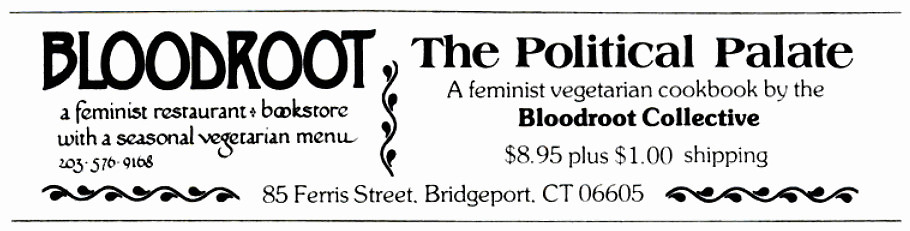
The first feminist restaurant, NYC’s Mother Courage, was founded in April of 1972. (Its co-founder Dolores Alexander discussed it in 2004-2005 interviews.) Others established in the 1970s included Susan B. Restaurant, Chicago; Bread & Roses, Cambridge MA; The Brick Hut, Berkeley CA; Los Angeles Women’s Saloon and Parlor, Hollywood CA; and Bloodroot, Bridgeport CT). Undoubtedly there were more, especially in college towns like Eugene OR and Iowa City IA. In the 1980s a number of women’s coffeehouses appeared, but they were performance spaces more than eating places.

FeministBloodroot1981

As part of the counterculture, 1970s feminist restaurants typically aimed at a broad set of goals. Women’s equal position in society was paramount but it was embedded in a project of establishing a more peaceful and egalitarian world. Feminist restaurants rotated jobs and paid everyone the same wages. They raised capital by small donations from friends. Staffs were entirely female and women also did most of the renovating. Their decor was spare, with exposed brick walls, mismatched furniture, and chalkboard menus. They served simple peasant-style food, usually prepared from scratch. Some served wine and beer. More often than not menus were vegetarian, or at least beef-less. The L. A. Women’s Saloon and Parlor supported farm workers and would not serve grapes or lettuce. The Brick Hut boycotted Florida orange juice during the anti-gay campaign of spokesperson Anita Bryant. The Women’s Saloon avoided diet plates and sodas, deeming them insulting to large-sized women.

Many proponents of feminist restaurants felt that women were often treated poorly in restaurants, many of which regarded men as their prime customers. Feminist restaurants made a point of  presenting women dining with men with the check and wine to sample. But for many women patrons, perhaps especially lesbians, the enjoyment of a non-hostile space was more significant.

At some point each feminist restaurant confronted the touchy question of whether they would serve men. Considerable acrimony erupted around this question at the Susan B. Restaurant in Chicago and Bread & Roses in Cambridge, resulting in the former restaurant’s closure after only a few months. At Bread & Roses a co-founder exercised non-consensus managerial power and fired a server who made men and some heterosexual women feel unwelcome, setting off rounds of group meetings. The restaurant, opened in 1974, was put up for sale and in 1978 became the short-lived “women only” Amaranth restaurant and performance space.

Today Bloodroot may be the sole survivor of the feminist restaurant era.

© Jan Whitaker, 2013

8 Comments

Filed under alternative restaurants, patrons, women

Co-operative restaurant-ing

Although it is a footnote to restaurant history, the notion that restaurants could provide a solution to social and domestic problems is one that has cropped up quite a few times in American history, beginning in the 1840s, continuing into the 1970s, and not totally extinct even today.

The idea of community dining began with Frenchman Charles Fourier’s plan for a society organized into communes (phalanxes) where people both lived and worked. Several were established in the United States in the 1840s and 1850s, in Ohio, Texas, Wisconsin, New York, and New Jersey. The North American Phalanx in Red Bank NJ, which continued for 12 years, may have been the longest lasting. Its phalanstery, a kind of hotel or apartment building, had 85 rooms and a “refectory” where members gathered at long tables and chose their meals from a bill of fare with prices.

The Fourier-inspired communes did not survive, but the idea of collective dining did. From the 1870s until World War I feminists saw commercial restaurants as the next, virtually inevitable, step in evolutionary progress that would liberate women from kitchens. Suffragist Tennessee Claflin observed in 1871 that women’s chores such as teaching children and making clothes were leaving the home and becoming special trades. Noting that men were becoming accustomed to eating their midday meal in restaurants, she expected food preparation to be next.

Others observed the same thing, especially with the growing popularity of kitchenless apartments. An 1876 article in The American Socialist viewed NYC apartment buildings where meals were served in ground floor dining rooms as an outgrowth of Fourier’s ideals. Although limited to fairly affluent families then, apartment living was regarded as a step toward universal cooperative housekeeping.

A goal of some futurists and feminists, such as Edward Bellamy and Helen Starrett, was to have complete meals delivered to the home ready to eat. Starrett wrote in 1889 that the solution need not be a non-profit enterprise. Rather, just as butter and soap making had been commercialized, she expected that the business world would find a way to do this profitably. Indeed, in Knoxville, Tennessee, a woman started a meal delivery service as early as 1896, sending out “steaming hot” food to families. The idea got a boost during World War I when a surging war economy drew hired cooks out of affluent households (e.g., Florence Hulling).

Author and social thinker Charlotte Perkins Gilman knew of three cooked food companies in operation, in New Haven, Pittsburgh, and Boston. She fully expected efficient restaurants and food services to replace the home as a site of production, which, she wrote in 1903, “lingers on inert and blind, like a clam in a horse-race.” In her 1909 novel What Diantha Did, the enterprising heroine not only runs a hotel for working women, she also operates a lunchroom for business men, a cooked food delivery service, and a mini-maid service.

Other than supporting utopian societies and liberating women from household chores, the goals of “public service” style restaurants in the 19th and 20th centuries also variously encompassed providing inexpensive lunches for young working women, luring alcoholics away from saloons, resolving labor strife, reducing the cost of living, and promoting healthy diets.

Social motives often lay behind the start of commercial restaurants also, such as the Dennett’s chain whose funding came in part from missionary societies. And some eating places that had their starts as community co-operatives developed into commercial ventures, such as the Hollister Cooperative Coffee Club or the Mission Cafeteria in Long Beach [shown], both in California.

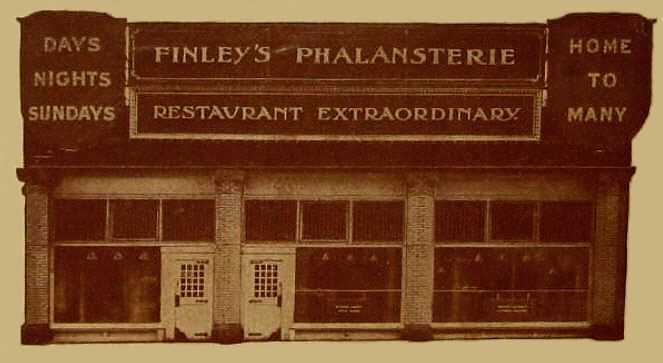
A curious outgrowth of the interest in communal dining occurred in Cleveland OH, where Richard Finley established Finley’s Phalansterie shortly after the turn of the century [pictured above]. Eventually he presided over six eating places in Cleveland and grew rich. Although he chose the generally unfamiliar name to pique interest in his restaurant, it turned out that he did in fact have communitarian motives in mind. His plan, reminiscent of Elbert Hubbard’s Roycroft in East Aurora NY, was to establish a colony in California where workers would live and produce arts and crafts furniture and objects. I was unable to discover how far he succeeded beyond building a hotel and cottages in La Canyada and publishing a magazine called Everyman.

The story of restaurants and eating places with social motives is not complete without mentioning the hippie and communal restaurants of the 1960s and 1970s – but that will be another chapter.

© Jan Whitaker, 2012

17 Comments

Filed under alternative restaurants, Offbeat places

The Craftsman, a model restaurant

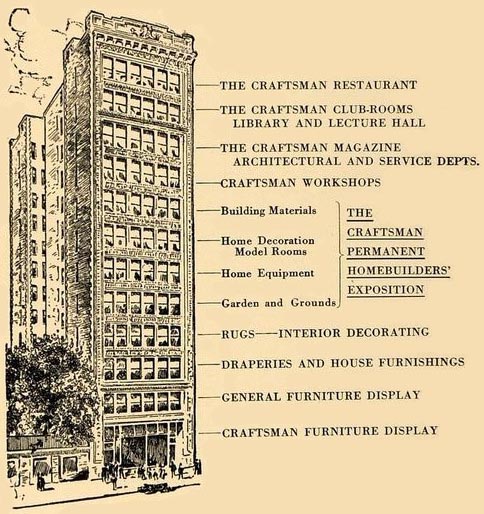
The restaurant operated by Gustav Stickley on the 12th floor of his retail house furnishings store on 39th street in NYC was a brave but brief experiment in pure food, sanitation, and “progressive living.” It opened in May of 1913 and was out of business a few months short of three years later when the entire retail business failed.

The restaurant’s ability to attract patronage was undoubtedly limited since it was intended to appeal to the same people who admired Arts & Crafts furniture and house fixtures. This did not include most Americans, particularly new immigrants who populated big cities such as New York. Additionally, restaurants located in stores, even big department stores which can attract hordes of shoppers each day, typically lose money.

The restaurant followed the same aesthetic, both in its decor and its approach to food preparation, that defined the Craftsman Workshop’s project generally. The Workshop’s ambitions were captured in the motto which appeared on furniture labels and the restaurant’s china: “Als ik kan.” In its quaint Dutch formulation, it was a pledge to do one’s very best work.

When applied to food this meant pure and fresh ingredients straight from the source, simply prepared by cooks using modern appliances in a pleasant work environment, and consumed slowly in a restful setting. “Style,”whether in house furnishings or a meal, was supposed to emerge organically from an honest approach to materials and workmanship. A 1910 article in the influential Stickley publication The Craftsman identified a type of ideal restaurant, the down-to-earth “marketman’s” café (such as New York’s Smith & McNell or Boston’s Durgin-Park) which used fresh fruit, vegetables, fish, and fowl that had never seen the inside of a factory or cold-storage warehouse.

Provisions such as eggs, dairy products, vegetables, and spring water served for lunch[eon], teatime, and dinner at the Craftsman Restaurant were trucked in daily from Stickley’s 600-acre Craftsman Farms in Morris Plains NJ. As food reformer and “real food” proponent Alfred W. McCann argued, the restaurant was a model for the entire industry. “The legalized chemical preservatives, chemical bleachers, chemical glazes, chemical flavors, inert fillers and extenders, coal tar dyes and grossly impoverished foods, however popular, can find no place on the Craftsman bill-of-fare,” he wrote in 1915.

The Craftsman Restaurant was a haven for people of “good taste” wishing to avoid the show-off culture of champagne and loud music exemplified by lobster palaces and cabarets. It was the polar opposite of the garish Café de l’Opera, though ironically each in its own way was a spectacular failure. The Craftsman appealed to patrons such as well-to-do club women and college alumni groups. Shortly before it closed, the restaurant hosted Columbia University’s class of 1902. They enjoyed their dinner but were sorely disappointed to find out that the restaurant served no alcoholic beverages.

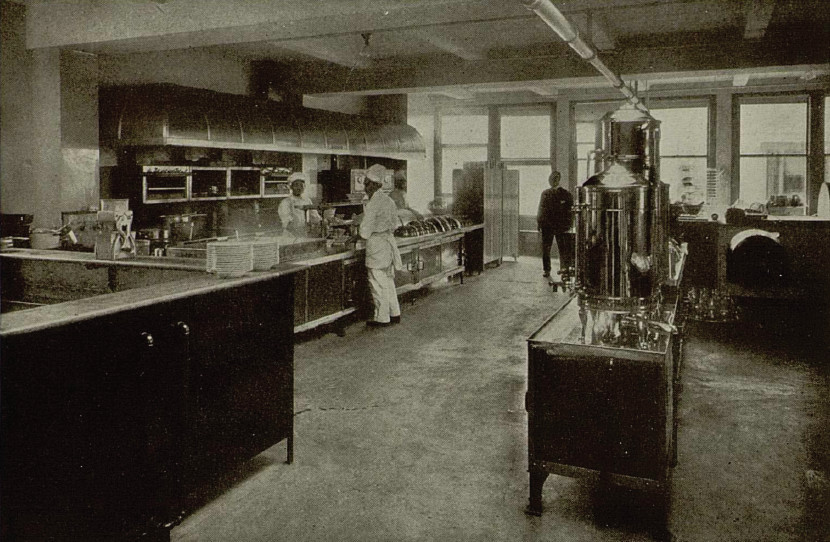
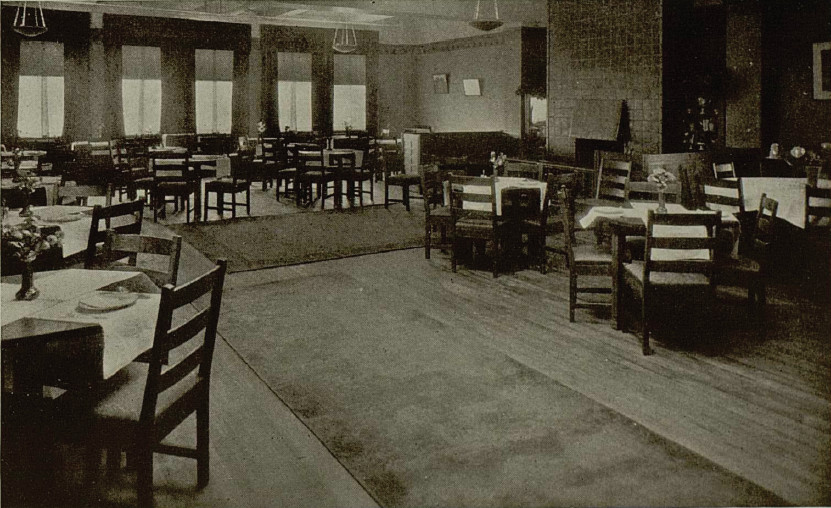
The dining room was decorated in earth tones: browns, deep reds, oatmeals, and creams. Plates, bowls, and cups were rimmed with a pinecone design. Bread was served in handmade willow baskets. The wood floor was mostly left bare while the tables were covered with criss-crossing Irish linen runners. A focal point of the room was a Germanic-looking hearth covered in Grueby tiles, with a hammered copper hood.

In keeping with the subdued decor, quiet and low-key service was accomplished by what one visitor described as “soft-treading little men of Nippon,” while stringed instruments softly played “something familiar from Grieg or [Edward] MacDowell.” This was most definitely not a restaurant for rowdies.

The store and restaurant closed early in 1916. In August the entire stock of the Craftsman Workshops store was sold at Gimbels Department Store at reductions of 35% to 50%.

© Jan Whitaker, 2011

7 Comments

Filed under alternative restaurants

Famous in its day: the Aware Inn

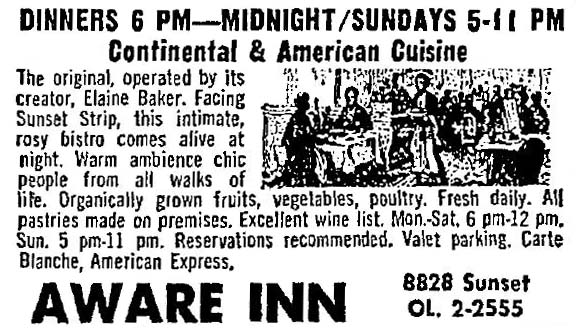
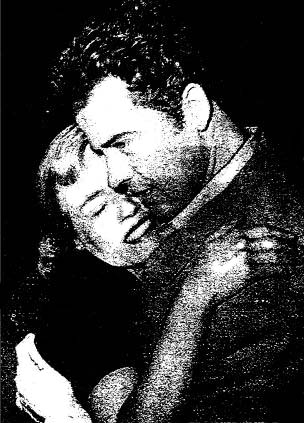
Whether or not it was the first organic restaurant of the post-WWII era, it is clear that Los Angeles’ Aware Inn significantly predated the late ’60s beginnings of the natural food movement in restaurants. When Jim and Elaine Baker (pictured below in 1955) opened it in 1957 they were dedicated to providing meals using fruits, vegetables, and meats produced without pesticides, artificial fertilizers, and hormones.

Jim Baker, a decorated WWII marine who trained soldiers in jujitsu during the war, came to southern California in 1951 to audition for Tarzan movies. When his film career failed to materialize, he joined the Nature Boys, a small cult of body-building health devotees who ate organic foods. Over the next two decades, he transferred his knowledge of organic food and cooking to a number of Los Angeles restaurants that he and Elaine started, including two Aware Inns, The Old World, and The Source.

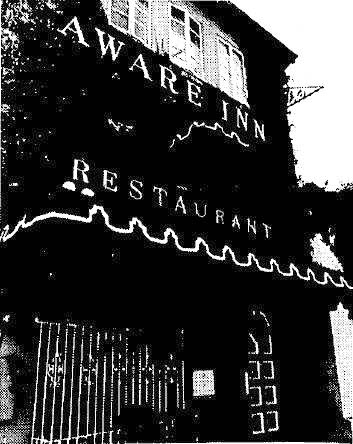
Soon after its opening, the original Aware Inn, at 8828 Sunset Boulevard on the Strip (shown above ca. 1981), became a magnet for Hollywood stars concerned with their health and beauty. Although the menu at the Aware Inn was organic it was pretty standard in other regards. True, it included fresh-squeezed carrot juice and brown rice, but the menu was also filled with organic versions of popular dishes such as burgers, beef stroganoff, and veal Marsala. Baker insisted in 1959 that he was no extremist. He aimed to serve “well rounded meals, but without the fats, carbohydrates and adulterants that you get in most restaurant food.” However in 1969, after his divorce from Elaine, he established The Source, a vegetarian restaurant where raw foods were served almost exclusively.

The Inn’s most famous dish was a hamburger interestingly named “The Swinger” which combined ground beef with cheese and chopped vegetables (see Recipe page). What inspired the name is uncertain but Jim was notably attractive to women. He reciprocated. It was at an apartment above the Aware Inn where in 1963 an irate husband came for revenge. A black belt in judo, Jim disabled his attacker, then used his foe’s gun to kill him (marking the second time he had killed a man in a dispute). His amorous career was just beginning – at the time of his hang-gliding death in 1975 Jim lived in Hawaii with 13 young women.

Following the divorce, Elaine carried on at the Aware Inn on Sunset (the second Aware Inn, in Sherman Oaks, had been sold to Al Kaiser in 1961). She kept the restaurant’s organic foods emphasis but cultivated the flavor of a European café rather than following Jim’s path at The Source which would lead him to develop a cult following and start a commune. A 1969 restaurant review praised the Aware Inn for dishes that were “consistently good and sometimes superb.” In addition to the Swinger, some of the restaurant’s signature items were chicken molé, roast brisket and kasha, and, for dessert, créme de Cassis over blueberry ice cream.

By 1970 the Aware Inn was one of a growing number of health food restaurants thriving in Los Angeles, but at the end of the decade it was getting poor reviews and went up for sale. In 1981 it was rechristened La Petite Maison. Later it became Rama Garden, a Thai restaurant.

© Jan Whitaker, 2011

48 Comments

Filed under alternative restaurants, proprietors & careers

“Way out” coffeehouses

greenspiderA345What could be more starkly different from the somber coffee shops of today with their earnest and wired denizens than the beatnik coffeehouses of the 1950s? Could Starbucks be anything but square to the beat generation?

The classic coffeehouses of the beatnik era were sites for conversation, poetry readings, folk music, improvisational jazz, stand-up comedy à la Mort Sahl, and experimental theater. In an era driven by the conformist quest for success and button-down normalcy they sheltered misfits, art, and European culture in settings decorated in moody “opium-den style” or stained-glass/marble/wrought iron “junkyard posh” assembled from the detritus of American cities then being dismantled.

Along with beats, coffeehouses were attractive to teens as well as curiosity seekers and wannabees. (See Dupo IL high school coffeehouse photo.) Authorities had an almost obsessive dislike of coffeehouses and their patrons. Even church basement coffeehouses came under attack. A John Birch Society member lectured youths at a YMCA coffeehouse in a Chicago suburb about how dissolute their gathering place was (“You can’t tell the difference between boys and girls”).

dupoIL1962HSAlthough the word beatnik came into usage around 1958 (inspired partly by Sputnik), the phenomenon of dropping out of the “rat race” to lead an existentialist, non-consumerist life was part of the aftermath of World War II akin to the “Lost Generation” after World War I. The first coffeehouses sprang up in Greenwich Village in the late 1940s, but the beats weren’t averse to hanging out in cafeterias either — their “Paris sidewalk restaurant thing of the time.” When coffeehouses began levying cover charges for performances, beatniks tended to drop out of them too.

bizarre1958The heyday of the coffeehouse was the late 1950s into the early 1960s. Few did much cooking so they weren’t restaurants in the true sense, but many of them offered light food such as salami sandwiches (on exotic Italian bread) and cheesecake, along with “Espresso Romano,” the most expensive coffee ever seen in the U.S. up til then. Of course the charge for coffee was more a rent payment than anything else since patrons sat around for hours while consuming very little. Other then-unfamiliar food offerings included cannolis at La Gabbia (The Birdcage) in Queens, Swiss cuisine at Alberto’s in Westwood CA, Irish stew at Coffee ’n’ Confusion in D.C., les fromages at Café Oblique in Chicago, “Suffering Bastard Sundaes” at The Bizarre in Greenwich Village, and snacks such as chocolate-covered ants and caterpillars at the Green Spider in Denver.
Coffeehouses went in for oddball names such as above and also the Hungry i in San Francisco, Cosmo Alley in Hollywood, Fickle Pickle and College of Complexes in Chicago, The Cup of Socrates in Detroit, Café Wha in Greenwich Village, House of Fencing Masters in New Orleans, Laughing Buddha in St. Louis’s Gaslight Square, and Café Mediterraneum in Berkeley.

© Jan Whitaker, 2009

54 Comments

Filed under alternative restaurants, Offbeat places

“Eating healthy”

Restaurants (and their critics) have often shown concern with patrons’ health, but the focus of concern has varied widely in different eras.

In the 18th century the idea that restaurants had a mission to restore health came to this country from France. The legend spread that a Frenchman named Boulanger invented the first restaurant, hanging out a signboard stating “I will restore you.” Whether or not this actually occurred — or whether he was “the first” — it is true that early restaurants in France promised to provide healthful dishes. The mission migrated to America as chefs arrived after the French revolution. When Julien’s opened in Boston the proprietor vowed to supply the infirm, convalescent, and weak with “nourishing” soups and broths, including turtle soups which, he advertised, would purify the blood.

But the early French “restorators” were voices shouting in the wilderness. For most of the next two centuries Americans believed their health depended on eating meat and lots of it. In the latter 19th century and into the 20th, concern shifted to unsanitary conditions in restaurants as health departments were created, ordinances established, and inspectors dispatched.

The vegetarian restaurants of the early 20th century demonstrated a renewed interest in healthy diets. Meat substitutes produced by the Kelloggs of the Battle Creek Sanitarium appeared on their tables, although breakfast cereals, whose popularity was aided by restaurant promotions, were undoubtedly the most successful of all health food products.

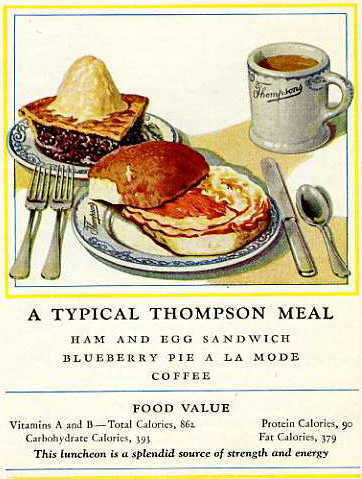
The food conservation guidelines of World War I lightened diets, with less meat and more vegetables on restaurant menus, as well as spreading knowledge of nutrition. A few chains, such as J. R. Thompson and Childs, provided vitamin and calorie counts in the 1920s. But the public was not too receptive. Stockholders booted out William Childs after he gained control of the mighty lunchroom corporation and removed meat from its menus, causing sales to plunge drastically.

After a prolonged beef-eating revival following the end of WWII rationing, health-conscious restaurants made a comeback as part of a counterculture critique of industrialized food. The “holy war against adulterated foods and french-fried, frozen, super sugar wastelands,” reported Mary Reinholz in the Los Angeles Times in 1971, had produced at least 25 organic restaurants in southern California, including H.E.L.P., Aware Inn, The Source, and Nucleus Nuance which served “evolution burgers,” “Virgo vege-loaves,” and carob mousse. One Los Angeles counterculture restaurant favorite, carrot cake, crossed over onto mainstream menus.

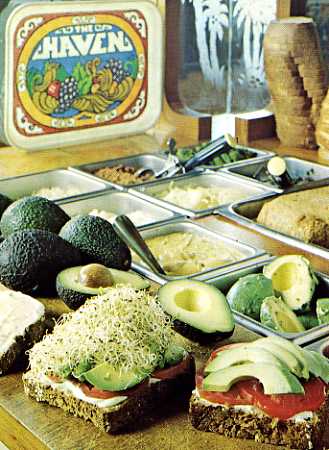
Natural food eating places, such as St. Louis’s Sunshine Inn, Long Island’s Shamballah Gardens, the Haven in Honolulu, Homeward Bound in Flagstaff, and Mary’s Natural Food Restaurant in Denton TX, to name but a few, soon spread throughout much of the country, laying the groundwork for the restaurant revival of the 1980s.

© Jan Whitaker, 2008

24 Comments

Filed under alternative restaurants, food, restorators