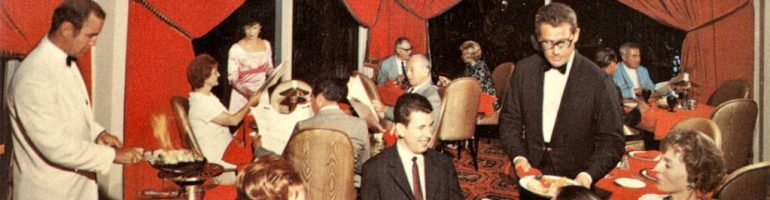
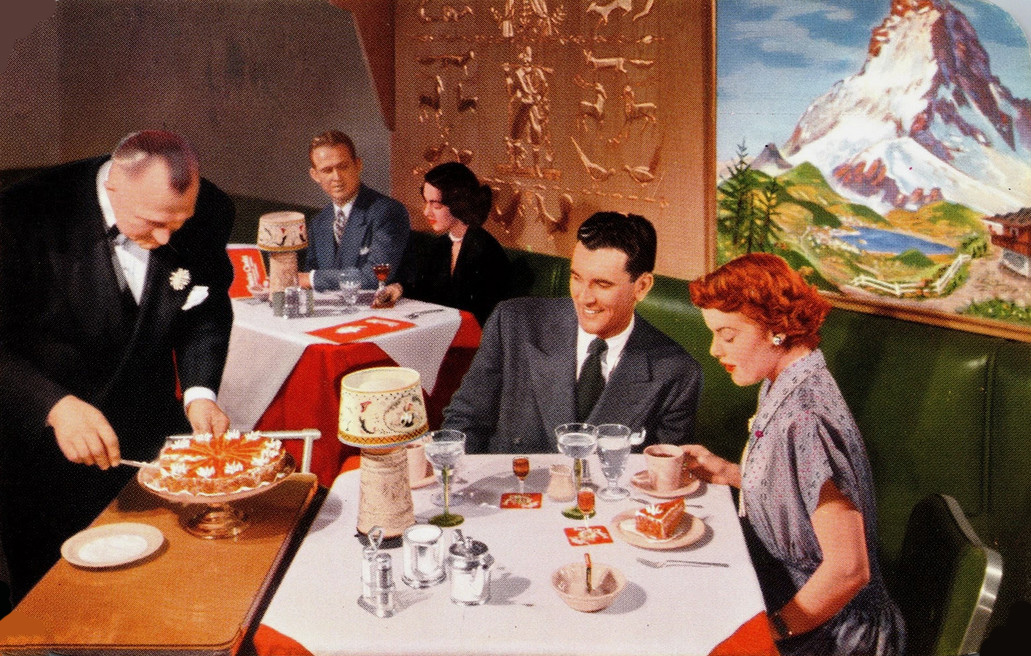
A few years back I published a post called “tableside theater” that looked at cooking performances at guests’ tables in restaurants. This sort of dining room drama occurred mainly in restaurants that wanted to give a sense of luxury that justified a higher price than the meal might otherwise command. [Above: Hotel Bismarck, Chicago]
Another aspect of restaurant theater, usually less dramatic, but also certain to draw attention and oohs and aahs from patrons was the use of carts for ready-to-eat food, usually desserts.
The trend toward tableside food preparation and dessert carts came along mainly after World War II. It is not hard to imagine how restaurant goers then might have longed for normalcy and entertainment.
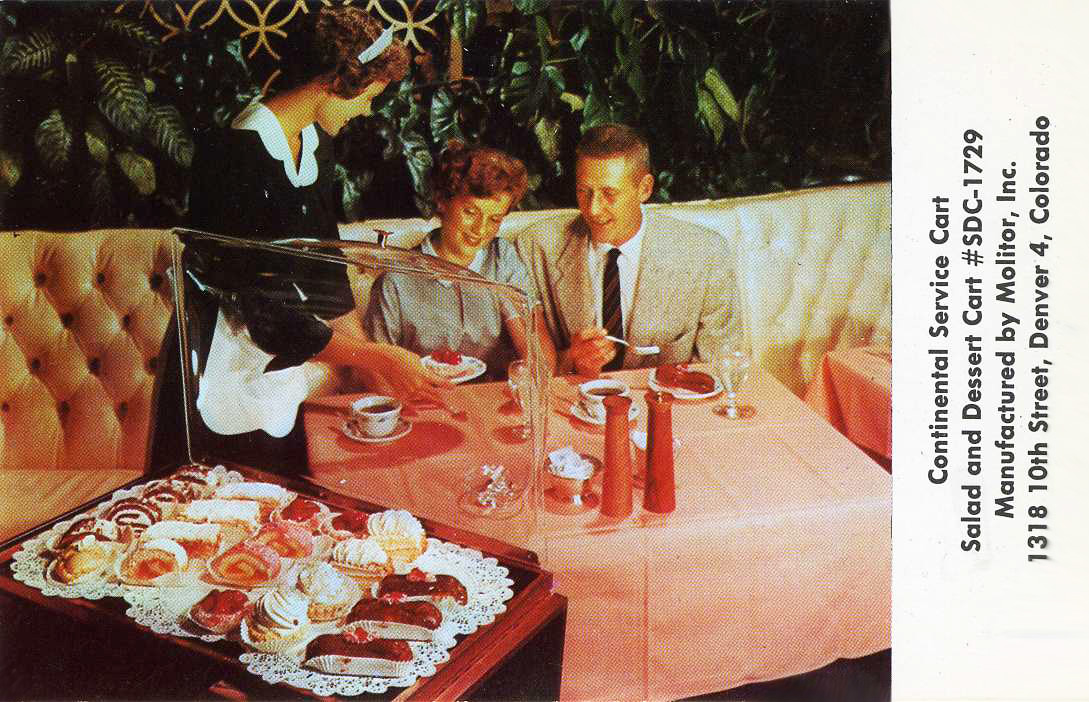
The 1950s is seen as the pinnacle decade of rolling carts of all kinds as well as tableside flambéing. Although carts with ready-to-eat desserts were likely to be found in a wider assortment of restaurants than those that provided tableside preparation, they too delighted guests. And the carts also enabled restaurants to boost demand for desserts. As the back of the postcard shown here notes, “Actual figures show customers buy more high profit desserts when Continental Carts are used to move them.” [The plastic cover of the cart shown above is not very elegant, but it was a practical way of keeping desserts from drying out.]
In Cleveland OH, the Taylor department store, inspired by New York and Europe, introduced rolling carts with salads, cold entrees, and desserts in 1950, in a space that had earlier been a cafeteria. Dessert carts were often used in department store restaurants. Chicago’s Marshall Field’s was not far behind, nor was the restaurant in Oakland CA’s airport. Pastry carts were also used at the Arnoldton, the restaurant in Trenton NJ’s Arnold Constable store.
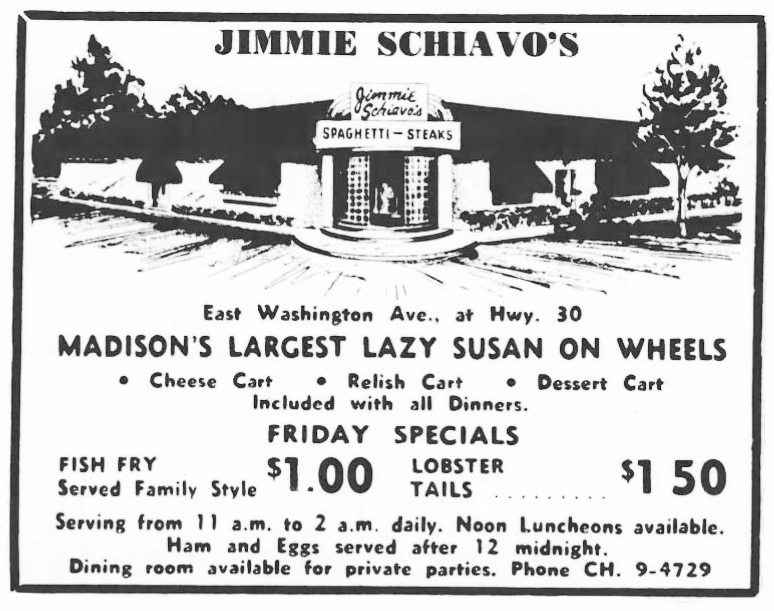
In some restaurants the dessert carts held a variety of after-dinner items including some that are unfamiliar to me. Jimmie Shiavo’s in Madison WI, which had cheese and relish carts in addition to dessert carts, offered desserts such as Italian cookies, a fresh fruit bowl, roasted pumpkin or sunflower seeds, mints, candied fruit, roasted ceci (chickpeas seasoned with spices) and “St. John’s bread” (carob bean pods). St. John’s bread turned up again at Club El Bianco in Chicago, where carts contained olives, St. John’s bread, cheese, peppers, fruits, and nuts, though whether they were all intended as desserts and grouped on the same cart is unclear.
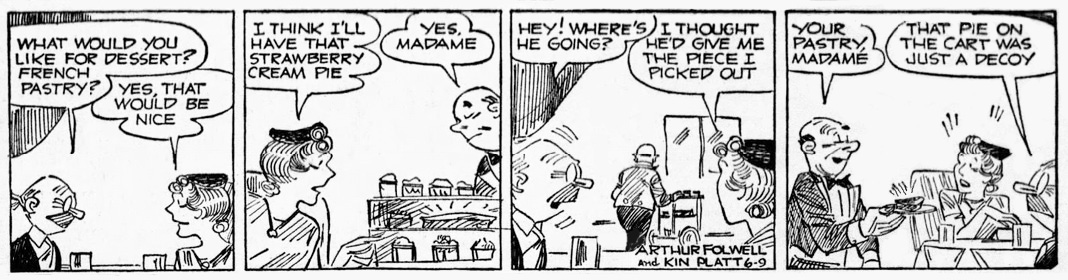
That dessert carts sell more desserts than would otherwise be the case seems to derive from their visual presentation, which is more powerful than a menu description. So it seems strange to me that carts would have items such as seeds, nuts, cheese, or other items such as those at Jimmie Shiavo’s since their appeal is not based on their looks. [The 1947 comic strip above suggests that sometimes carts were for display rather than serving.]
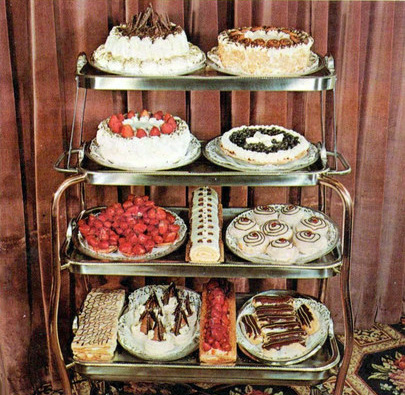
Tableside food presentation did not end in the 1950s, but continued through the 1960s and into the 1990s, though I have the impression it was fading by the late 1980s.
An example of a restaurant that eliminated tableside drama in the 1980s was The Buckingham Inn of Lima OH. Through the 1960s, 1970s, and much of the 1980s it specialized in luxury symbolism. Despite also operating an adjoining place called the Peanut Barrel that offered beer, pizza, and sing-alongs, it appeared to be an old English Inn adorned with knights’ armor and deadly weapons such as a truncheon and a lance. Steaks were the popular fare, but a pastry cart offered chocolate, lemon, and cocoanut cakes three inches high.
In 1986, as the Buckingham Inn’s owner made plans to replace the inn with a more casual family-style restaurant on the site, the pastry cart was auctioned along with the crystal chandeliers.
© Jan Whitaker, 2026

 It's great to hear from readers and I take time to answer queries. I can't always find what you are looking for, but I do appreciate getting thank yous no matter what the outcome.
 Restaurant-ing through history
Hi Jan, Your blog brought a couple things to mind, When we traveled with kids, we found that it was much more economical and less wasteful if we went to a cafeteria. There the children could pick out what they wanted based on sight! Denise could almost always count on macaroni and cheese, which may not be on a restaurant menu. Of course, getting by the dessert section could be a challenge, and often it was FIRST! Also here in Sioux Falls, there are still two restaurants chain that display baked items and desserts, “The Cracked Pot” and “Perkins” The Cracked Pot is the only place that I know of that a person can get sour cream raisin pie! Joan
Years ago we stayed at the Hotel Alhambra Palace in Granada Spain, and my wife ordered a Manhattan. They brought a cart and mixed her drink at our table! Anytime we’re presented with a salad cart or dessert cart, we remember the Manhattan cart in Granada. 😁
There is an old school restaurant in Las Vegas that still has the dessert cart as well as the rolling salad cart where the waiter makes your salad to order. They also still do a couple of tableside flaming desserts. It’s Hugo’s Cellar at the Four Queens in Downtown Vegas.
Hi Jan – What an interesting and enjoyable article!! Wonderful postcards!! I chose to do my undergrad in New York City, much to the horror and objections of my Midwestern parents. My father had a cousin who lived in Manhattan that he had been very close with many decades earlier. He contacted her and she and her husband met us for dinner in NYC. I remember it was a VERY fancy schmancy restaurant, and they were evidently regulars, as they were treated like royalty by the staff. At the end of the dinner, a stunningly beautiful young lady (who looked like a model!) came by the table with a dessert cart!! I thought that was so classy –and I still do, over 50 years later!
Best regards, Bob
That’s a great memory!
The dessert tray with sample desserts is still very popular. I assume because it sells desserts. The last places I saw with towering carts were in Las Vegas pre covid. I think covid did in a lot of tableside prep too. Though I did see it at an Italian restaurant in Chicago in 2021.
Carts are still somewhat common at dim sum restaurants, at least in San Diego.
I know they use carts but I wasn’t sure about dessert carts specifically.
Yes, the San Diego ones even seem to wait to bring carts of sweeter dim sum until after you’ve had some of the savory dim sum, despite the somewhat haphazard trajectory of the carts.