
In a talk he gave at the National Restaurant Association convention in 1965, restaurant designer Richard Kramer observed that “Eating and drinking are anxiety-evoking situations that reduce man’s independence and make him regress to a child-like dependency.” Going into a restaurant made him feel “angry because he is hungry and also dependent on someone else to feed him.”
I find it so interesting how he linked anxiety and anger, not to mention restaurants and anger.
He applied this mostly to men. By contrast, I would think most women then would have felt grateful and relaxed when going to a restaurant because someone else would be doing the cooking and clean up.
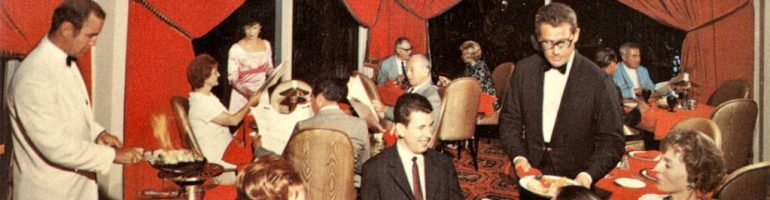
Kramer, who said he had studied psychology and psychotherapy, had a very successful career as a restaurant designer and founder of Integrated Design Associates in Los Angeles in the 1960s. The company continued in business long after he retired in the 1980s. IDA won 6 of 19 awards given by a national magazine in 1964, two of them for the restaurant El Gaucho in Beverly Hills’ Wilshire House [shown above].
In addition to El Gaucho, IDA’s clients included Hyatt Hotels, a couple of Playboy Clubs, the Balboa Bay Club, Chez Voltaire in the Beverly Hills Rodeo Hotel, the Little Corporal in Chicago, Quivira Inn in San Diego, Dobbs Houses at the Dallas/Fort Worth Airport, eating facilities in the Air Resort Hotel in Fresno and the Friendship International Airport in Baltimore, The Lodge of the Four Seasons in Missouri’s Ozarks, and a number of western Sirloin Pits.

After reading Kramer’s approach to design I could only wonder what his interiors looked like. Although I could find very few images of restaurants he designed, I noticed that he seemed to like to use the color red, a color that has been linked strongly to mid-century restaurants especially attractive to male diners. I was surprised when I saw the red interiors, mainly because I don’t see redness as soothing. But perhaps the role of red in restaurant decor was to suggest luxury more than to soothe an anxious, angry diner. [above: Chez Voltaire]
His observations were that people eating in restaurants “want to be taken care of in a basic psychological sense.” They choose restaurants that make them “feel secure.” But he was also aware that a restaurant had to present a sense of luxury if guests were to “enhance their status and bolster their egos.” He wrote that “The designers’ task was to find a balance between extravagant formality and boring familiarity.” Otherwise their interiors might fail to “activate a buying mood.” Another hazard was that the diner might decide that a restaurant served bad food, according to Kramer, who declared, “To any angry, anxious person, the best food can have no taste except bad.”
Who knew that the stakes in restaurant design were so high?
© Jan Whitaker, 2025

 It's great to hear from readers and I take time to answer queries. I can't always find what you are looking for, but I do appreciate getting thank yous no matter what the outcome.
 Restaurant-ing through history
Thank you for this fascinating posting. I worked in a lot of restaurants that followed Kramer’s designs and always wondered, why red? I think you are correct that men in the 1960s and 1970s saw red as a sign of luxury, aligned with strange “I Dream of Jeannie” fantasies. As you have noted before, the restaurants of this period were targeted primarily at men, and many of my male customers commented on how much they liked the plush red faux-leather seats and general “ambiance” (usually mispronounced) of our dark interiors. I do not miss those places. Michael
Psychological update: I am a kitchen and bar designer and often work with the interior designers, engaging in our usual “push/pull” of form versus function when it comes to the public spaces. With today’s competition in restaurants and clubs, once the particular demographic is identified, the interiors must evoke what is expected from the class and age group of the anticipated diner. Modern and airy with sustainable finishes for the millennial? Beachy yet classy for the retired wealthy? There are so many directions to go these days, now that dining out is not simply considered a man thing but an everyone thing.
Mise en Place Design-Florida
Interesting — Thanks for the update!
That red was everywhere from pizza parlors to higher end restaurants in my childhood. It was a real contrast from the popular tones in home decor, which trended more cool toned. It does read very masculine that I see it in this context.
Very interesting, especially as pre-dating the culinary and dining efflorescence that took root since the 1970s.
It’s my comment above Jan, forgot to log in. Adding also, I’m not sure red really plays either way in the end. At most I think it is family friendly as kids are said to like bold colours. Lots of chain restaurants did feature red or striped red and white back in that time.
Hi Jan — How very interesting!!The whole concept of “restaurant phobia”is new to me, and, frankly very bizzarro. I wonder how much the time period when he wrote his findings influenced his writings. The 1950’s-1960’s were definitely the Mad Men era when men were supposed to be hard working, hard drinking, and hard living. This persona would definitely have a sharp edge, a degree of built in aggressiveness and volatility. To me, dining out is a joy. Someone else cooks,serves,and cleans up and all I have to worry about is what I want to order! As always, your article was very stimulating and interesting! Thank you again. Best regards, Bob
PS The Bordello-like red interiors are something I remember in “fancy” restaurants from my childhood. Red is a hot, aggressive color, and to me suggests heated emotions rather than luxury. I wonder if Kramer leaned towards using red to reinforce the toxic masculinity of the day.
Now I’m curious if anyone has done a psychological update fifty years later?
Good question! I’m going to look around for what I can find.