Tag Archives: vegetarian restaurants

An early health food empire

It’s rare to find business documents from long-gone restaurants, but last weekend I stumbled upon two letters to investors from the Physical Culture Restaurant Company headed by fitness and health food advocate Bernarr Macfadden [shown above, age 42].

Macfadden was a body-builder, natural food proponent, and entrepreneur who decided to spread the gospel by opening inexpensive, largely plant-based restaurants at the turn of the last century. He attributed his strength and energy to this special diet.

The 1904 end-of-year letter reported that four new restaurants had been added to the ten already in business, and that they had done business totaling over $243,000, with a net gain of $2,637. Five restaurants had been judged failures and closed, four of them in NYC and one in Jersey City. He and his board of directors believed in rapidly shutting down locations that did not draw crowds. The letter blamed a “business depression” and the normally slow start of new locations for the smaller-than-hoped-for profits.

Although he wanted the restaurants to succeed, his personal income was not dependent upon them. Macfadden’s primary business was publishing periodicals, beginning in 1899 with Physical Culture, which discussed diet and health, followed by True Story, Liberty and then, increasingly, a large number of detective and romance magazines with titles such as Dream World, True Ghost Stories, and Photoplay. In addition he authored scores of books on fitness, sex, and health, and established a tabloid newspaper, The New York Evening Graphic. His publications earned him a fortune.

The total number of Macfadden restaurants open at the same time never seemed to exceed sixteen or so. The first ones were in New York City, of which there were nine at one point. Others were spread across the East and Midwest, including Boston, Newark, Jersey City, Philadelphia, Pittsburgh, Detroit, Cleveland, Cincinnati, Chicago, and St. Louis. There was also one in Toronto. [above: 1906 advertisement and 1906 restaurant at 106 E. 23rd, NYC]

In the 1907 letter to stockholders shown above he floated the idea that the restaurant holdings might grow to 40 or 50 units if stockholders invested in more stock. This never happened.

Despite the growing popularity of the restaurants, it seems that for Macfadden they served primarily as a way to spread the gospel of a healthful diet. He could not be described as a restaurateur. No doubt he helped to conceptualize the restaurants and make up the early menus, but he did not manage them except in his role as corporate executive.

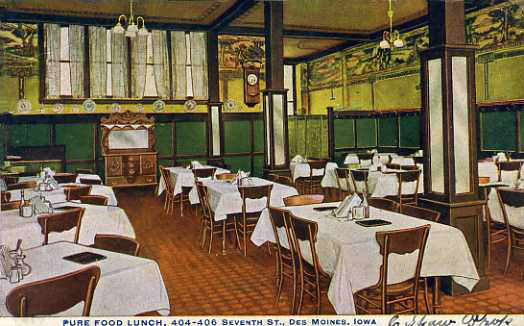
Prices were low in his early restaurants. A bowl of thick pea soup was 1c, as was a bowl of steamed hominy or oats or barley. Whole wheat bread and butter, however, cost 5c as did creamed beans or whole wheat date pudding. He sold loaves of whole wheat bread for 10c. [shown above]

A Macfadden menu shown in a 1919 British book reveals a wealth of choices then but also higher prices that reflect post WWI inflation. Five cents now bought less. Mushrooms on Toast cost 20c, as did meat substitutes Nuttose and Protose. A Macaroni Cutlet or Lentil Croquettes cost 25c, while omelets such as Mushroom, Walnut and Pecan, Orange, or Protose and Jelly were 30c.

In 1931, at which point only three Physical Culture restaurants remained, Macfadden gave up his fortune, said to be $5,000,000, and created the Bernarr Macfadden Foundation. In a radio broadcast he said: “It is a source of indescribable relief to feel like a free man again. Too much money unwisely used makes people greedy and ungrateful, destroys the home, steals your happiness, enslaves, enthralls you, lowers your vitality, and enfeebles your will.”

Yet his personal life continued to be full of numerous wives, affairs, and lawsuits. And, despite being “freed” of his fortune in 1931, he continued to spend money lavishly, taking it from the treasury of the Physical Culture Publishing Company after he turned that into a public corporation. Stockholders accused him of using nearly a million dollars for his own private interests, which included failed attempts to become a presidential candidate, governor of Florida, or mayor of New York.

In 1931 the Foundation opened the first of several Depression-era penny restaurants, no doubt modeled on Macfadden’s first restaurant at the beginning of the century where most dishes cost only one or a few cents. The initial Depression “pennyteria,” run by the Foundation, was located in midtown NYC. Drawing a crowd of about 6,000 a day, it quickly became self-supporting.

At a penny restaurant run by the Foundation, one cent would buy any of the following: coffee, split pea soup, navy bean soup, lentil soup, green pea soup, creamed cod fish on toast, raisin coffee, honey milk tea, cabbage and carrot salad, steamed cracked wheat, hominy grits, raisins and prunes, bread pudding, whole wheat doughnuts, whole wheat bread, or whole wheat raisin bread.

As the operator of the 1930s restaurants, the Foundation proved more flexible than Macfadden about dietary standards, but evidently he still had some say over what was served. According to one account he agreed to let meat appear on the menu as well as dairy products. Meat took the form of beef cakes, beef stew, and chicken fricassee. But he stood firm about bread, insisting only whole wheat be served.

I found no trace of the Macfadden restaurants nor the Foundation’s penny restaurants in the 1940s. Macfadden largely faded from the headlines, dying in 1955 and leaving an estate valued at only $5,000.

© Jan Whitaker, 2024
6 Comments

Filed under alternative restaurants, chain restaurants, menus, popular restaurants, proprietors & careers, restaurant prices

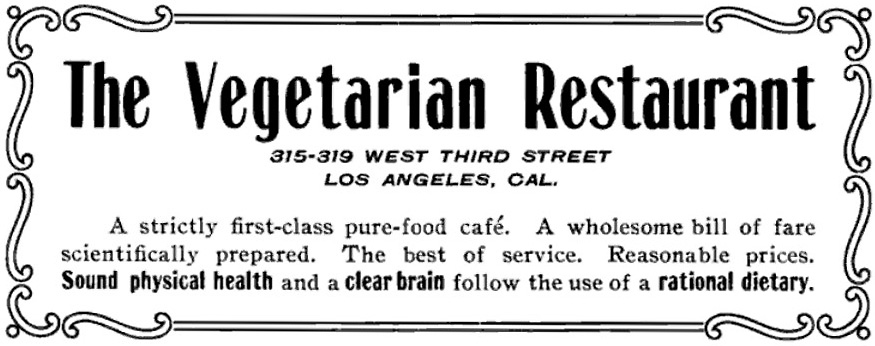
Early vegetarian restaurants

vegetarianpurefood880

As early as the 1830s in the U.S., the Graham Journal of Health and Longevity espoused a regimen called “Nature’s Bill of Fare.” It advocated meatless meals that contained no more than three different articles of food, and no desserts, condiments, or beverages except water. Diners were to eat at precisely the same time each day and chew very thoroughly. Needless to say, the “Grahamites” were very much at odds with the majority of Americans who expected to eat meat three times a day.

Some of the followers of Sylvester Graham lived in special boarding houses where no meat was served, but it wasn’t until the 1890s that the first public vegetarian restaurants appeared in this country.

The first was the well-named “Vegetarian Restaurant No. 1” opened on West 23rd Street in New York City in 1895. It was sponsored by the New-York Vegetarian Society, which did not tolerate either taking life for food or drinking alcohol.

One of the co-founders of No. 1 was its manager Louise Volkmann, a remarkable 50-year old German-born woman who was active in the women’s suffrage movement, the labor movement, and the peace movement, as well as being a music teacher and a volunteer in prisons and hospitals. However, not even such a force of nature as Louise could make the restaurant succeed. It closed due to insufficient patronage in less than a year.

vegetarianrestOutWest1902

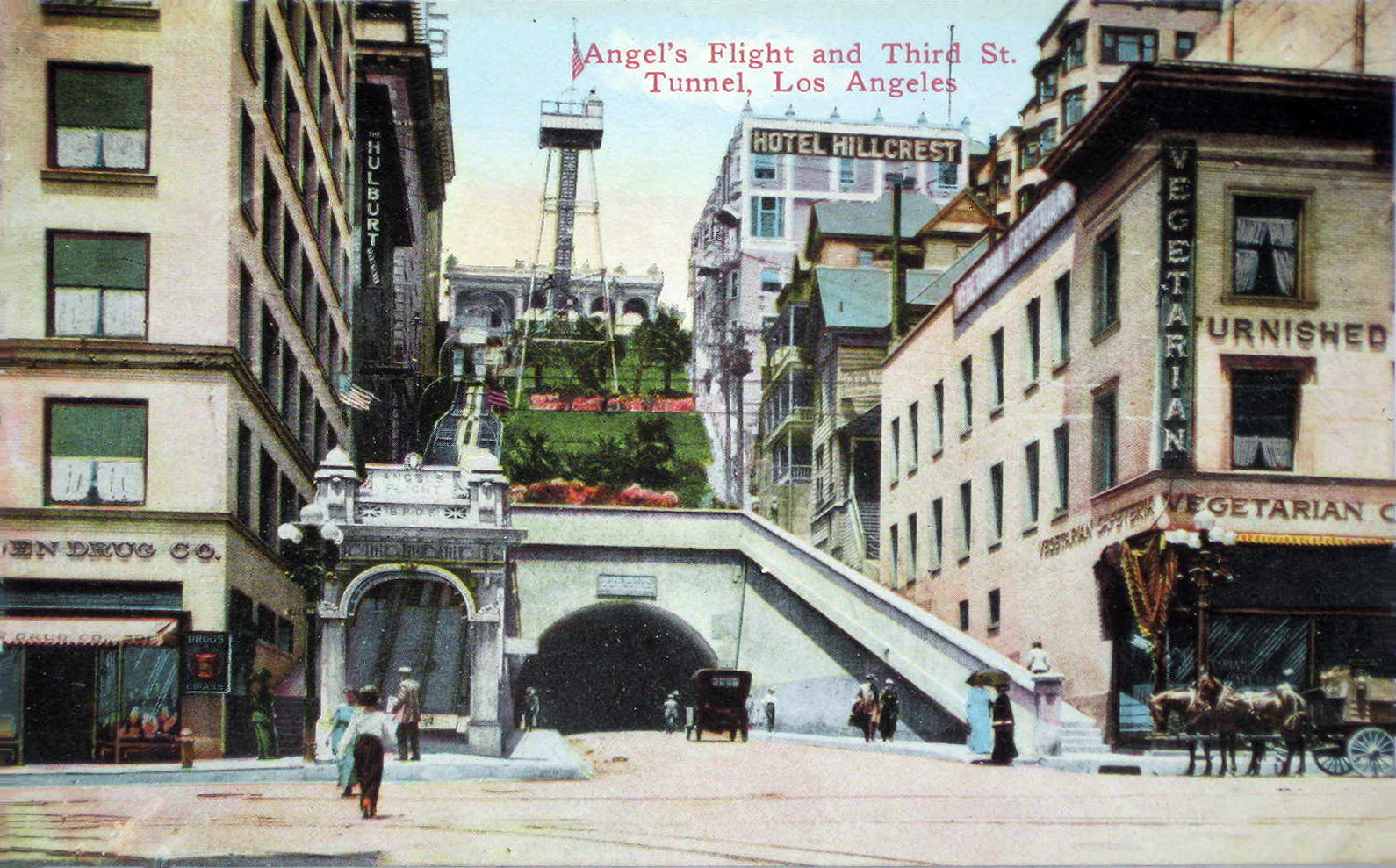
VegetarianCafeteriaLA

By 1899 a few more vegetarian restaurants had opened around the country. In Minneapolis a restaurant operated by two partners, Peterson and Mataumura, made the concession of supplementing the menu of Vegetable Turkey and a roast made of crushed nuts with a few meat dishes for non-vegetarians. Detroit and Boston also had restaurants catering to vegetarians, while San Jose actually had two, one of which also accommodated meat eaters. Detroit’s vegetarian café evidently was vegan; its macaroni was served with nut paste rather than cheese and its eggs were made of cereal or nuts and served boiled, curdled, or scrambled with lemon or, presumably fictitious, “cream.” [illustration of Los Angeles’ Vegetarian Cafeteria, ca. 1910]

Many of the early vegetarian restaurants served nut and grain-based food products – Granose, Nuttose, Wheatose, and others made by the Battle Creek Sanitarium Health Food Company in Michigan. Well-off people, not necessarily all vegetarians, would sign up for a stint at the Sanitarium to improve their health. A vegetarian dinner there in 1900 featured items with remarkably unattractive names such as Gruel, Dry Gluten, and Protose Salad.

vegetarian1912Cleveland

The vegetarian movement and its restaurants got a boost from rising meat prices and stockyard scandals shortly after the 20th century began. A 1904 directory listed 57 vegetarian restaurants nationwide, and the passage of the Pure Food and Drug Act in 1906 encouraged more to open. New customers mobbed vegetarian restaurants while eating places of all kinds added meatless dishes such as spaghetti and omelets to their fare, an exercise they would repeat under the austerity measures of World War I. Up to and during the war, vegetarian cafes flourished and chains began to form, such as the Physical Culture Restaurants in New York, with branches in Boston, Philadelphia, Pittsburgh, Buffalo, and Chicago. In addition to the Battle Creek connection, a number of pre-WWI vegetarian restaurants were connected to the Seventh-Day Adventist religion.

Often going under names such the Hygienic Restaurant or the Pure Food Restaurant, a typical vegetarian restaurant menu of 1902 or 1903 might have included selections such as these from Chicago’s Mortimer Pure Food restaurant:

Asparagus on toast, 15
Roosevelt [vegetable] cutlet, with mushroom sauce, bread and butter, 20
Poached eggs, with rice and currie sauce, bread and butter, 25
Spinach, with poached eggs on toast, 25
Broiled new potatoes on toast, 20
Spaghetti a la Mortimer, 10
Broiled fresh mushrooms on toast, 25
Baked beans, 10

Burl's1950sLA2How well vegetarian restaurants fared in the 1920s is unclear. The Childs restaurant chain, by then a public corporation, embraced vegetarianism briefly but changed its policy after its stock prices dropped in response. On the other hand, restaurant industry leader Myron Green, a Kansas City cafeteria proprietor, claimed in 1928, somewhat unbelievably, that meat eaters constituted less than 25% of food service patrons. In the early 1920s Los Angeles added two raw food restaurants and a Sephardic Kosher café to its list of meatless eating places. Also in this decade, a chain of vegetarian cafeterias appeared in the South, including one in Knoxville TN. In New York City Herman and Sadie Schildkraut operated a vegetarian hotel in the 1920s and by 1933 were directors of Schildkraut’s Vegetarian Food Emporiums, headquartered at 225 W. 36th.

Although meat rationing during World War II would bring back menus featuring vegetable plates, the vegetarian movement would not experience another boom until the counter-culture-inspired food revolution of the 1970s.

© Jan Whitaker, 2008, revised 2015

29 Comments

Filed under alternative restaurants, food

Serving the poor

Created with Nokia Smart Cam

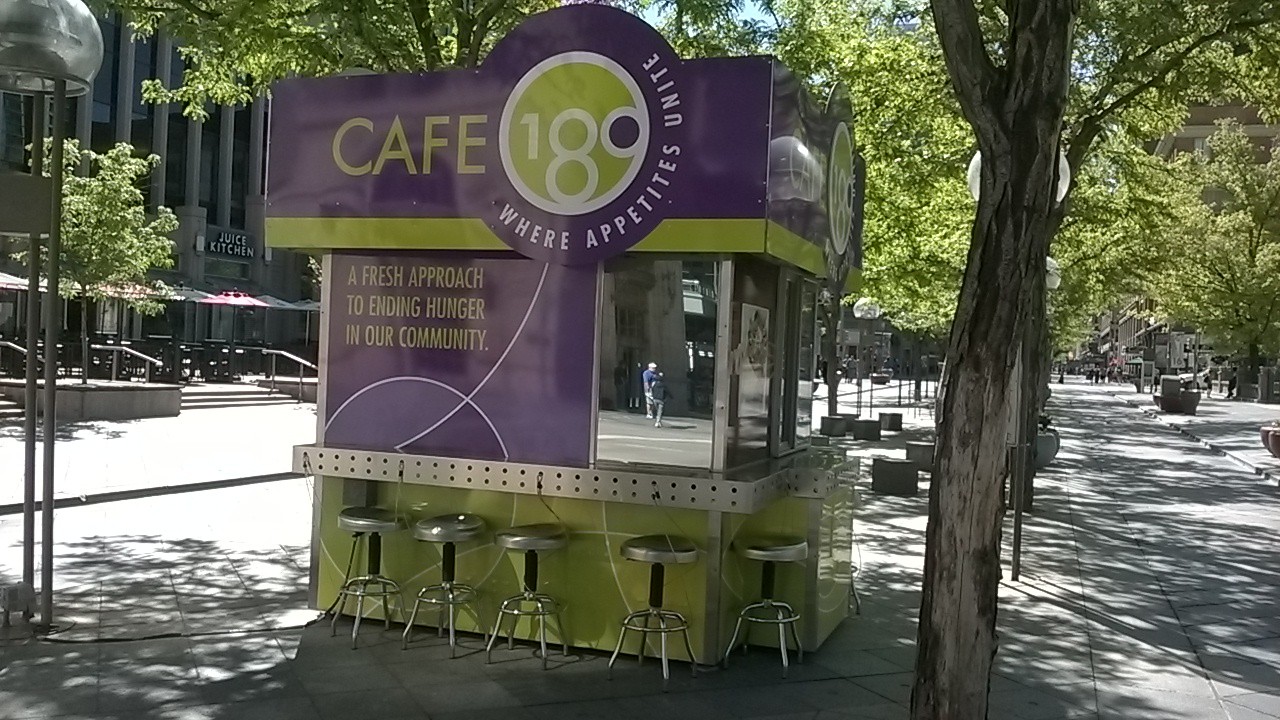
Recently, in Colorado Springs, I ate lunch at Seeds, a “community restaurant” devoted to making meals affordable to all. Guests are invited to pay what they can and, if that is nothing, to volunteer for an hour. A few days later, I saw another similar enterprise, Café 180, located on Denver’s outdoor 16th Street Mall.

It might seem like a new phenomenon but it’s more of an old idea with a new twist. Sellers of cooked food ranging from vendors with a cart all the way up to deluxe restaurants have long given away food to the needy.

In 1820 a French restaurateur in the City of Washington (D.C.) informed the public that he would sell the beef left over after being boiled for his special bouillon, while “to persons unable to pay it will be given gratis.”

John W. Farmer, a wealthy plumber, opened a Free Dining Saloon in New York City during the financial panic of 1857. After the first six months he announced he had served nearly 231,000 meals composed of dishes such as soup, corned beef, pork, ham, fish, bread, potatoes, cabbage, and turnips. Though hailed by the poor, especially the Irish, the New York Tribune rebuked him for failing to distinguish the deserving poor from the drunks, reprobates, and other “vile” persons “who prefer the bread of idleness to that of industry.” He carried on for several years, then opened the Farmer Institute, a reading room and lecture hall where speakers promoted an economy based on cooperation. A Cooperative Building Association that was formed as a result was quite successful.

Many free and low-price dining rooms as well as restaurant breadlines have sprung up during panics and depressions (of which there have also been many). Some have been motivated by religion or a social cause. In the 1870s a bad economy combined with the temperance movement helped make Holly Tree Coffee Inns successful. They were designed by Christian groups as alternatives to saloons, pitting “Queen Mocha against King Alcohol.” In addition to serving coffee, the self-supporting coffee houses provided low-priced food for working-class men in Hartford, Chicago, New York City, Washington, Boston, and many smaller New England towns. Quaker Joshua L. Bailey created similar coffee houses in Philadelphia.

The severe depression of the 1870s inspired others to open cheap restaurants. Some had meals for 10 cents, some for 5 cents, and some sold dishes for as low as 1 cent apiece. In New York a restaurant proprietor described only as an “old lady” was popular with newsboys for bargains like “Plate of soup one cent” and “All kinds of meat one cent.” Despite her rock-bottom prices she claimed to make a good profit.

CharityFleischman'sbreadline1913

Louis Fleischmann earned a fine reputation for the breadline he started at his New York Vienna Bakery restaurant during the Depression of the 1890s. He kept it going until his death in 1904, whereupon his son continued it for several years [shown above]. Another New Yorker, the Bowery’s Mike Lyon was also well known for his beneficence. Every morning at 5:00 a.m. he handed out food left from the night before to hundreds of women and children who gathered at his back door.

Physical fitness advocate Bernarr Macfadden also fed New York’s poor, thereby introducing what he claimed was the city’s first vegetarian restaurant in 1902. He recreated a similar penny cafeteria in 1931, selling soup, codfish, beans, prunes, bread, and other dishes for 1 cent each. He charged more for coffee because he didn’t think it was a “vital” food. Similar restaurants could be found then in Detroit and Springfield MA and probably many other cities. Max Rosoff invited the poor to eat for free in his NY Times Square restaurant after 10 pm., while Harry Rapoport, operator of a Jewish dairy restaurant on the Lower East Side was called the “Mayor of Second Avenue” in recognition of his culinary charity, especially after feeding 300 capmakers during a 7-week strike during the 1930s Depression.

charityclifton's30centmealEqually impressive were the efforts of Clifford Clinton who not only ran a penny restaurant for about six months during the Depression but also made low-priced or nearly free meals a standard in his Los Angeles Clifton’s cafeterias. [30-cent meal shown, 1940s] Patrons were instructed they could pay what they wanted. He was patronized largely by the elderly who appreciated getting “A Tra-ful for a Tri-ful” at his odd but cheerfully upbeat cafeterias. Hot cereals ran about 8 cents while an egg was 9 cents. In 1954 he served a whopping 20,000 meals each day in his two cafeterias. During World War II he created a “Meals for Millions” foundation that funded scientists to develop an inexpensive soy-based meal distributed by wartime relief agencies to refugees throughout the world.

BTW, the lunch at Seeds was good as was the service. It’s a popular spot.

© Jan Whitaker, 2014

10 Comments

Filed under alternative restaurants, restaurant customs

Back to nature: The Eutropheon

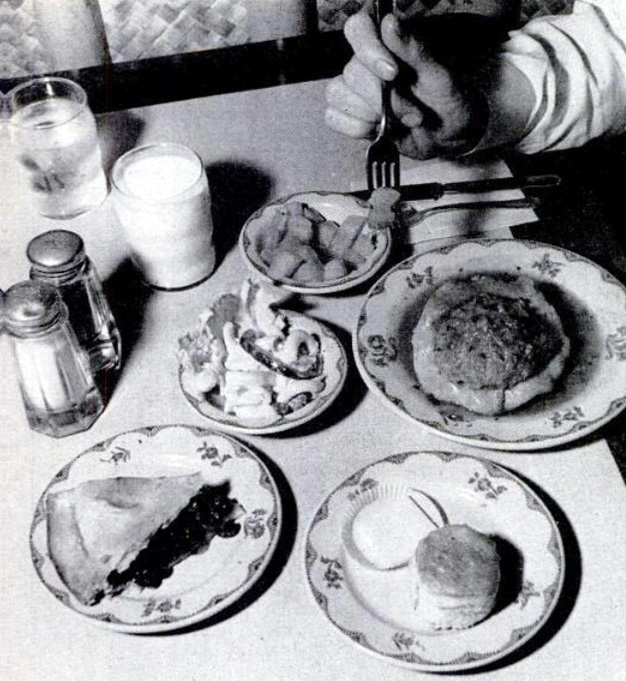
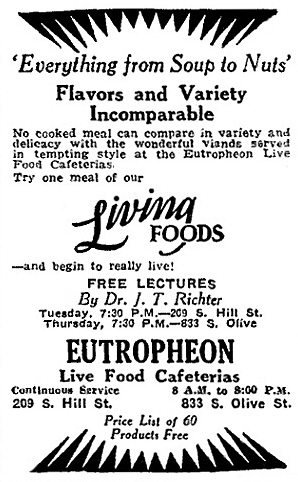
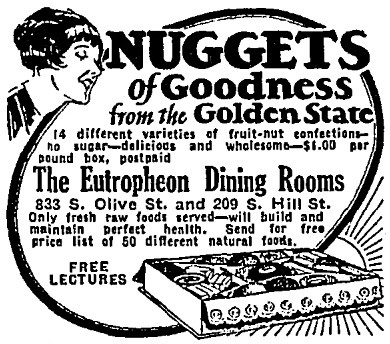
rawfoodeutrophean1928Last week’s post on a recipe from The Aware Inn, an early natural food restaurant in Los Angeles, took me back to founder Jim Baker and his adventures with the Nature Boys. I learned that some of the members of this group, who lived in the woods, dressed like Tarzan, and ate natural foods, worked at a Los Angeles raw food restaurant called The Eutropheon.

Just by its name, readers might suspect it was more about spreading the gospel of raw food diets than an ordinary money-making commercial eating place. They would be right.

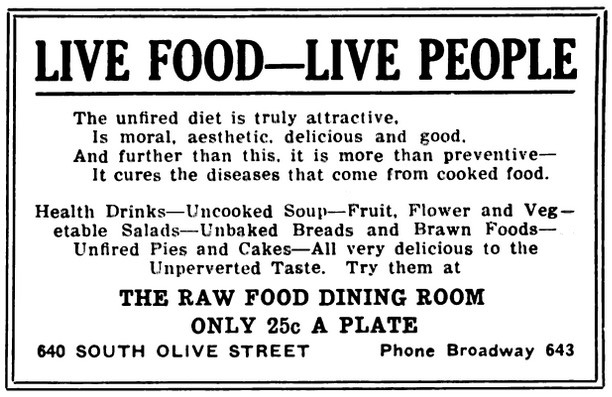
rawfoodTheNewJusticeJune11919A raw food restaurant, not yet named The Eutropheon, but very likely run by Eutropheon founders Vera and John Richter, was established in Los Angeles in 1919. It was evidently affiliated with, or at least sympathetic to, The New Justice, a short-lived publication dedicated to defending the Russian revolution [the 1919 advertisement here appeared in the magazine]. A story in the Los Angeles Times reported that the restaurant played Hawaiian music on a phonograph, distributed a leaflet called “The Truth About Russia,” and displayed a copy of the Soviet constitution along with a portrait of American socialist leader Eugene Debs. Its menu included uncooked soup, fruit and flower salads, and unbaked breads and pies.

In 1920 the Raw Food Dining Room had a new Los Angeles address, 326 W 2nd. In 1922, there was a Raw Food Dining Room, now called The Eutropheon, in Long Beach CA, as well as in Los Angeles at 927½ W 6th. How many of these were open at the same time is uncertain. There was also a Vegetarian Cafeteria on Figueroa serving “A complete line of Cooked and Raw Foods,” but this must have been run by someone other than the Richters since they were never known to serve cooked food. A Eutropheon cropped up in San Francisco in 1926, at 574 California Street. In 1928 the Richters had two Eutropheons in Los Angeles, one at 209 S. Hill and the other at 833 S. Olive.

There appear to have been very few raw food advocates in the United States, and almost no restaurants (until relatively recently), making the Richters pioneers. There were, however, some raw food enthusiasts in the US prior to The Eutropheon. Plans were laid by the Chicago Raw Food Society to open a raw food restaurant there around 1900 or 1901, but it’s unclear if it ever materialized. In 1907 a group in New York City held a raw food banquet at a hotel there. There was also a group in Cincinnati in the early 1920s.

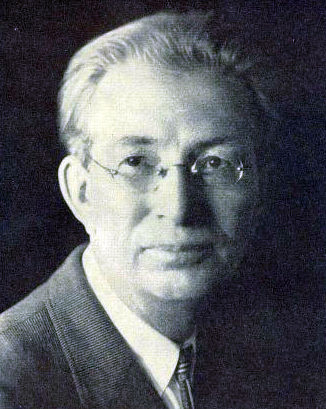
rawfoodJohntrichterJohn T. Richter, as he was known in Los Angeles, had come to the city around 1918 or 1919, opened a raw food restaurant, and began lecturing on the benefits of that diet and other aspects of natural living. When and how he met his wife Vera is unknown as is anything about her background, but she seems to be a key figure in the raw food movement in Los Angeles. Judging from her 1925 cookbook Mrs. Richter’s Cook-less Book, she may have developed many of the recipes for soups, salads, grain and nut dishes, and desserts that were served in The Eutropheon.

RawFoodVeraRichterBefore coming to California, Richter was known as Theophilus J. F. Richter. At least 20 years older than Vera, he was born of German immigrants in Illinois in 1864, grew up in North Dakota, and earned a diploma sometime in the late 1880s or the 1890s in “Swedish movement cure” in Chicago, probably from the Folke-Kjellberg Institute. He married a woman named Violet in Chicago in 1891 and they had three children. After living in Fargo for several years, the family moved to Minneapolis and Theophilus obtained a degree as a naturopathic physician. Evidently he adopted a raw food diet around 1911 after taking classes with Chicago doctor George Drews. He still gave his address as Minneapolis as late as 1917.

The Richters received quite a bit of publicity for their restaurant from Los Angeles naturopath and gymnasium owner Phillip Lovell. Lovell also had a radio show and wrote the “Care of the Body” column that appeared in the Los Angeles Times in the 1920s and 1930s espousing alternative medicine and health regimes. Declaring himself a regular patron of the Richter’s restaurants, Lovell wrote in 1928, “To my knowledge, these are the only two restaurants in the country that function without the aid of a cookstove.”

rawfoodrestaurant1926Why Lovell’s career and The Eutropheons attained success in California is an interesting question. It’s doubtful the Richters got rich but the fact that their restaurants survived for about 20 years is surprising given that raw food restaurants were found nowhere else at that time. As for Lovell, he amassed enough money to commission architect Richard Neutra to build the first steel-frame ultramodern house in the US. It was completed in 1929 and contained a full-size gymnasium. I suspect that the reason California was such fertile ground for health and fitness gurus had something to do with the large number of people, especially the elderly, who vacationed or moved there from the Midwest hoping the climate would cure their ills.

Sometime in the late 1930s it appears that the Richters turned over The Eutropheon at 833 S. Olive to Milan Geshtacoff who had once been a kitchen worker there. How long it stayed open and what the fate of the S. Hill street location was I don’t know.

© Jan Whitaker, 2014

14 Comments

Filed under alternative restaurants, food, proprietors & careers