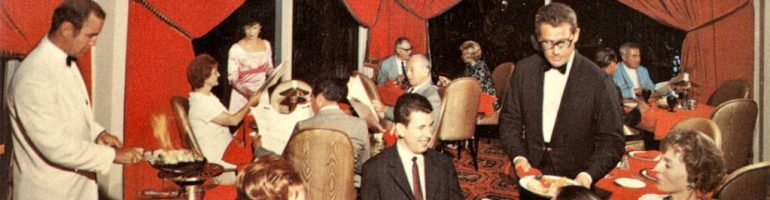

After prohibition ended gangsters were in search of a new game. It didn’t take much time to discover the solution, in fact it was already in progress in Chicago by the late 1920s. [Above, Howard Johnson’s, Chicago, 1954]
As I mentioned in an earlier post on rackets, the new game involved getting protection money from weak sectors of the economy, namely businesses that had low-paid workers such as, but not limited to, restaurants. Unions wanted to recruit the workers but owners resisted. One solution seemed to be a bombing campaign that would soften the owners’ resistance. Some unions hired hoodlums to do the deed.
According to an account by Louis Adamic in his classic 1931 book Dynamite: The Story of Class Violence in America, workers wanting better pay and shorter hours were threatening to strike. The racketeers, according to Adamic, began to “‘muscle’ their way into the union offices and affairs, and in not a few cases took over the control of the organization.” The racketeers made more money and the unions thrived, at least in terms of growing membership.
To avoid the bombs, restaurant owners also paid gangsters protection money. If not, a bombing campaign might begin, perhaps starting with a weaker bomb, maybe a “stink bomb” or a mild explosive. If those didn’t work, it escalated to dynamite, resulting in heavier structural damage.

Often the bombings occurred late in the night or very early morning, but at other times, especially when stink bombs were used, it was during business hours. Even a stink bomb could put a restaurant out of business, since frequent customers, whose clothes might be ruined in the episode, would probably never return. Plus the restaurant could get a bad reputation. [Above, “humorous” letter sent to a newspaper in 1963]
Although workers unionized at numbers of restaurants in the 1920s and 1930s, especially in New York and Chicago, it’s not clear how much they benefitted. There is no doubt that they needed better pay and shorter hours. Many were working 12-hour days for very low pay.
Sometimes minor improvements did occur. A 1937 trial in NYC showed that if a restaurant owner chose to pay for protection against the mob there was one set monthly fee, but a lower one “if he contracted for increases of 50 cents or $1 a week for his workers and signed a closed shop contract,” that is, hired only unionized workers.
Famous New York restaurants such as Lindy’s were assessed with lower fees for joining protection plans because their fame helped persuade other restaurants to cooperate. A number of New York City restaurants resisted and were bombed., including Childs on 43rd street, many cafeterias, Park Lane, Ye Eat Shoppe, Rectors, Eatomat, Silver Dollar and Marine Grill, and Grant Lunch. Of course, there were many more.
New York succeeded in calming gangster infiltration (to what degree is unclear), but in Chicago it continued in restaurants into the 1970s. Union membership declined, but restaurant owners were still threatened and bombed, with racketeers seeking payment to make it stop.

Invariably, Chicago restaurant owners declared that they had no idea whatsoever about who had bombed them or why. More surprisingly, police also seemed strangely mystified. Very few bombers were ever caught or convicted. [Above, the owner of Wilkos in the Chicago suburb of Berwyn is comforted after 1964 bombing of his restaurant]

In 1964 Chicago Daily News columnist Mike Royko reported that the Illinois Fire Marshall William Cowhey said he was puzzled about what was going on. During a press meeting, Royko wrote, “Cowhey’s eyes squinted, as if he were peering into the distance for something. ‘The . . . rhyme . . . or . . . the . . . reason,’ he said, slowly. ‘If we could . . . get . . . the . . . rhyme or . . . reason.” In another column Royko explained, “The duties of the fire marshal included going to the restaurant, viewing the gaping hole in the door, the shattered windows, the rubble in the street, and announcing to newsmen: ‘This is arson.’ This job out of the way, it is the fire marshal’s duty to crouch and pick up a piece of rubble and stare at it so a picture can be taken.” [Above, owner inspects damage at his Ivanhoe restaurant in Chicago, 1964]
Although union membership and racketeering had declined by the 1980s, protection shakedowns, sometimes involving bombs, continued in that decade, and possibly still occur today.
© Jan Whitaker, 2025


 It's great to hear from readers and I take time to answer queries. I can't always find what you are looking for, but I do appreciate getting thank yous no matter what the outcome.
 Restaurant-ing through history