Tag Archives: fried chicken

Chicken in the Rough

Frequently when I write about the demise of a restaurant chain I can almost be certain to hear from at least one person who lets me know there is a survivor of that long-gone chain.

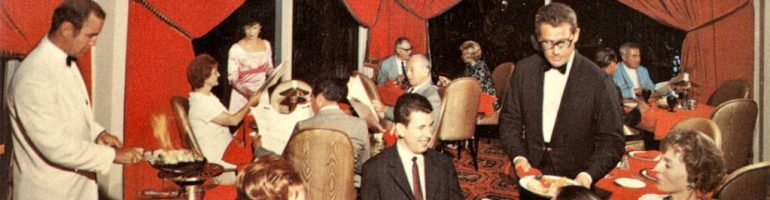
And, yes, that is also true of Chicken in the Rough, a franchised process for preparing fried chicken. As recently as now, Palms Krystal Bar & Restaurant in Port Huron MI offers “The World’s Most Famous Chicken Dish,” as it has for decades. In 2000 a Palms order consisted of an unjointed half fried chicken, with shoestring potatoes, hot bun, and jug of honey. Two orders cost $9.99 and they even threw in free coleslaw. In the 1930s an order usually was priced at 50 cents. [above, 1940s menu from an Arkansas restaurant]
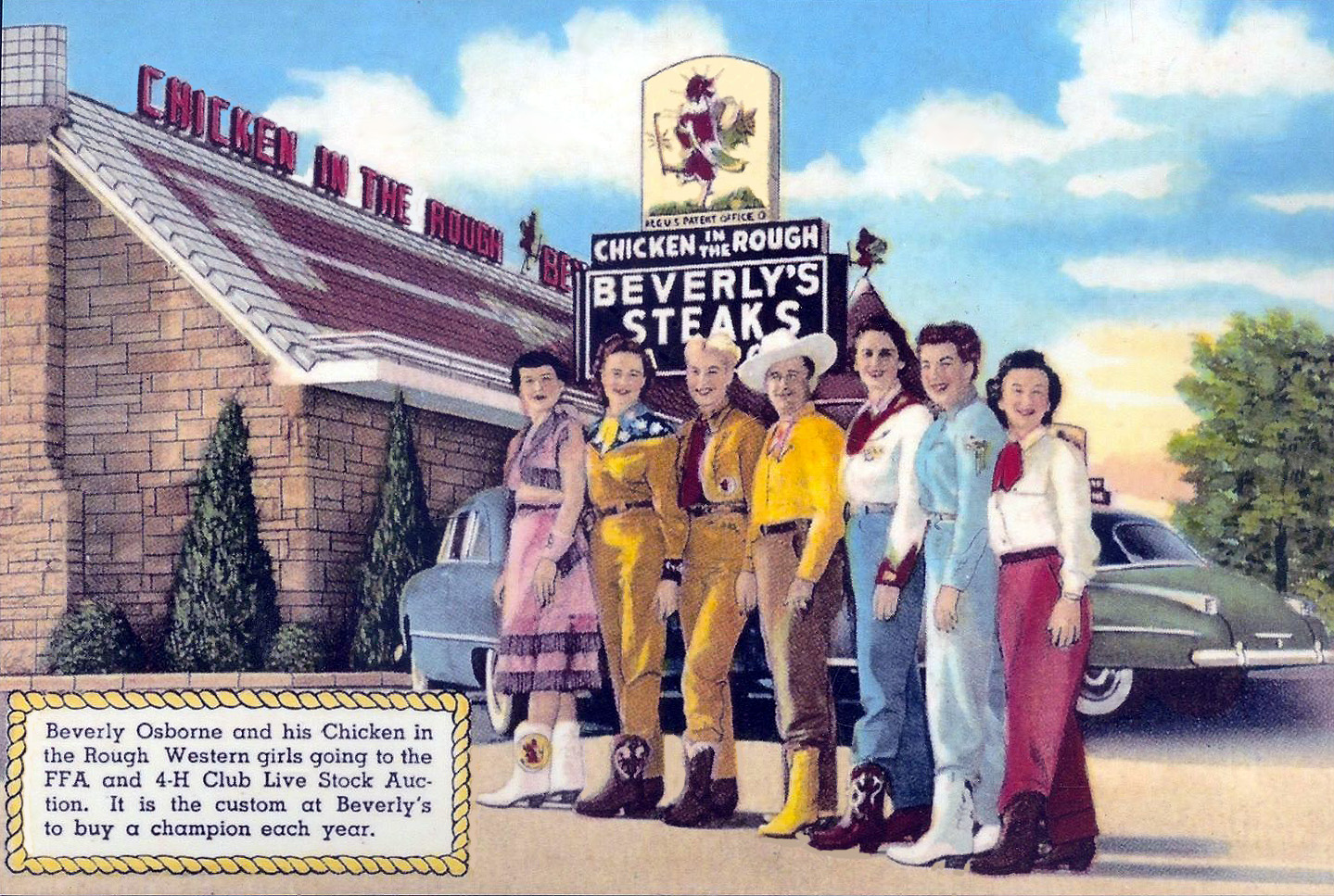
The developers of the Chicken in the Rough formula were a husband and wife team, Beverly and Ruby Osborne. They ran roughly nine cafes and waffle shops in Oklahoma City and even the 1930s Depression could not halt their enterprising spirit. [above: Beverly Osborne pictured in yellow boots]

Their operations employed the magic word in modern management of that time – “system” – to streamline their operations and reduce costs. In 1936 they opened a drive-in in Oklahoma City which introduced customers to their method of preparing chicken. They soon began franchising the process and the trademark. In 1942, they patented their imprinted dishware and glasses, and the image of a chicken with a broken golf club, all of which had been in use for several years.
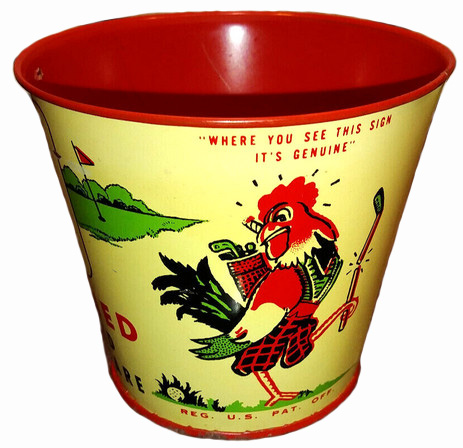
“In the Rough” was a perplexing phrase that often needed an explanation. It meant no silverware was provided despite the half chicken being unjointed. Evidently customers proved willing to adapt to “roughness,” although I’ve run across some evidence that over time some franchisees served the chicken in pieces. Another alternative was to serve the meal with a small metal pail filled with water for cleaning hands.

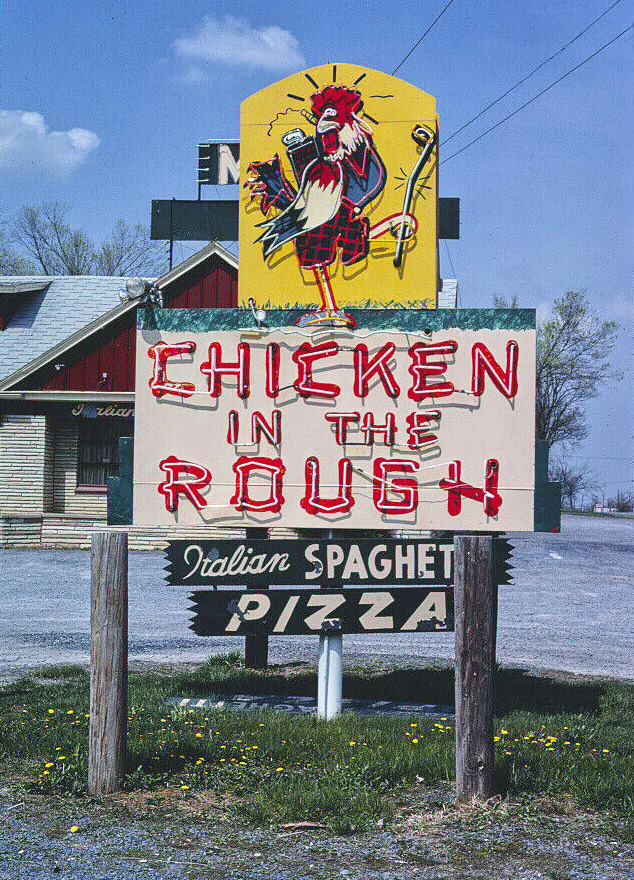
When the Osbornes opened the Ranch Room at their Oklahoma City drive-in in 1937 a large advertisement appeared in The Daily Oklahoman. Just in case anyone reading it didn’t realize the name Chicken in the Rough had been copyrighted, they were informed of this six times in the text: Yes Sir, “Chicken in the Rough.” (Copyrighted) – In one year we are known from coast to coast for “Chicken in the Rough.” (Copyrighted) – Served without silverware. In one year we have sold over 50,000 chickens or 100,000 orders of “Chicken in the Rough.” (Copyrighted) – We are now able to offer for sale franchises on “Chicken in the Rough.” (Copyrighted) . . . We took the town by storm – “Chicken in the Rough.” (Copyrighted) 50c. [Above: Madison WI franchisee]

The Osbornes were very particular about the meal’s composition, preparation, and presentation. Franchisees were required to use a freshly killed chicken, weighing 2 pounds and graded A, meaning it had been raised in an incubator and had sustained no injuries. No batter could be added to falsely make it look bigger and it had to be cooked in vegetable oil that had not been used for any other purpose. Inspectors came by regularly to make sure franchisees were following the rules.

World champion runner Jesse Owens, winner of four gold medals in the 1936 Olympics, was slated to open a restaurant featuring Chicken in the Rough in Chicago in 1953, for which he planned to use delivery wagons decorated with large images of himself racing. I could not determine the fate of that plan, but I don’t think it ever materialized.

The Osbornes sold the rights to their franchised process in 1969 and ten years later ownership changed hands once again. At the time of the first sale of the business there were only 68 franchises in 20 states left, compared to possibly 379 in 38 states at the peak, which I am guessing was in the late 1940s. Judging from a 1946 postcard that claimed to list all the U.S. restaurants with franchises then, most of the populous states without franchisees were in the Northeast. By contrast, Michigan had the most, followed by Indiana and California.

Unlike that of Harlan Sanders, who also began by selling a chicken recipe across the U.S. some years after the Osbornes, their venture remained a franchised cooking process and did not develop into a chain of restaurants.

© Jan Whitaker, 2023

18 Comments

Filed under popular restaurants, proprietors & careers, signs

Basic fare: fried chicken

Actually chicken, however it was prepared, was not so basic until well into the 20th century. Only then were poultry raising and marketing streamlined to produce the tender, year-round, low-cost product which made chain restaurants such as Kentucky Fried Chicken and Chicken Delight feasible. Until after World War II chicken was not terribly popular in most restaurants, often being rather expensive yet tough and stringy.

The chicken found on the menus of most American eating places of the 18th and 19th centuries was not fried, but roasted, boiled, or broiled. Fried chicken seemed to be limited to the South for many decades. The first instance of fried chicken in a restaurant that I have found occurred at the 1876 Centennial fair in Philadelphia where one of the concessions specialized in Southern dishes such as fried chicken and hominy. Despite this, fried chicken did not catch on in restaurants for some time. It could be found mainly in small, down-home style cafés run and patronized by Afro-Americans. An example in the 1890s was a small cabin called the Café Du Chat Noir in Washington, D.C., run by a former slave who went by the name Madame Early. A bit later, in San Francisco, a black restaurant provided possum and yams in season, corn pone, watermelon and chicken, fried, boiled, or roasted. Another type of early 20th-century fried chicken venue was the Chinese restaurant.

The third kind of eating place that made a specialty of fried chicken was the country tea room. In fact chicken of all kinds – fried, in salads, or creamed on waffles – dominated tea room menus. It’s likely that the substantial increase of women restaurant patrons in the 20th century, tea rooms’ main clientele, was behind the rise in chicken’s popularity. Restaurateurs often noted that while men preferred steak, women favored chicken. Taking the family for a Sunday automobile ride into the countryside for a fried chicken dinner at a tea room or family-style inn was a major form of entertainment for millions of Americans well into the 1950s.

The reason that fried chicken became popular primarily in out-of-the-way places, whether Afro-American, Chinese, or tea rooms, may have been due to these places having access to freshly killed chickens at a time when so much poultry served in restaurants had been ruined by long stays in cold storage. Cold storage chicken –- i.e., frozen — so dominated the market that in 1909 California law required restaurants to inform patrons if their chicken came from that source. On the other hand, restaurants run by blacks and Chinese often kept live chickens in cages, while rural tea rooms had local suppliers.

© Jan Whitaker, 2008

Leave a comment

Filed under food

Fried chicken blues

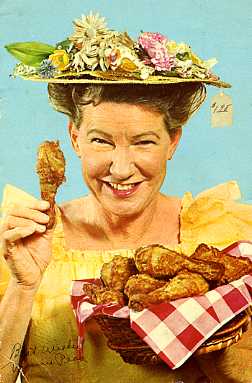
The 1960s were a boom decade for marrying fast food to franchise businesses christened with celebrity names. Chicken seemed like the up-and-coming successor to hamburgers in a business more about marketing concepts and stock quotations than food or hospitality. Following the success of Harlan Sanders, whose 500-unit Kentucky Fried Chicken chain mushroomed to 1,700 when he sold to a corporate buyer, entrepreneurs looked around for other celebrities to hitch their schemes to. Performers Minnie Pearl, Mahalia Jackson, James Brown, and Eddy Arnold, along with many sports figures, were persuaded to lend their names, rarely assuming any further involvement.

Minnie Pearl’s Chicken System, Inc., was the creation of Tennessean John Jay Hooker whose political ambitions included becoming governor, then president. Minnie Pearl, a Grand Ole Opry comedien whose frumpy stage persona suggested down-home eating, covered the white market, while gospel singer Mahalia Jackson lent her name to the black-owned side of the enterprise aimed at black inner-city consumers. Around the same time, ca. 1969, “king of soul” James Brown figureheaded the Gold Platter soul food chain which failed to get beyond the pilot stage in Macon, Georgia. Minnie’s and Mahalia’s ventures, too, lasted only a few years. Hooker, chicken systems mastermind, did not make it into office, but Benjamin Hooks, co-owner of Mahalia Jackson’s Gloree-Fried chicken (carryout only), went on to become executive director of the NAACP.

Though hailed as a restaurateur, Jackson received royalties for the use of her name but did not choose to invest in the Mahalia Jackson Chicken System, Inc. Perhaps she did not approve of its slogan: “It’s Gloree-Fried, and that’s the gospel truth.” The Minnie Pearl system totaled several hundred locations at its peak but it’s not clear how many outlets the Jackson chain comprised, probably many fewer. Chicago had only two units, paired with gas stations. The chain also operated in Memphis, Cleveland, Jacksonville, and Detroit. In addition to chicken, menus included fish sandwiches, sweet potatoes, fried pies, and a ‘Soul Bowl’ of chicken giblets in gravy on rice.

Minnie Pearl’s chicken — and later roast beef sandwiches — business went bankrupt in 1970.

© Jan Whitaker, 2008

Leave a comment

Filed under chain restaurants, food