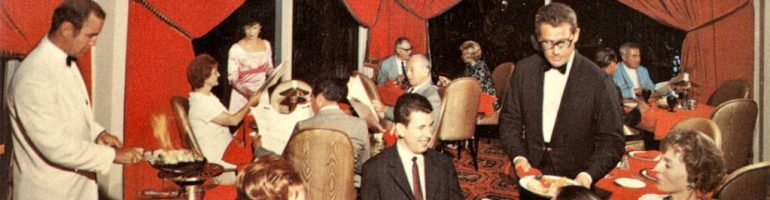
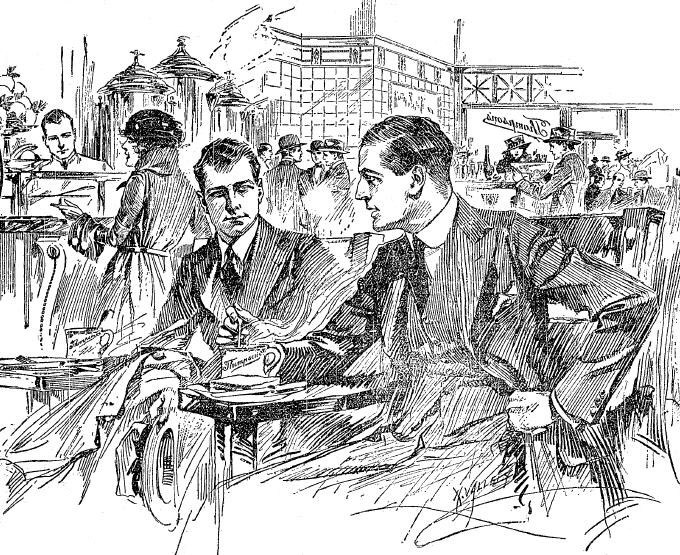
 Although it is largely forgotten today, the Chicago-based John R. Thompson company was one of the largest “one arm” lunchroom chains of the early 20th century. We so strongly associate fast food chains with hamburgers that it may be surprising to learn that Thompson’s popular sandwiches included Cervelat, smoked boiled tongue, cold boiled ham, hot frankfurter, cold corned beef, cold salmon, and Herkimer County cheese, served on “Milwaukee Rye Bread” baked by the chain’s bakery. Thompson was proud that his meals were suited for sedentary office workers of the 1900s and 1910s. A 1911 advertisement claimed that lunch at Thompson’s “won’t leave you logy and lazy and dull this afternoon.”
 Thompson, an Illinois farm boy, ran a rural general store as his first business. He sold it in 1891, moved to Chicago, and opened a restaurant on State Street. He proved to be a modernizer in the restaurant business as well as in politics.
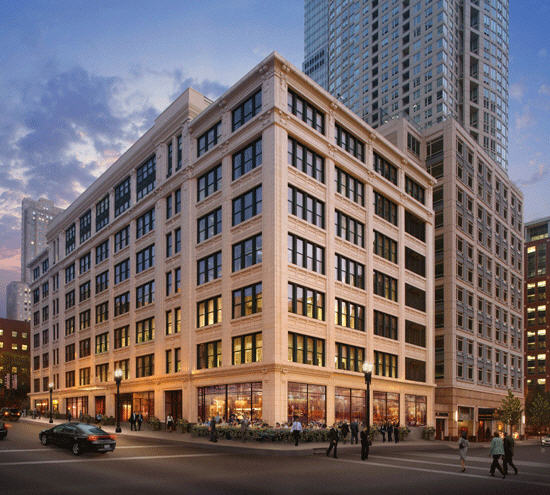
He operated his restaurants on a “scientific” basis, stressing cleanliness, nutrition, and quality while keeping prices low. In 1912 he moved the chain’s commissary into a premier new building on North Clark Street (pictured, today). Thompson’s, then with 68 self-service lunchrooms plus a chain of grocery stores, became a public corporation in 1914, after which it expanded outside Chicago and into Canada. By 1921 there were 109 restaurants, 49 of which were in Chicago and 11 in New York (with a commissary in NYC). By the mid-1920s Thompson’s, Childs, and Waldorf Lunch were the big three U.S. chains, small by comparison to McDonald’s but significant nevertheless.
 In politics Thompson served as a Republican committeeman and managed the campaign of a “good government” gubernatorial candidate in 1904. A few years later he failed in his own bid to run for mayor, promising he would bring efficiency to government while improving schools and roads. In the 1920s he financed a personal crusade against handguns.
Despite John R. Thompson’s progressive politics, his business would go down in history as one that refused to serve Afro-Americans. Or, as civil rights leader Marvin Caplan put it in 1985, “If the chain is remembered today, it is not for its food, but for its refusal to serve it.” J. R. died in 1927. Where he stood on the question of public accommodations is unclear but the chain faced numerous lawsuits by blacks in the 1930s. However the best known case occurred in 1950 when a group of integrationists led by Mary Church Terrell was refused service in a Washington D.C. Thompson’s. The group was looking for a case that would test the validity of the district’s 19th-century public accommodations laws. After three years in the courts the Thompson case (for which the Washington Restaurant Association raised defense funds) made its way to the Supreme Court which affirmed the so-called “lost” anti-discrimination laws of 1872 and 1873 as valid.
 Over the years the Thompson chain absorbed others, including Henrici’s and Raklios. At some point, possibly in the 1950s, the original Thompson’s concept was dropped. By 1956 Thompson’s operated Holloway House and Ontra cafeterias. In 1971, as Green Giant prepared to buy Thompson’s, it had about 100 restaurants, including Red Balloon family restaurants, Henrici’s restaurants, and Little Red Hen Chicken outlets.
© Jan Whitaker, 2010


 According to accounts, “D. L.” wrote his own colorful advertising copy, such as, “These hams are cut from healthy young hogs grown in the sunshine on beautifully rolling Wisconsin farms where corn, barley, milk and acorns are unstintingly fed to them, producing that silken meat so rich in wonderful flavor.” Equally over the top was his copy for Idaho baked potatoes, with references to a “bulging beauty, grown in the ashes of extinct volcanoes, scrubbed and washed, then baked in a whirlwind of tempestuous fire until the shell crackles with brittleness…” Customers who had not previously eaten baked potatoes soon learned to ask for “an Idaho.” Another heavily promoted dish, “Old Fashioned Louisiana Strawberry Shortcake,” was “topped with pure, velvety whipped cream like puffs of snow.”
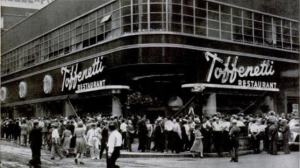 Another factor in his success was winning catering contracts at two world’s fairs, Chicago in 1933 and New York in 1939-40. Following the NY fair he outbid Louis B. Mayer for an immensely valuable piece of Times Square real estate on the corner of 43rd and Broadway. He hired Skidmore, Owings & Merrill to design a two-story, glass-fronted moderne building (pictured), outfitted with an escalator and a show-off gleaming stainless steel kitchen. The restaurant served 8,500 meals on opening day.
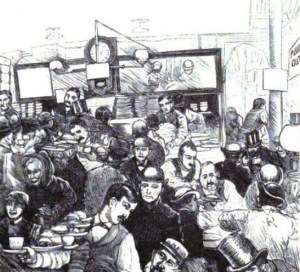 As the decade starts there are over 19,000 restaurant keepers, a number overshadowed by more than 71,000 saloon keepers, many of whom also serve food for free or at nominal cost. The institution of the “free lunch” has become so well entrenched that an industry develops to supply saloons with prepared food. As big cities grow, the number of restaurants swells, with most located in New York, Pennsylvania, Illinois, Massachusetts, and the Midwest where young single workers live in rooming houses that do not provide meals. Southern states and the thinly populated West, apart from California, have few restaurants.
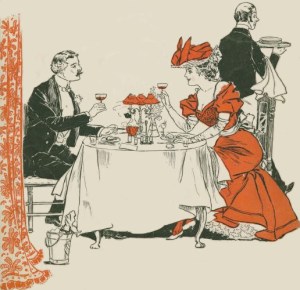 Near the decade’s end, the “Gay 90s” commence and those who are able and so inclined pursue the good life, which increasingly includes going to restaurants for the evening. It is still considered somewhat disreputable to do this, so some people go out to dinner only when visiting another city.
 1893 A drunken man fires five shots into
 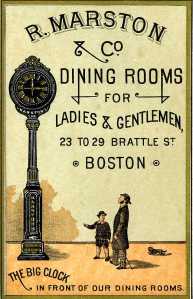 1895 Competition from cafés and restaurants in Massachusetts has just about wiped out the old boarding houses where renters had all their meals supplied. One reason is that people prefer restaurants because they get to choose what and when they eat. – Boston’s Marston restaurant, established by sea captain Russell Marston in the 1840s, opens a women’s lunch room on Hanover Street.
 During the war (1941-1945) the creation of 17 million new jobs finally pulls the economy out of the Depression. Millions of married women enter the labor force. The demand for restaurant meals escalates, increasing from a pre-war level of 20 million meals served per day to over 60 million. The combination of increased restaurant patronage with labor shortages, government-ordered price freezes, and rationing of basic foods puts restaurants in a squeeze. With gasoline rationing, many roadside cafes and hamburger stands close.
 1941 When the restaurant in the French pavilion at the New York World’s Fair closes, its head Henri Soulé decides he will not return to a Paris occupied by Germans. He and ten waiters remain in New York and open Le Pavillon. Columnist Lucius Beebe declares its cuisine “absolutely faultless,” with prices “of positively Cartier proportions.” – Chicago cafeteria operator
 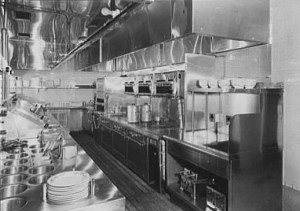 1946 Like health departments all across the country, NYC begins a crack down on
 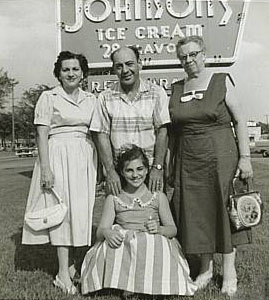 1949 Howard Johnson’s, the country’s largest restaurant chain, reports a record volume of business for the year. HoJos, which has not yet spread farther west than Fort Wayne IN, plans a move into California.
 The name has cast a spell over Americans since the 1890s and bits of its odd history have played out in the U.S. The fortunes of the “world’s most famous restaurant” have risen and fallen. It has won high ratings and lost them. It has been the subject and site of operettas, songs, and movies. It has been declared a French national treasure and an altar to haute cuisine, but also a fraud and a tourist trap. Maxim’s name has appeared on perfumes, airplane meals, and franchised outlets, yet even today it resonates.
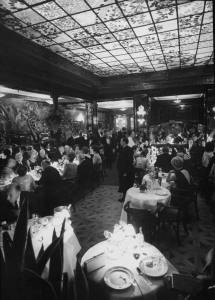 According to most accounts a waiter named Maxime Gaillard began Maxim’s in 1893. Yet another report calls him maitre d’hôtel Signor Maximo, while another stakes a claim for Georges Everard as founder in 1890. Everyone seems to agree, though, that the early Maxim’s was a late-night glamour magnet for American and English visitors to Paris, liberally supplied with friendly prostitutes. In 1899 it acquired a flamboyant Art Nouveau interior with enough murals, curves, and mirrors for a loopy carnival ride. Its prices were high, which may explain why many turn-of-the-century patrons, though dressed in silks and tuxedos, preferred to watch the action while munching pommes frites, an early specialty of the house.
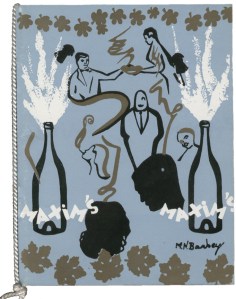 Detractors, such as H. L. Mencken, charged that Maxim’s “gypsy” orchestra was composed of Germans and that the toy balloons floating around were from “the Elite Novelty Co. of Jersey City, U.S.A.” In “Paris à la Carte” (1911), Julian Street, an authority on French food and wines, asserted “I abominate it,” and denounced it as “a brazen fake, over-advertised, ogling, odoriferous; a nightmare of smoke, champagne, and banality.” Debauched merrymakers aside, these were the golden years, before World War I, the era of wine, women, and song on which the Maxim’s legend would be built.
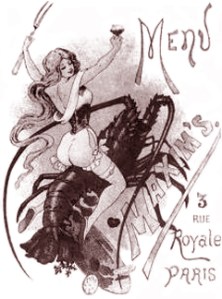 By 1953 the restaurant had earned 3 stars in the Michelin Guide and was starting on a new course. It had developed a frozen food division which supplied airplane meals and was poised to sell frozen sauces and entrées in select American stores. In another twist, Maxim’s authorized a
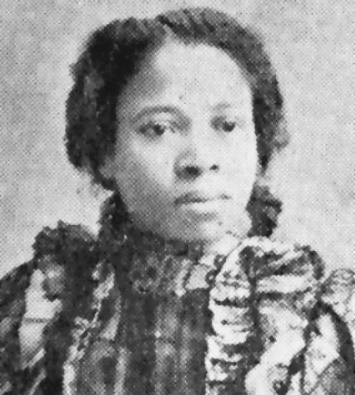
 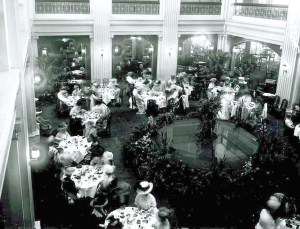 In 1890 Harry Gordon Selfridge, manager of Field’s in Chicago, took the then-unusual step of persuading a middle-class woman to help with a new project at the store. Her name was Sarah Haring (pictured) and she was the wife of a businessman and a mother. In the parlance of the day, she was needed to recruit “gentlewomen” (= middle-class WASPs) who had “experienced reverses” (= were unexpectedly poor), and knew how to cook “dainty dishes” (= middle-class food) which they were willing to prepare and deliver to the store each day.
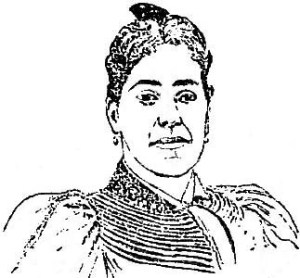 And so — despite Marshall Field’s personal dislike of restaurants in dry goods stores — the Selfridge-Haring-gentlewomen team created the first tea room at Marshall Field’s. It began with a limited menu, 15 tables, and 8 waitresses. Sarah Haring’s recruits acquitted themselves well. One, Harriet Tilden Brainard, who initially supplied gingerbread, would go on to build a successful catering business, The Home Delicacies Association. Undoubtedly it was Harriet who introduced one of the tea room’s most popular dishes, Cleveland Creamed Chicken. Meanwhile, Sarah would continue as manager of the store’s tea rooms until 1910, when she opened a restaurant of her own, patenting a restaurant dishwasher in her spare time.
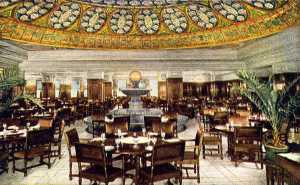 A graduate of Chicago’s School of Domestic Arts and Sciences named Beatrice Hudson opened the all-male sanctum Men’s Grill (pictured) about 1914 and was responsible for developing a famed corned beef hash which stayed on the menu for 50+ years. Later she would own several restaurants in Los Angeles, coming out of retirement at age 76 to manage the Hollywood Brown Derby and again in her 80s to run The Old World Restaurant in Westwood.


 It's great to hear from readers and I take time to answer queries. I can't always find what you are looking for, but I do appreciate getting thank yous no matter what the outcome.
 Restaurant-ing through history