Category Archives: restaurant catering

Restaurant-ing in movieland

In 1916 a newly arrived New Yorker named Adolph “Eddie” Brandstatter and a partner opened a café in Los Angeles. Modeling it on an unnamed New York City restaurant, they named it Victor Hugo and designed it to introduce fine French cuisine and continental service to the cafeteria-loving city.

Four years after opening the Victor Hugo, Brandstatter turned his attention to a Santa Monica project, the Sunset Inn, buying it with a new partner and selling his share in the Victor Hugo. His short tenure at the Victor Hugo was an early sign of his seeming “love it and leave it” relationship to most of the restaurants he created. Despite that, he rapidly became a well-known and well-liked public figure.

Trying to track all his restaurant ventures is a dizzying job.

By June of 1920 the Sunset Inn, which had served as a Red Cross center during WWI, had been remodeled and outfitted with a jazz band. Wednesdays were devoted to performances by Hollywood actors. But in 1922, less than two years after its opening, and despite the Inn’s apparent success, Eddie sold his share and moved on.

That same year, only a few months after departing from the Sunset Inn, he bought a new restaurant, the Maison Marcell, remodeling and reopening it. A little more than a year later he remodeled it again, renaming it the Crillon Café. Meanwhile, shortly after opening the Marcell, he had advertised the sale of his home’s furnishings, including suites from the living room, dining room, and two bedrooms, along with curtains, draperies, oriental rugs, flatware, and tableware.

Presumably the sale was meant to raise funds for his next project, the Café Montmartre which he opened in January of 1923 on Hollywood Boulevard, with a coffee shop below it on street level. At the luxurious Café Montmartre he continued the method of luring customers that had been adopted at the Sunset Inn: linking the café to the movies, attracting stars and a gaping public. Reputedly this often involved subsidizing meals for actors short on funds. [photo: Los Angeles Public Library]

The Montmartre would become the restaurant most closely identified with him, and the longest lasting of his cafes, staying in business for nine years. He took an active role in it, greeting and mingling with guests from the film industry, as well as overall management. Yet that workload barely slowed him down. In May of 1923, the Los Angeles Examiner announced that Eddie, “Little Napoleon of the Cafes,” was planning to open “the exclusive Piccadilly Coffee House on West Seventh street between Hill and Broadway.”

1925 was a busy year of ups and downs. The Crillon closed, as did his newly opened cafeteria called Dreamland, not even open for a full year. It was the only cafeteria I’ve ever come across that had dancing!

He also began a catering company that furnished food to movie casts and crews. In the next few years, the catering company took on some big projects. In one case it provided meals for 2,500 in Yuma AZ when the Famous Players-Lasky studio was filming Beau Geste. [above photo] To do that it was necessary to build a plank road atop the sand and to drill wells. The company also catered to studios when they filmed in Hollywood at night, as was the custom. That could mean serving as many as 25 studios on some nights.

The Depression – and probably the end of silent film — took a toll. When Montmartre began to sag, he opened a swanky club next door for film people called the Embassy. It opened in 1929, closing three years later when his decision to open to the public failed to rescue it. [above: the public waits to get in] Also, in 1932 he was caught removing art objects and furnishings from the then-closed Montmartre, planning to use them in his next venture. At his trial it came out that the actual owner of the Montmartre was the realtor who had built the Montmartre and backed him by putting up capital, loaning him personal funds, and paying him a salary of $100 a week. He was found guilty and put on probation for two years.

In 1933 he opened a restaurant he called Sardi’s but in no way connected to New York’s Sardi’s. With booths, tables, and fountain service, and featuring his popular set-price buffet luncheon, it quickly became a success. Its success did not stop him, however, from launching another restaurant, a chop house called Lindy’s that he seemed to have no further link to. In 1936 Sardi’s was destroyed by fire. When it was rebuilt two years later he sold his share to a partner. [rebuilt Sardi’s shown above]

In 1939 he opened his final eating place, the Bohemia Grill, with prices as low as 35c for Pot Roast and Potato Pancakes. The following year he took his own life, apparently troubled by money worries. Among the honorary pall bearers at his funeral were Charlie Chaplin, Tom Mix, Bing Crosby, and studio head Jack Warner.

© Jan Whitaker, 2024
8 Comments

Filed under patrons, popular restaurants, proprietors & careers, restaurant catering

Catering to airlines

After the early years of serving cold box lunches, U.S. airlines tried to improve their in-flight food service, sometimes through alliances with restaurants and restaurant chefs. As early as the 1930s, the decade in which transcontinental flights began, hot meals were becoming common. In 1939 George Rector, formerly of the swank and swinging Rector’s of pre-prohibition Broadway in New York City, advised Braniff Airways on their menus. He gave his blessing for a Thanksgiving menu that year that included roast turkey with oyster sauce and chestnut dressing, pickled watermelon rind, and other select dishes.

It’s fair to ask why airlines switched from cold box lunches, given how difficult and expensive it was to provide full-scale hot meals. A large part of the answer is that in the beginning they wanted to distinguish themselves in comparison with train travel. Over time, though, planes would become bigger and faster, offering cheaper fares and attracting many more passengers. Through all of this, meals would go from an attraction to a target for cost reduction.

It’s hard to know exactly what Rector’s role entailed. It may have been devising menus and training chefs rather than getting his hands dirty. Decades later that was probably equally true of another well-known chef, Wolfgang Puck of Spago in Los Angeles. In 1983 he advised luxury Regent Air Corp. on suitably impressive meals for its flights between LA and Newark. After being delivered to the airport via Regent’s limousine, passengers were treated to Beluga caviar, smoked salmon, and lobster fresh from Maine, washed down with fine wines. Within three years the airline had racked up $36 million in debt and was sold.

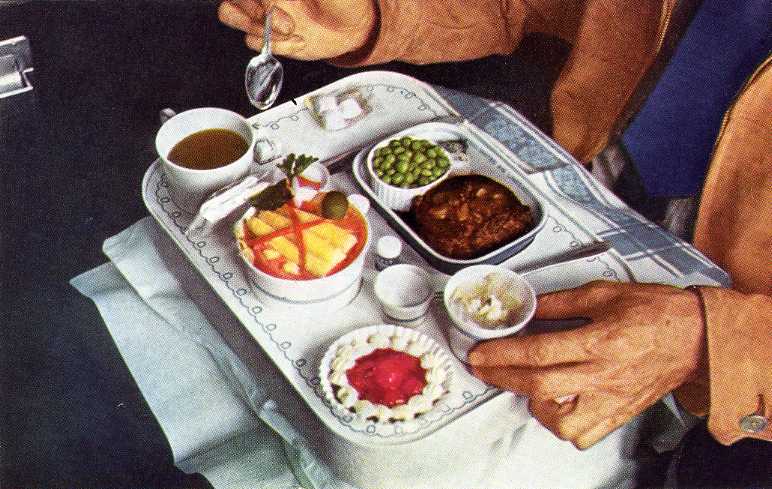
United Airlines was one of the few airlines that maintained their own flight kitchens. Starting in 1947 they were headed by Swiss chefs. Trained in European kitchens, they came to United with experience in major hotels and restaurants in the capital cities of Europe and America. Nonetheless United’s menus, whether in English or Franglais, were less than thrilling, especially when the various courses were all grouped together on a tray as depicted on this late 1960s postcard. Even though I’ve seen many United menus, I remain stumped about the ingredients in the “salad” that look remarkably like asparagus spears reposing on a bed of orange gelatin (though, to be fair, I’ve never seen gelatin on a United menu).

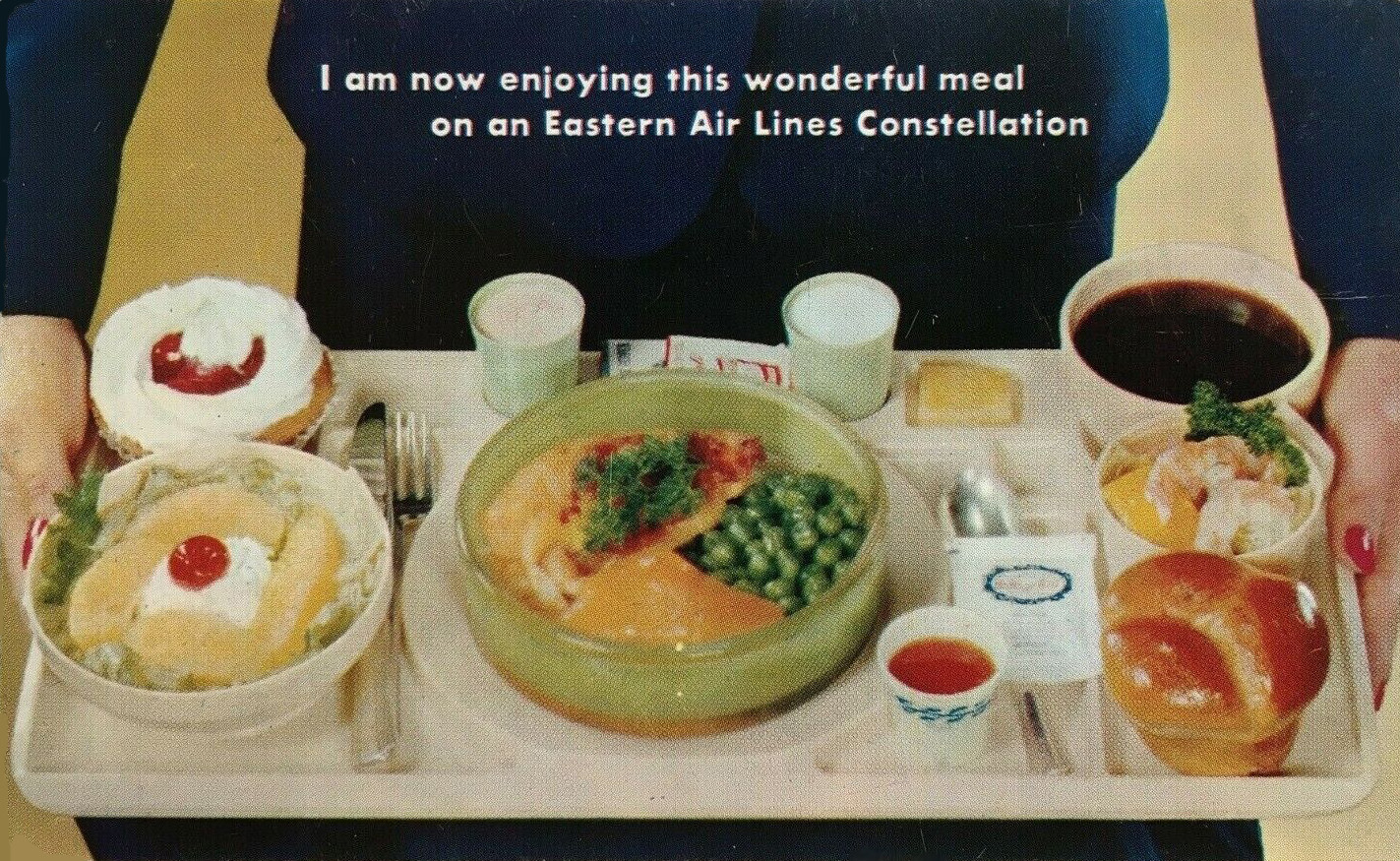
There were no Swiss chefs at the D.C. area’s Hot Shoppes drive-ins in 1937 when that company began to supply Eastern and Capital airlines with in-flight meals. Eventually the Hot Shoppes would become the Marriott Corp., a major airline caterer that became one of the largest, as did another that evolved from a restaurant chain, Dobbs House.

Meals in the 1950s may have been somewhat ho-hum (despite the fact that almost all flights were still first class only), but alcoholic beverages brightened the trip for some passengers. Despite the failed efforts of Senator Strom Thurmond of South Carolina, who introduced legislation in 1957 to outlaw the sale of alcohol on airplanes citing both safety and moral issues, nine domestic airlines began serving it in the 1950s, and the number grew from there. [Above, Delta, 1959]

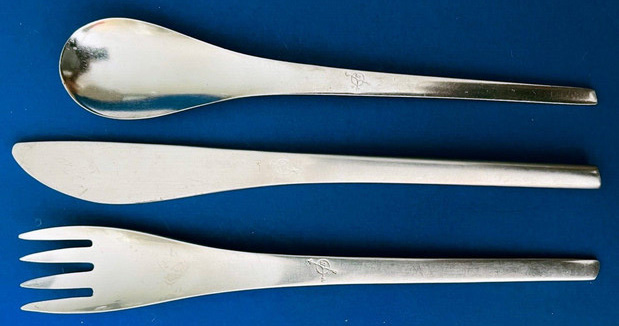
Two free drinks became an attraction offered by a number of airlines as they ramped up their meals. Competition in cuisine became intense among the major carriers in the 1960s, in some cases involving the participation of fine, or at least famous, restaurants. This was perhaps inspired by Pan Am who recruited Maxim’s to supply meals for flights departing from Paris. Soon airlines in the U.S. began to conjure intriguing flight names such as Famous Restaurant Flights, Captain’s Table, and Royal Dining Service. American Airlines enlisted “21″ to supply flights leaving NYC, while Eastern – once catered by the Y.M.C.A. – signed up the elite Voisin for first-class flights from New York and the Pump Room for those from Chicago. Eastern discarded its humdrum serving pieces [at top of page] of old for Rosenthal china and stylish silverware [shown below]. As a commentator said in 1967, “ Practically every airline worthy of the name also calls itself a flying five-star restaurant.” [above, Voisin chefs preparing food for Eastern Airlines, 1965]

The peak of competition in food probably occurred in the early 1970s, when airlines offered champagne breakfasts, a variety of hors d’oeuvres, lobster plus steak dinners, and prime rib sliced on a rolling cart for each guest — ditto for displays of salad tossing. Passengers could request special meals designed to suit taste, health, or cultural/religious requirements.

Through all of this, though, there were always complaints about food. Almost everyone agreed that warmed-up meals could never match good home cooking or fine restaurant fare. And, of course, there were those who preferred to make their own arrangements and have the cost of meals subtracted from the cost of their ticket.

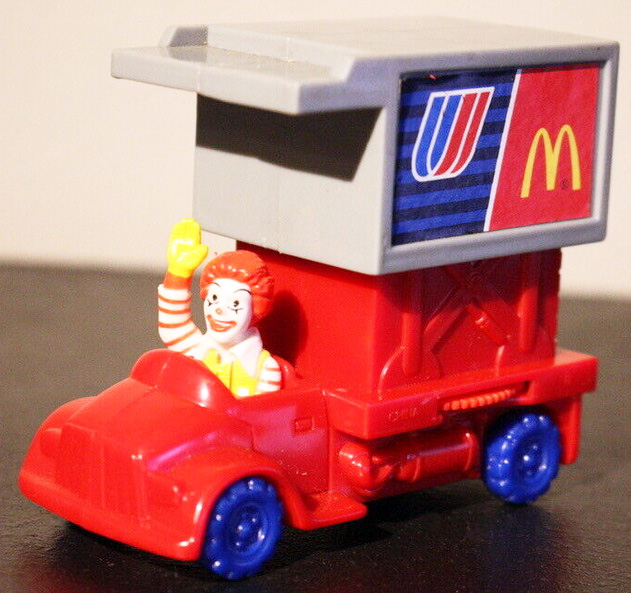
They got their wish in 1978 with the passage of the Airline Deregulation Act. Airlines were freed to compete in terms of fares and routes. New airlines were created. Some old ones grew mightier while others, such as Braniff and Eastern, disappeared in the 1980s recession. “Frills” were eliminated. Snack packs came into being, making the sandwich and apple of the 1930s seem almost generous. In the 1990s United began offering McDonald’s meals for children.

While hot meals did not completely disappear, they tended to be limited to first class passengers whose proportionate numbers had shrunk drastically since the 1950s. Today, meals by foreign carriers get the highest ratings.

© Jan Whitaker, 2022

9 Comments

Filed under food, proprietors & careers, restaurant catering