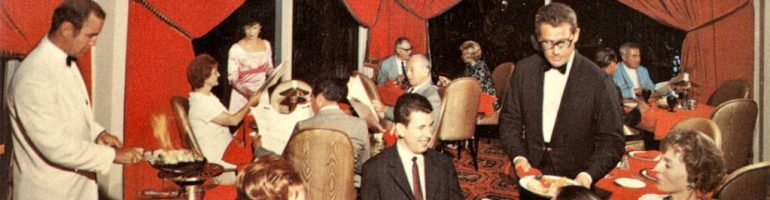
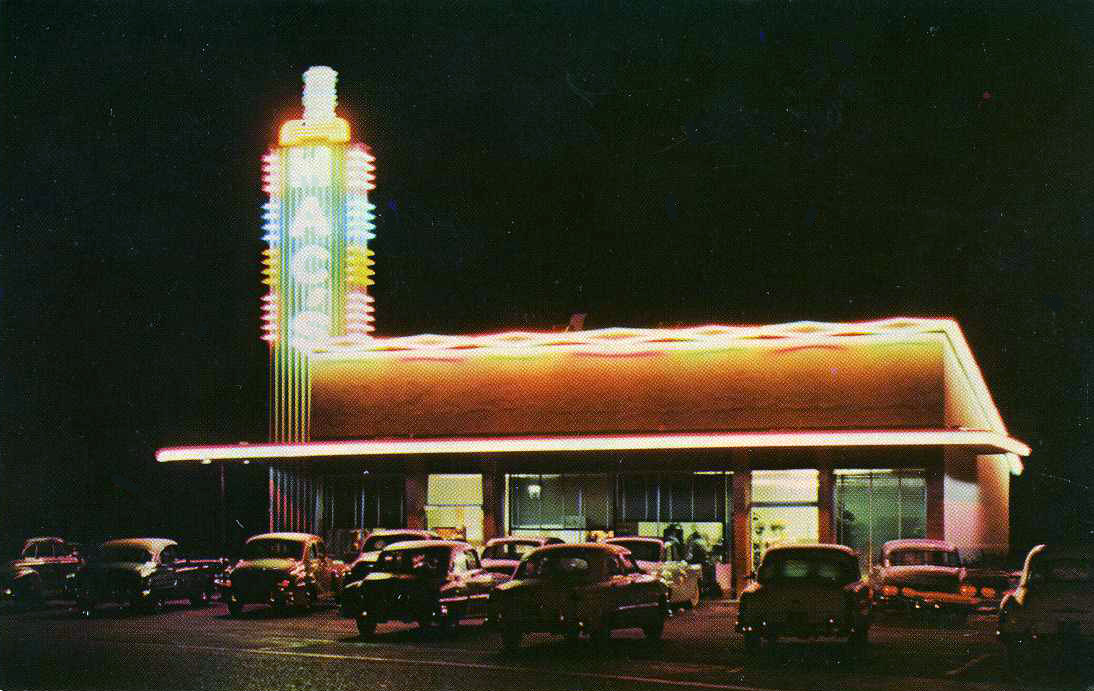
The four gases used initially by neon signs – neon, argon, krypton, xenon – were discovered by English scientists in the 1890s and adapted for use in signs by Frenchman Georges Claude a short time later. Though not the first, an early neon sign was used in Paris in 1913 to advertise Cinzano vermouth. [shown above: Mac’s, Corpus Christi TX]
But it wasn’t until the late 1920s that the signs became popular with restaurants in America. Particularly in the West where car culture was developing, the eye-catching signs helped attract the attention of drivers.
In the early days neon signs in a town’s business district could also be taken as a sign of progressiveness. A 1929 advertisement for an electrical display company in Great Falls MT advised businesses that their adoption of a neon sign would impress people, encourage progress, and “beautify Great Falls.”

Their use became well established in the 1930s. In the 1934 book Curious California Customs, the author commented, “To the casual visitor, Wilshire Boulevard, after dark, is a flashing cavern of Neon signs, most of which are calling attention to eating places.” A later postcard of Hollywood Boulevard at night in the 1950s demonstrates the effect of a street full of neon signs [shown above].
In the late 1920s the signs began moving across the country. Among early adopters were eight Benish Restaurants in St. Louis, four White Way Hamburger outlets in Colorado, the Horn & Hardart Automats in Philadelphia, and four Janssen’s Hofbraus in New York City. Salt Lake City outfitted multiple New York Coney Island Sandwich Shops with the signs.
Bright neon signs and images remained quite popular throughout the country into the 1940s. But if they were meant to make a business stand out from the crowd, that became more and more difficult as the numbers grew.

Neon signs were undoubtedly most effective for roadside restaurants on dark roads that stayed open at night [above: [Bratten’s Grotto, Salt Lake City, 1956]. Or for eating places in somewhat obscure locations that required signs that could be seen from afar. Unfortunately, they didn’t look as impressive during the daylight hours [below: Bratten’s Grotto, daytime].

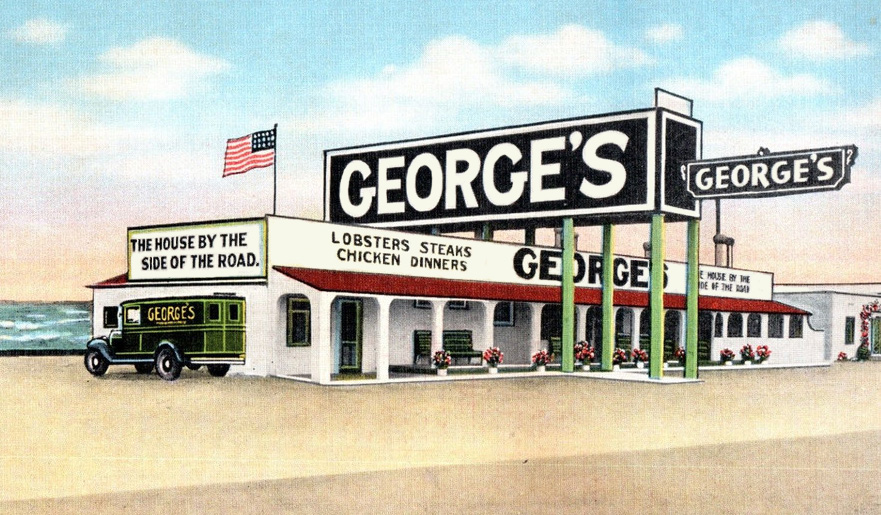
Before neon, efforts to craft signs that could attract distant or speeding traffic were undoubtedly less successful, less visible in the dark. George’s grotesquely large sign shown below, for example, was neither attractive nor sufficiently visible at night. As a slightly later version of this postcard revealed, the restaurant soon found it necessary to add spotlights atop the sign.
Neon wasn’t for every eating place. To critics it lacked artistic pedigree and dignity. Elite restaurants wanted nothing to do with it. It might announce the presence of the Green Frog or the Zig Zag Sandwich Shop, but certainly not New York’s La Chaumiere.
A 1960 book on restaurant decor pronounced neon in bad taste, saying, “Incandescent lighting is more expensive but has a kindlier glow and, thanks to the bad association arising from the tasteless use of neon, is generally considered ‘classier.’” As cities declined with the growth of suburbs, such attitudes toward neon grew more negative.
Nor was neon welcome in classy towns and communities such as Palm Springs, Carmel-by-the-Sea, and Sonoma in California; Santa Fe, New Mexico; the Hamptons on Long Island; and Cohasset, Massachusetts, to name but a few that banned it.
Rejection of neon grew in the 1960s and 1970s. In 1965, food critic and editor Craig Claiborne was uneasy about eating in the one (barely) acceptable restaurant he could find in Roswell NM, which he said had “the air of something once removed from Las Vegas or Miami Beach with its neon-silhouetted champagne glass and flashing neon bubbles.” His unease increased upon stepping inside and seeing a lighted goldfish tank, male customers not wearing coats, and bartenders with “narrow, abbreviated ties.”

Antipathy to neon in the 1970s, as before, was associated with urban decay and seedy neighborhoods characterized by run-down buildings and businesses such as bars and strip clubs. More cities and towns banned it.
Soon there were few “tube benders” left who could create or repair neon signs, which were increasingly being replaced with lighted plastic signs that were easier and cheaper to make and less prone to damage outdoors. Yesterday’s real neon signs that had survived soon showed up as quaint wall decor in warehouse-style theme restaurants.
A few commentators, such as a reporter for the Fort Wayne News-Sentinel, began to wonder about the return of neon. She speculated in 1975 that “that much-maligned symbol of everything that’s bad about American commercial districts” might “someday be recognized as art.”
Sure enough, in 1976 the Smithsonian put on an exhibit that included neon signs, among them examples from a Kosher restaurant, a foot-long hotdog place in Cleveland, and from a Spanish-American restaurant in Greenwich Village, a many-colored creation that combined a lobster, pig, fish, chicken, crab, and a steaming coffee cup.
Nowadays, vaguely quaint-looking plastic “neon” signs might show up as interior wall decor in the sort of restaurants that want to suggest they are fun places.
© Jan Whitaker, 2024

 It's great to hear from readers and I take time to answer queries. I can't always find what you are looking for, but I do appreciate getting thank yous no matter what the outcome.
 Restaurant-ing through history
Working with local sign companies brings a level of personalized service that’s hard to get from national chains. They understand the area’s zoning laws, climate challenges, and community style. That local knowledge really shows in how signs are designed and installed. Plus, turnarounds tend to be faster
I grew up in what was a sleepy suburb on the south side of Winnipeg. When I was a kid in the 1960s, we would drive to the far west side of the city to visit relatives. They lived in a side street, just ten houses south of the mighty Portage Avenue — about eight lanes, and eight miles of neon signs in front of car dealerships, motels and restaurants. It was a dazzling, and enthralling drive. I especially liked the ones where portions of a sign flashed in sequence to spell business or product names.
Excellent. 👍👍
I love neon and mourn the loss of those signs!
A foot-long hotdog restaurant in Cleveland – I wonder what it was.
The circle of life. Always a great read.
Hi Jan — What an interesting and informative article!! I personally find the image of a nighttime street with multiple neon signs very exciting, but I have always loved retro/vintage design. Be well, Bob
Me too!
Unfortunately, the 1946 film “It’s a Wonderful Life” helped to turn people against neon signs, as they are a defining characteristic of the nightmare version of “Potterville.”
Great article about neon! Craig Claiborne is just plain WRONG! (And a fearful snob. He should be ashamed of himself, wherever he is.) Neon does, in fact, exude exoticism, allure, and WARMTH. And the SUBTLETY of colors available is unmatched. A neon sign emerging out of pure darkness has a power all its own. (And how I love that little BUZZ when you hear when you get up close!) Neon creates an ambience, indoors and out (and, I might say, a SUBTLE one) that plastic signs simply cannot touch. How intriguing, in a way, that they were so maligned. They ARE, I think, making a comeback…but slowly, and not nearly on the scale one would like to see. Too often they’re just OUTLINING painted signs.There’s a museum of neon in Downtown LA. Marvelous and awe-inspiring. (I have a small neon sign in my front window, custom-made, that says, simply, HOME. It’s beautiful and much beloved by the whole neighborhood.)
The inclusion of Sonoma in the towns frowning on neon reminded me of this theatre marquee in Sonoma:
https://sanslartigue.wordpress.com/2014/07/10/sebastiani/
There is a NY artist who has taken photos of Chinese restaurants using neon signs. I really like them myself and I do see them as an art. The premiere of my storytelling play Shadows&Secrets May 4/5 about my grandfather Chin Foin’s suspicious death will be accompanied by his art exhibit of Chinese restaurant memorabilia from the early 1900s and his neon sign restaurant photos. Wish you were here in S.F. to see both! Your writings about my grandfather helped spur my interest in what really happened to him.
How wonderful about your play! And, yes, Chinese restaurants were big users of neon, though I didn’t find much to illustrate that.