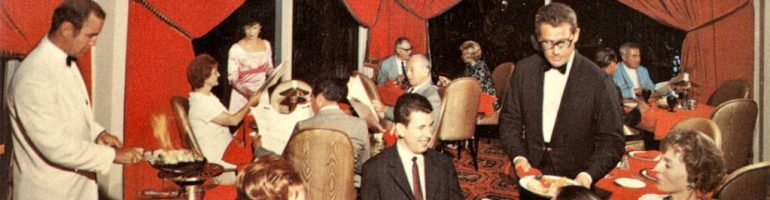

Despite the documentary absence of postcards, I’ve discovered that there were others — after a lot of searching. And I’m glad, because in nostalgic American culture, drive-ins are seen as deeply and exclusively white.
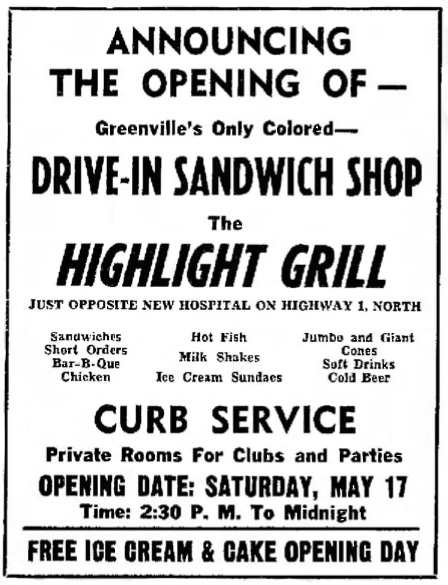
Most I’ve located got their start in the 1940s and 1950s, the same years that white-owned drive-ins made their first appearance many places, particularly warmer climates. More people in those years, especially after WWII, had cars and a little extra money to spend. [Highlight Grill, Greenville MS, 1952]
The earliest reference I’ve found was to The Drag, on Lyons Avenue in Houston. In an advertisement for its sale in 1941 it was described as a “famous colored drive-in.”
Black drive-ins were most likely to be found in Southern cities before the Civil Rights Act of 1964 made Jim Crow segregation illegal and all public restaurants had to serve everyone regardless of race. Although they could be found in Northern cities, it seems they were more likely to be in good-sized Southern cities such as Chattanooga, Memphis, and Nashville TN, Louisville KY, Little Rock AK, and Birmingham and Tuscaloosa AL.
Altogether I’ve run across 54 Black-owned drive-ins in this country, which is not many but surely an undercount. I have not found any in the Northeast. Nor in the land of drive-ins, Southern California, where they dated back to the 1930s. No doubt there were some, but probably fewer than elsewhere.
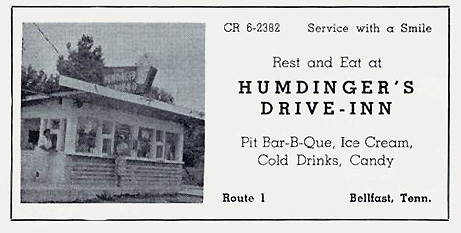
It was mainly in the 1960s that they began to show up in the yearly Green Books that advised Black travelers on places to stay, eat, fill up with gas, etc., in unwelcoming parts of the U.S. – i.e., most of it. (I cannot be 100% certain that every drive-in listed in the Green Books had a Black owner since sometimes white-owned restaurants that welcomed Black customers were also listed.) [Shown here, a Green Book advertisement from the 1961 edition.]
Many, maybe most, of the drive-ins served barbeque. For example, Nichol’s Drive-In in East St. Louis IL specialized in hickory-smoked Beef Ribs, Snoots, Pork and Chicken. It mentioned Soft Drinks, but a number of Black drive-ins served beer. Selling beer to underage customers seemed to get some of them into trouble.
I noticed that when a new Black-owned drive-in opened, it was usually greeted with enthusiasm in Black newspapers. White newspapers, on the other hand, often only reported on them in association with disorderly incidents and legal violations.
When a Black-owned drive-in was proposed for a location near a white residential area, it was unlikely the plan would be approved. (The same held true for Black-owned drive-in movie theaters.) In 1951 a Black man seeking official approval to build a drive-in restaurant in Memphis faced a hostile lawyer representing whites who opposed it. The opposition’s lawyer referred to the drive-in as a “Negro night club,” and when the applicant’s lawyer objected, maintained that a drive-in was “the same thing.”
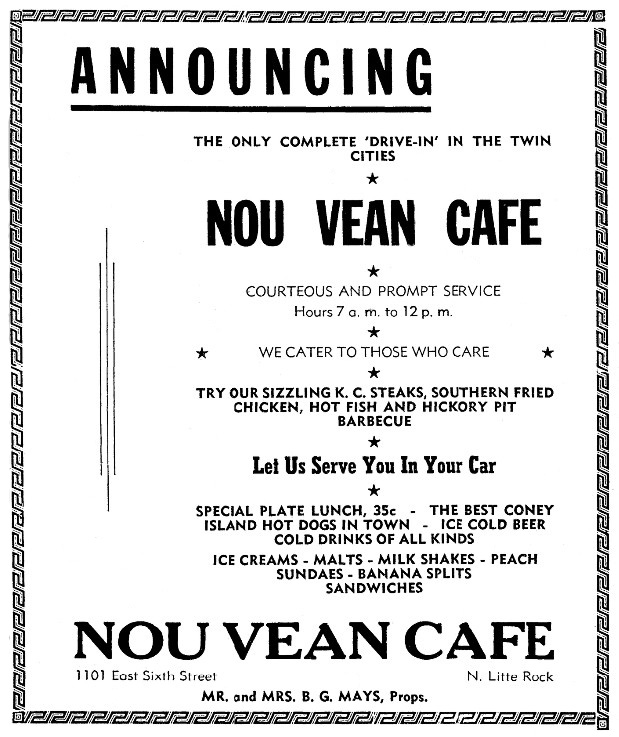
The drive-ins that seemed to fare the best were those owned and run by prominent figures in Black communities. In the 1940s Little Rock’s Nou Vean Drive In was owned by Barnett G. Mays, a realtor, developer, and liquor store owner. He encountered numerous roadblocks throughout his business career, but seemed to press onward despite them. In Milwaukee a drive-in called Robbys appeared to have a promising future when it opened in the late 1960s. It was named after the son of owner J. C. Thomas, a community leader who was also a realtor, operated two billiard parlors named Ebony Cue, and published a newspaper called Soul City Times. [Above: Nou Vean, 1945; Below, Robbys 1969]

However, drive-ins generally – both Black and white – met major competition in the late 1960s when fast-food chain restaurants spread across the country. In Milwaukee Robby’s as well as Big Mike’s Ghetto Drive-In faced off with national chains and lost.
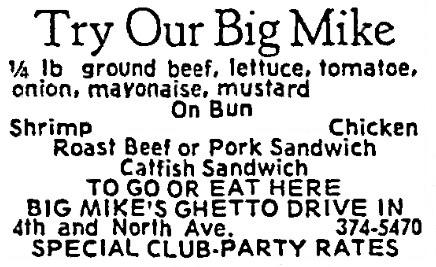
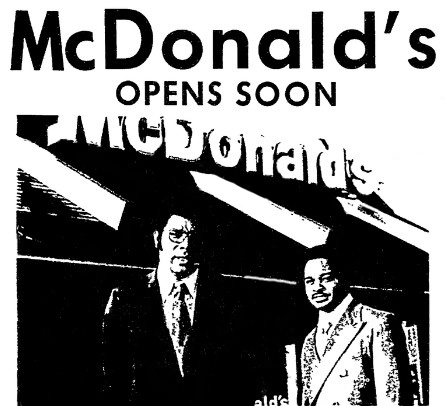
Big Mike’s owner Mike Watley, a social activist and close associate of comedian Dick Gregory, explained that he could not compete with a national corporation. With lower sales volume, he paid higher prices for food, a situation intensified by being given less financial support. His meat supplier, he said, capped his credit at $100, while white customers could run up their bill to three or four thousand. Although Watley blamed his failure on competition from a “white-owned corporation,” the nearby McDonald’s franchise was owned by two Black men, one of them Wayne Embry, a former player with the Milwaukee Bucks. Their McDonald’s venture was quite successful. [Above: Big Mike’s, Milwaukee, 1969; Below: Wayne Embry, left, and his partner, 1971]
Independent Black-owned drive-ins have not totally disappeared, however. In Longview TX White’s Drive-In, established in 1952 in conjunction with the White’s motel, has recently been re-opened by younger members of the family.
© Jan Whitaker, 2023

 It's great to hear from readers and I take time to answer queries. I can't always find what you are looking for, but I do appreciate getting thank yous no matter what the outcome.
 Restaurant-ing through history
Great article.
Very nice blog, thanks.
In Navarra, Spain and I often travel to Fl. I found this place in Tallahassee, https://www.facebook.com/tallykingsbbq/
Thanks!
Howdy. Great article. And I hadn’t thought about Wayne Embry in years. He was a good player. Neil S.
A sad part of our history, but history nonetheless. Thank you for the info.
You’re amazing and inspiring Jan. Thank you. Happy holidays.
I always enjoy this blog and I never knew about black owned drive ins. Thank you!!! Looking forward to your next entry!
Hi Jan — What a fascinating and informative article! I knew absolutely nothing about this subject. Thank you for your obvious extensive research and interesting information.
Best regards, Bob
Good work Jan!
Jan, thank you for this very important part of social history. I never knew about blacks owning drive-ins! It must have been a difficult business!
Two things:
– Does ‘hot fish’ refer to the temperature or the spiciness?
– What were ‘snoots?’ Pig snouts?
Stephen
Thanks, and spiciness and snouts.
Would have loved to try some of those places!
Thanks for capturing this important piece of food history!