 As I read the morning newspaper a sentence by the head of a local restaurant dynasty caught my attention. “We all have fryolator oil running through our blood veins,” he said.
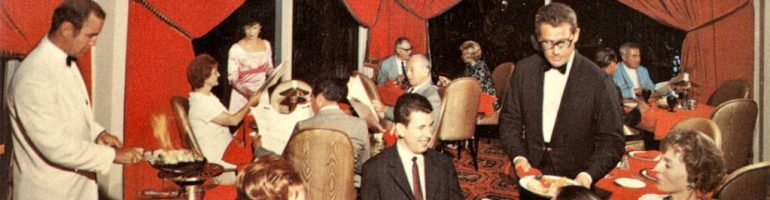
The speaker was Andrew Yee. His family enterprise includes a newly acquired retro diner, several popular bars & grills, a sushi restaurant, and a venerable Polynesian showplace, the Hu Ke Lau, begun by his father in the mid-1960s.
I was delighted to find the quotation because I was in the midst of researching deep-fried food in American restaurant history. Also because it is rare that topics such as cooking oil come up in reviews and discussions of restaurants. Yet nearly every restaurant kitchen contains a bubbling vat of it.
And always has.

Think about how often you have been enveloped in a miasma of aged cooking oil fumes while passing a restaurant’s outdoor ventilating fan. In 1978 restaurant reviewer Phyllis Richman visited a regional restaurant expo filled with demonstrations of deep frying; she subtitled her Washington Post story “The smell.” Her experience was nothing new. In 1887 neighbors complained about the odor coming from a Cleveland OH “French fried cake baker” using cottonseed oil, which had recently come on the market as a replacement for high-priced lard.
Not that lard fumes would have smelled much better. In 1849 a journalist’s plan to survey the flourishing “eating houses” of lower Manhattan was cut short by the overpowering “smell of fried grease before we got through the first street.” Not surprising when you consider that fried oysters were a top menu attraction and had been for at least a century, probably longer.
The number of deep-fried foods eaten in the 19th century was extensive, including oysters, doughnuts, fish and fish balls, clams, potatoes, all kinds of fritters, “corn dodgers,” brains, chicken, and even parsley.
Deep fat frying in the home in the 1800s was frequent, as far as I can tell. But that changed as kitchens were transformed from rough workrooms to adjunct living areas. For some time now the restaurant industry has benefited from the fact that most home cooks dislike deep frying in their own kitchens and would rather have restaurants prepare their French fries and onion rings.
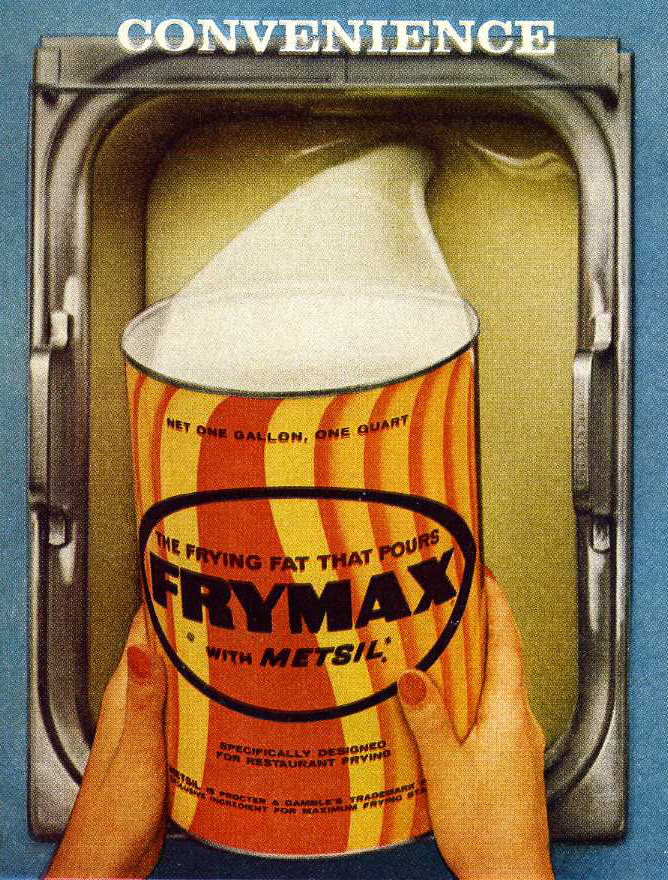
 When the Pitco Frialator was invented in 1918 it quickly became standard equipment in restaurant kitchens because it extended the life of cooking oil, reducing costs and improving food quality. Oils were developed that would not break down under high temperatures. Then frying kettles came out with built-in thermostats adjusted to type of food.
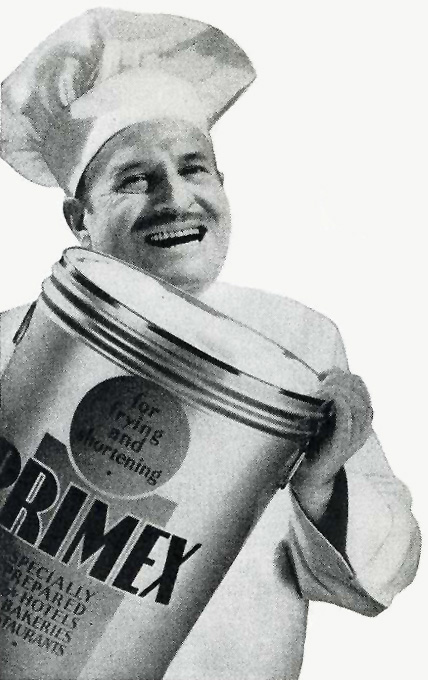 Profits from the value added to inexpensive foods by deep frying in the 1930s were a boon to struggling restaurants. A 1938 article in The American Restaurant, a trade magazine, estimated that many deep-fried dishes – among them sole, potatoes, oysters, and croquettes – could be priced at four or five times their cost. A restaurant in Duluth MN, The Flame, boasted in an advertisement (to the trade, not the public!) that it had built an “enviable reputation” for fried food through using “tons and tons of Primex.”
 The successful marketing of frozen foods in the 1960s expanded restaurants’ deep-fried selections. Breaded, frozen French-fried shrimp became a top seller. Once only available in Gulf Coast restaurants, by 1960 shrimp appeared on restaurant menus all over the U.S. In 1969 a Gallup Survey rated it America’s favorite deep-fried food in the fish category; in 1973 it ranked #1 among all deep-fried foods.
 Deep-fried chicken ranked third favorite, after shrimp and potatoes, to the disappointment of fans of pan-fried chicken, which was becoming a rarity in restaurants in the 1960s.
Drive-in restaurants relied heavily on deep frying. According to a 1961 Drive-In Magazine, “There was a time not long ago when a deep fat fryer and a neon sign were practically all you needed to put yourself in the drive-in business.” But competition was becoming fierce as fast food chains challenged drive-ins’ popularity with young diners, the customers most attracted to deep-fried food and least afraid of its dietary consequences.
Despite the profitability of deep-fried food, two perils faced restaurants: dark breading and sogginess. Both were due to incorrect frying temperatures, and frying kettles and oil that had not been maintained properly. Customers had a strong preference for fried food that was “golden brown,” but not too dark or hardened into a shell. As an article about “lethal” truck stop fare put it: “You strike a chicken leg and the crust falls away in a curved sheet to disclose a sight best forgotten.” The problem of greasy, limp French fries was cited by Gallup as customers’ second biggest complaint.

But neither darkness, greasiness, nor calories dampened the popularity of deep-fried food. Deep-fried appetizers dominated menus of 1980s chain restaurants designed to appeal to a young adult demographic. At West Coast Froggy’s Cafés (specializing in “food and fun” – and fat) seven out of eight appetizers on a 1980 menu came out of the frialator.
It’s likely we all have oil in our veins.
© Jan Whitaker, 2016

 It's great to hear from readers and I take time to answer queries. I can't always find what you are looking for, but I do appreciate getting thank yous no matter what the outcome.
 Restaurant-ing through history
This is amazing. My grandfather was a chef. I was just looking for a deep fryer he had. It had a chef with red eyes when it got hot.
Loved your blog for years, first time commenter. Common by the 80’s, but quite exotic in our medium-size city of Fort Worth, were the fried veggies offered by only a couple of restaurants here by 1974–mushrooms, zucchini, and eggplant. They were beloved by my high school crowd, but viewed as sort of hippie-dippie chow by many in town–vegetables! that weren’t potatoes!
Great blog 🙂 just come across it today
Undercooked French Fries and chips- also known as “dead men’s fingers”!
Great name!
your post are always so interesting Jan…no one else is doing this well not quite like you are doing…more public, reader friendly :)) xo
Thanks, Isis!
Another great post, Jan. Thanks!
Thanks, Joan — let me know when you get yours going.