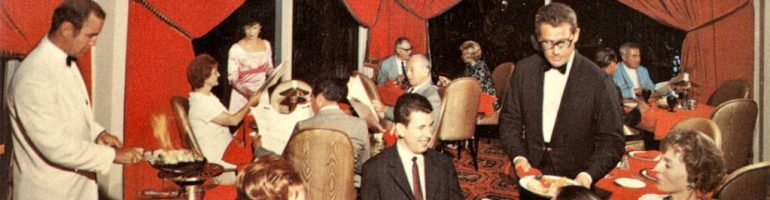

The San Francisco restaurant Coppa’s became legendary in the early 20th century as a gathering spot for bohemian artists and writers, especially after they decorated its walls with curious and intriguing murals. Though the murals remained in existence for scarcely a year, because of the devastating fires that followed the earthquake of April 1906, they have been forever tied to the restaurant’s mystique.
 Over the course of months in 1905 the murals were drawn in chalk crayon by artists who frequented the restaurant on Montgomery Street. Legend has it that proprietor Giuseppe “Joseph” Coppa papered (or painted) his walls a hideous red that offended their esthetic sensibilities, impelling them to mask it with their humorous, nonsensical drawings. An alternative explanation is that Coppa asked the artists to draw on the walls and that he chose red as a good backdrop. I find this more convincing since Coppa himself was a painter.
A row of stenciled black cats at the original location, by Xavier Martinez, was inspired by Le Chat Noir in Paris, the city where Martinez had studied painting. They gave the restaurant its nickname, The Black Cat, which was also used at its new post-fire location.
While I was at the Library of Congress a few weeks ago I had a chance to look at the hard-to-find book The Coppa Murals, by Warren Unna (1952). He interviewed some of the artists involved and also Felix Piantanida, Coppa’s early partner who was responsible for preserving the photographs shown in the book. It’s likely the photos were taken for use in an article by Mabel Croft Deering not published until June 1906 in The Critic, but written before April’s destruction caused Coppa’s closure. The murals themselves were at some point scrubbed off or painted over by the landlord.

Though the restaurant was looted by vandals, the building Coppa’s restaurant was in actually somehow escaped destruction [shown above]. With few buildings intact, its value rose and Coppa’s landlord raised the rent, leading Coppa to vacate and open another Black Cat on Pine Street in November. He and Piantanida split up, and for a short time Piantanida conducted a restaurant called La Boheme in the space formerly occupied by Coppa’s.
The artists and illustrators who contributed drawings included some who would become prominent, such as Maynard Dixon, Xavier Martinez, and Gelett Burgess. The artists, along with poets and writers, contributed puzzling sayings and quotations that adorned the walls, fascinating – and insulting – customers (“Philistines”) who came to gawk at the bohemians.

The cover of Unna’s book shows a crude rendering of a mural by Xavier Martinez depicting the restaurant’s core group of regulars. Martinez is seated at the far right. Standing behind him is poet Bertha Brubaker, wife of Perry Newberry, smoking a cigarette. Her nickname “Buttsky,” which referred to her habit of saving cigarette butts, appears in the “hall of fame” of names that run beneath the black cats. The names of Coppa’s regulars are interspersed with those of famous writers such as [Johann Wolfgang] Goethe, [François] Villon, and [Guillaume] Apollinaire. The few women named are hard to identify since their last names do not appear, but Maisie was freelance writer Mary Edith Griswold and Isabell was allegedly a newspaper writer.
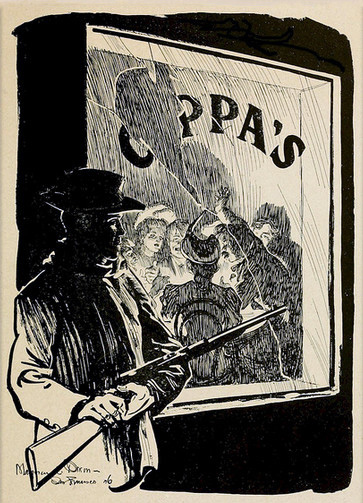 When Coppa moved to Pine Street, a new row of cats appeared, but now marching in the opposite direction. Maynard Dixon also contributed several new images. One of his shows Coppa unfurling a scrolled menu to a crowd that includes regulars who were violinists, writers, poets, and artists. On another wall Dixon commemorated Coppa’s “Last Supper” at his old location, celebrated soon after the fire and necessitating official approval and protection from a marshal who stood guard outside. Another notable feature of the Pine Street murals were two works by a woman, painter and jewelry designer May Mott-Smith.

Coppa’s second Black Cat closed in 1913, after which Joseph and his son Victor launched Neptune Palace, a more commercial cabaret restaurant. In 1916 Joseph returned to a bohemian theme with The Red Paint, a short-lived restaurant on Washington Street that went out of business at the start of Prohibition, stopping the flow of “red paint,” i.e., wine. It too had murals, never completely finished and lacking the inspiration of those at the earlier Black Cats, despite Maynard Dixon’s participation once again. Many in the old gang had moved to Carmel by the Sea and things were not the same.
 In 1922 Coppa opened yet another restaurant, at 120 Spring Street, offering “old-time dinners,” possibly so-called because they were paired with illicit wine. Joseph was often arrested in raids by prohibition agents, and Victor once escaped by running out the back door. It’s possible the restaurant was officially padlocked for a time because in 1933 it “re-opened,” with the unveiling of a painting by the ever-faithful Maynard Dixon of a nude woman dressed only in shoes, stockings, and a large-brimmed hat with her legs crossed atop the table, toasting an obese man opposite her [see 1933 advertisement]. The same image was used on the cover of the restaurant’s menu at its final location, 241 Pine. That closed in December 1939, marking the end of Joe Coppa’s long culinary career.
Joseph’s wife, Elizabeth, who had been the dining room manager and cashier, died in 1938. After his retirement he took up painting, focusing on portraits of men such as business magnates, Italian dictator Benito Mussolini, and poet George Sterling.
© Jan Whitaker, 2015

 It's great to hear from readers and I take time to answer queries. I can't always find what you are looking for, but I do appreciate getting thank yous no matter what the outcome.
 Restaurant-ing through history
I am reading a book called “A Cooks Tour of San Francisco,” 1963. My Dad just passed it on. I grew up here so thoroughly enjoyed reading your piece.
As I am thoroughly enjoying this book, the author Doris Muscatine states that the artists contributed their talents to doing the Bohemian fresco in the original restaurant because of Coppa’s generosity in feeding the artists and homeless for free.
Reading the book brought me online to find more — and I did! Thanks so much for posting the lovely photos and anecdotes. Truly appreciated reading all you wrote! Happy 2025 now . . . from the Great San Francisco!
I think many restaurant owners let artists eat for free. At Coppa’s it worked out as a good deal for everyone. I need to look for that book, don’t think I’ve run across it.
Pingback: The King of the Clairvoyants: The Man who bought the Sunnyside Conservatory – Sunnyside History Project
I’d like a copy of the scan as well.
An anonymous response was left on March 10, 2020 offering scans of Mama & Papa Coppa, Coppa’s Restaurant. I would love a scan as offered. They are my Great-Great Grandparents. Warmly, Vicky Coppa Hien
Hi Vicky,
You must be Joe and Elsie’s granddaughter? I am Jeff Gardner, Marie Gardner’s son. She was Joe’s sister. Send me an email jmgcpa and it is at att.net
Vicky email me jmgcpa@att.net. Victor Coppa was my grandfather
I am so sorry not to have seen your requests Jeff Gardner and Gregory. E-mail me bruce@phcreative.com
Nice article. I have a photo taken at Coppa’s sometime in the 20’s showing a dinner featuring many of SF artists including Maynard Dixon, Maurice Logan, Louis Traveso, Frank Van Sloun and many more.
I am interested in getting a copy of that picture. Giuseppe Coppa was my great grandfather.
I would also be interested in obtaining a copy of that photo. Giuseppe Coppa was my great grandfather as well. I am the older brother of Jeff Gardner.
Was your great Grandfather known as Papa Coppa, and his wife as Mama Coppa? I have some nice old photos labeled “Party for Mama and Papa Coppa of Coppa’s Restaurant off California St. in SF.” If this is a connection to you, I’d be happy to send you scans of the photos.