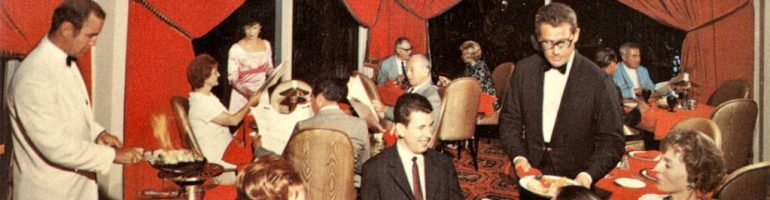
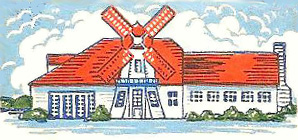
 The Dutchland Farms story parallels that of Howard Johnson’s, its competitor and eventual conqueror. Both were chains of ice cream and lunch shops that began on Massachusetts roadways in the 1920s. But they experienced the Depression very differently. Howard Johnson’s expanded while Dutchland Farms shrank. Though Howard Johnson triumphed over its competitor, there is no doubt that Dutchland Farms strongly influenced HoJo’s development.
Unlike Howard Johnson’s, the Dutchland Farms chain grew out of a real dairy farm, established in 1897 by shoe manufacturer Fred F. Field. Years before the first Dutchland Farm dairy store – not yet a restaurant – opened in 1928, the dairy farm of the same name in Brockton MA had become nationally famous for its prize-winning herd of Holsteins. The ice cream produced by the farm in “28 flavors,” sometimes 30, was advertised as the only Grade A ice cream made in Massachusetts. (Most ice cream then was made from Grade B milk which has a higher bacterial count; now Grade B milk is mostly used for making cheese.)
By 1933 the newly incorporated company had 50 roadside stores that sold milk, butter, and eggs, and also served toasted sandwiches, frankfurters, and fountain treats, as well as “Chinese Chop Suey” supplied by Hung’s Food Products Co. of Boston. Soon the menu expanded to include complete dinners. Menus displayed Dutchland Farms “registered” colors, orange, blue, and white, which also formed the color scheme for buildings. The canvas awnings on the white building depicted on the South Easton MA postcard below would have been in eye-catching orange and blue stripes.
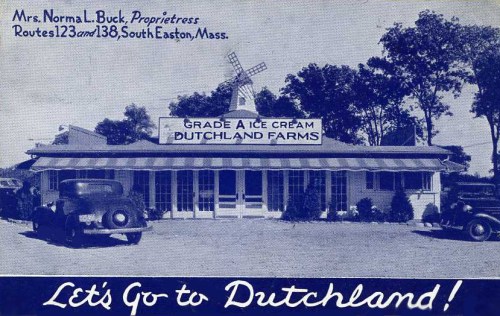 Fifty was probably the greatest number of Dutchland Farms units in operation at any given time. In addition to eastern Massachusetts where most units were located, the company did business in New Hampshire, Rhode Island, Connecticut, and New Jersey. Some restaurants were operated by the company itself but most were franchised, as was true of Howard Johnson’s. Women formed 10 to 15% of Dutchland Farms proprietors, a large percentage for a restaurant chain.
In addition to colorful awnings, Dutchland Farms buildings had two outstanding visual characteristics: orange roofs and decorative windmills which sat atop the roof or formed part of the building front. The roadside restaurants were situated on busy thoroughfares and both features were intended to attract motorists’ attention. Additional evidence of positioning for mobile customers were Dutchland Farms’ ample parking lots.
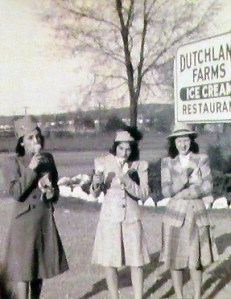 The Depression was rough on Dutchland Farm operators. A dozen or more of the restaurants went out of business. Some proprietors shifted their allegiance to Howard Johnson. A Fairfield CT operator who opened a Dutchland Farms in 1935 switched to Howard Johnson’s after only a few months. Another, Louise Prout, co-proprietor of a Dutchland Farms in Lakeland NH and another in Pocasset MA, decided to go with Howard Johnson’s when she opened a restaurant in Cambridge in 1936.
Still other Dutchland Farms restaurants became independents. A proprietor near Newport RI rechristened his The Mile Post, while a Dedham MA Dutchland adopted the name of its proprietor, Mary Hartigan. The same fate would one day befall Howard Johnson’s. Louise Prout turned her Cambridge HoJos into The Clipper Ship, disguising the cupola, sheathing the front with dark paneling, and decorating the entry with wrought iron.
Dutchland Farms tried to reorganize its debts in 1939 but was sold to Howard Johnson’s in 1940. Johnson kept the orange, blue, and white colors but was barred from using the Dutchland Farms windmills on restaurants operating as Howard Johnson’s, and chose cupolas instead. However, some of the restaurants he acquired continued to do business as Dutchland Farms and, presumably, kept their windmills. The last Dutchland Farms restaurant I could find evidence of was in Quincy MA in 1951.
It is not obvious why Howard Johnson succeeded and Dutchland Farms failed. Was it because after Repeal Howard Johnson restaurants served alcoholic beverages whereas Dutchland Farms did not? Or was it due to how well the businesses were conducted? Or just luck?
© Jan Whitaker, 2012

 It's great to hear from readers and I take time to answer queries. I can't always find what you are looking for, but I do appreciate getting thank yous no matter what the outcome.
 Restaurant-ing through history
Pingback: Dutchland Farms | William M. Conlon (1923-2009)
The fascinating history behind a lot of these small Dairy operations that created an ice cream shop is what America is made of. Another interesting fact on Milk Grade quality was in the Early 1900s when milk grades were being established, Grade B as recognized by The Hoards Dairymen, was seen as some of the highest quality milk a farm could produce.
With the research in the 1910s-20’s of Somatic Cell counts, grade milk was put into the grades we see today from Grade D to Grade A and Grade Super Premium. Dutchland farms was definitely a pioneer in the Home Farm ice cream business.
I remember a Dutchland on Rt 55 in Poughkeepsie, NY. Seems to me it was more of a convenience store, though. Early to mid 70’s until Cumberland Farms took over.
How do I send you a photo relevant to Dutchland Farms, since I cannot attach it to this email?
Under my picture in the right hand column is a link to my email.
Wonderful story. Is there any market for Dutchland Farm property like ice cream spoons?
Hi Mike, I have no idea. Probably you’ve already checked e-Bay, which is where I would look to see if there has been any interest.
Hello! You have a wonderful blog here! Ready for this coincidence? My gram grew up in Chicopee, Ma and I have started a project of transcribing her diaries, sharing them with her, and writing about the experience. She was writing about going to Dutchland quite a bit so I did a google search and found this blog! How have we not met before?! May I, with giving proper credit, share your blog on my blog? You may wanna come on over and check it out, too!
Certainly you may share it. Looks like you have a treasure trove with so many diaries!
My wife and I had our first date in 1952 at the Dutchland location on Galivan Blvd in Dorchester, Ma. It was a cute place and eventually became a paint store. We are still married 58 years and going strong. Jack
Congratulations! and thanks for your message.
Dutchland “drive-thru” Route 28, West Bridgewater, MA. Still there.
Was that across from a cemetery? I remember there was a store with an old windmill on it. It fell or blew down several years ago. I only realized what it most likely was after learning about Dutchland through a census record that recorded a family member worked at as a waitress at Dutchland, though a different location. I was curious to learn more as I knew in 1950-60’s, this family member waitressed at Howard Johnson’s. History is interesting.
This is bizarre – or at least highly improbable, given the size of the Internet. We have corresponded before regarding the fire at Toto’s in Holyoke (of which I am probably the last surviving witness) and my grandfather’s encounter with Ruth Wakefield. Well, you may be interested to know that there is a surviving Dutch Farms windmill at Gledhill Nursery, 660 Mountain Road, West Hartford, Connecticut; it was formerly at the Dutch Farms at Bishop’s Corners which was demolished in 1952 and (all seven tons of it) moved to its current location (See the Hartford Courant for 13 July 1952: “Bishops Corner Windmill Moved to Pool at Nursery”). They seem to take pride in the windmill and maintain it. In any event, that may be the only surviving artifact and certainly the only one of any significance.
Next time we correspond, maybe I will tell you about the time I met Colonel Sanders.
Respectfully,
alan weeks
That’s a rather amazing fact — thanks! I’d love to hear your story about the Colonel.
There is still a windmill on a drive thru on Rt 28 in W. Bridgewater, Mass. along with an old restaurant building and a milk processing building.
I found the site where he dumped his bottles from his diary farm from the 1920s.
Are any bottles kicking around? My great grandfather Charles Dowling operated a Dutchland Farms restaurant in Falmouth and I’d love to get my hands on a piece of memorabilia. My 85 year old mother would love it!!
Do You know anything about a restaurant named Prior’s Duck Farm? I think it was in business in the late 1920’s to early 1930’s in Easton MA.
The only thing I can tell you is that in 1930 Leon Coleman Prior ran a duck farm in South Easton MA, on Turnpike Road. He had a boarder named Ira J. Powell, age 61, who was a cook in an (unnamed) restaurant.