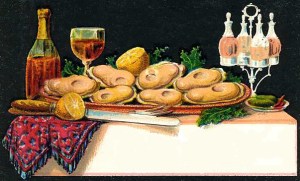
 The nation has begun to grow westward though settlement is still mostly along the coast. Seven cities exceed 10,000 in population in 1810, rising to eight over the decade. In the largest city, NY (152,056 in 1820), commerce is on the rise, yet by mid-decade there are only eight hotels and five banks. Pigs run free in the streets. The defeat of Britain in the War of 1812-1815 does not cause an immediate end to British influence on public eateries, though there are a few French restorators. Beefsteaks are popular and oysters are served almost everywhere. Alcohol flows freely. Most eating places are also drinking places and boarding houses as well. Board can include lodging or not — some people pay a weekly or monthly fee simply for meals.
Highlights
1810 With close to 34,000 inhabitants Boston, the nation’s fourth largest city, has almost 50 victuallers who run either cook shops where householders take food to be cooked or places where cooked food is served on the premises. There are also five confectioners, one restorator (Jean Gilbert Julien), three taverns, three coffee houses, and seven wine shops, some of which serve cooked food.
1811 Robert Wrightson, owner of the Union Coffee House in Boston, advertises for “a young Woman to do Kitchen Work.” He has recently opened a hotel near Cambridge where, he promises, he will stock the finest Champagne, Madeira, Sherry, Port, and London Brown Stout. Also on tap: bowling alleys and “Dinners and other Refreshments provided at the shortest notice.”
1814 In Newport RI, N. Pelichan announces he has opened a Victualling House and is ready to serve “good Beef-Steaks, Oysters, Turtle-Soups, etc. with Pastries, Wines and all kinds of Spiritous Liquors, of the very best quality.” He looks forward to hosting dinners and suppers for men’s clubs and societies which make up a good part of the dining public.
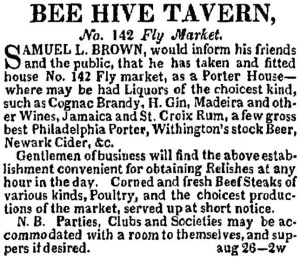 1815 On July 17 Hannah Julien, who has run Julien’s Restorator since the death of her husband Jean ten years earlier, informs the public that she will be serving a “fine green turtle” that day. – In Salem MA, John Remond, who is black and from the West Indies, also runs a restorator where he prepares soups, green turtles, cakes, wafers, French rolls, and other delicacies.
1817 Boasting that he has cooked for wealthy men as well as President James Madison, Henry F.Doyhar promises to furnish breakfasts, dinners and suppers at his Washington, D.C. fruit and pastry shop “on the shortest notice.” Evidently he also has a billiard table on the premises because a few months later he receives a pardon from President James Monroe for keeping it without a license. – Meanwhile, over in Georgetown William Collins lures epicures with “the richest gravies, finest jellies,” York, Cove, and Nantiquoke oysters, canvassback ducks, and “every article that will serve to embellish a supper, and give gaiety and animation to the repast.”
1818 For a day of recreation, Philadelphia families head to Greenwich Point Tavern on the Delaware River. They order a meal or simply graze on turtle soup and ice cream which are prepared every Sunday. If they become bored they take a boat ride across the river to Gloucester Point on the New Jersey side.
1819 A New York oyster cellar on Chatham Street fills up around 9 pm with patrons who drop by for fried, stewed, or raw oysters washed down with their favorite alcoholic beverages. A visitor describes the interior: “There were several tables in little boxes, covered with cloths not very clean, and having broken castors, filled with thick vinegar and dirty mustard, together with knives and forks not very tempting in their appearance.” He is also critical of the age of the patrons (too young), their appetites (too big), and the times (too extravagant).
© Jan Whitaker, 2009
Read about other decades: 1800 to 1810; 1860 to 1870; 1890 to 1900; 1900 to 1910; 1920 to 1930; 1930 to 1940; 1940 to 1950; 1950 to 1960; 1960 to 1970; 1970 to 1980

 It's great to hear from readers and I take time to answer queries. I can't always find what you are looking for, but I do appreciate getting thank yous no matter what the outcome.
 Restaurant-ing through history
Absolutely fascinating – all those turtles and oysters! I’ve just discovered your blog and will now be exploring regularly.
Pingback: Topics about Wines » Taste of a decade: restaurants, 1810-1820
Pingback: Taste of a decade: restaurants, 1810-1820