

The early French restaurants in this country probably were the best places to eat in the late 18th century and early 19th. Along with gourmet food (they said), they offered to improve the health of ailing patrons. This was in keeping with restorators in France at the time. [Above: part of an 1800 advertisement for a new Portland ME restorator]
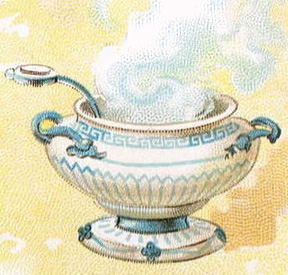
Among customs that differentiated restorators from eating places in general was their soup. As in France in the early days of the development of the restaurant, soup was an important part of the business. It was meant to restore health, leading the eating places that specialized in it to call themselves restorators.
Restorators in this country offered other dishes as well as soup, of course, but the fact that they served soup tended to set them apart from other eating places which generally did not offer it at that time. Julien, whose restorator is considered the country’s first “restaurant,” was known as the “prince of soups.” His soups included barley, turtle, and “brown soup,” which was a beef consommé. Like many restorators, he also offered alcoholic beverages including wine.
Most of their advertising does not mention cost, however one that does quotes shockingly high prices in 1797. A Philadelphia restorator named Bossee offered “Jelly Broths, and every thing that may be wished for, as well Liquors and Meats of all kinds. Exactly at Three o’clock there will be a Dinner served, at One Dollar for each person, with half a bottle of old Bourdeaux wine.”
That, and a few comments I’ve found from the days in which they flourished suggest that restorators were patronized by men who were wealthier than the average.
Of course, restorators also provided a wide range of dishes beyond soup. Pastries were specialities too. Boston’s Dorival & Deguise advertised in 1796 that they furnished “every thing that the season affords, such as Meat, Poultry, Fish, Vegetables, Fruit, etc., which will be varied with a great variety of excellent Creams, Pies, Cakes, etc. – such as never fail of pleasing the palate of Gentlemen who are in, or out of Health.” Note that American cooks of that time were not known for their skill in creating pastries.
The custom of many restorators of providing alcoholic beverages put restorators on the list of objectionable public resorts in the eyes of the anti-alcohol forces that gained strength in the 1830s. A magazine titled The Youth’s Companion published an article in 1837 that worried about how (male) youth would spend time “at the fashionable ‘Restorator,’ where the taste of its delicacies and the fumes of the wine cup and the cigar will soon obliterate the salutary impressions you may have received by reading the Youth’s Companion, or at the Sabbath School.”
It is true that the period in which restorators flourished in cities was in fact considered by historians as “probably the heaviest drinking era in the nation’s history.” [Drinking in America, Edward Lender & James Kirby Martin] But most heavy drinkers were imbibing liquor, not wine.
Nevertheless there were still places called restorators as late as the 1880 census, though maybe they were just restaurants calling themselves that, or a designation made by old-fashioned census takers. Advertisements did not mention soup or an emphasis on health beyond the 1830s.
© Jan Whitaker, 2025


 It's great to hear from readers and I take time to answer queries. I can't always find what you are looking for, but I do appreciate getting thank yous no matter what the outcome.


 Restaurant-ing through history