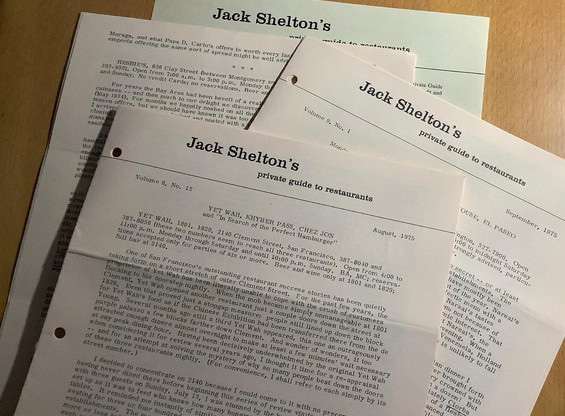
I recently bought the three newsletters by San Francisco restaurant reviewer Jack Shelton shown above. At least I thought they were written by Jack Shelton.
But I was wrong.

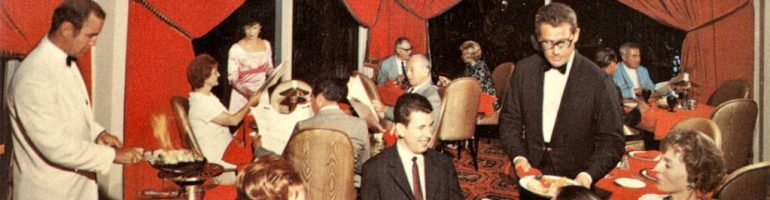
He began producing the newsletters in 1967, eleven years after he came to Sausalito, near San Francisco. His main occupation was producing direct mail advertising and fundraising appeals. But in 1959, before beginning his “private guide,” he had published a 94-page booklet called Jack Shelton’s Gracious Dining Guide to Outstanding Restaurants in San Francisco. Another venture was a popular book that he and his partner updated every few years called How to Enjoy 1 to 10 Perfect Days in San Francisco, which also included restaurants [shown above]. Both the guide book and the newsletter were co-authored by Jack Juhasz, but Shelton’s name was featured. Juhasz lived with Shelton and it’s likely they were life partners as well as business partners.
It did not take long for his newsletter to catch on with San Franciscans. Almost immediately he had 3,000 subscribers and the number continued to grow. Soon he was also being interviewed on radio programs and frequently mentioned in newspaper columns.
He had strong opinions about restaurants. An early citing of his newsletters noted that he was a tough critic who “finds the quenelles lacking in flavor, their sauce containing too much brandy, the escalope du veau in too thick a covering, and the salad dressing too sweet. The souffle ‘proved to be pudding-like in texture and a disappointing finale . . .’ The check, including an $8 bottle of Chateau Magdelaine (served in too small glasses), was $27.95 for two.”
He was also quite critical of waiters. On a radio show in 1968 he boldly declared, “Waiters are like dogs – they know when you’re afraid of them. Otherwise they lick your hand.”
He measured a restaurant’s quality by what customers got for their money. So he might give a more favorable review to a casual, inexpensive place such as Tommy’s Joynt or a Haight-Ashbury restaurant with a $3 wiener schnitzel.
As is almost certain to happen to any reviewer, he made some restaurant people angry. The chef of the Palace Hotel reacted badly when Shelton criticized his filets of sole in champagne sauce, saying they were “tasteless” with a “curdled” sauce. The furious chef declared that the sauce was impossible to curdle and that he disliked critics who wouldn’t identify themselves.
Shelton said he ate in restaurants six times a week, visiting those he was reviewing three times, and paying his own bill. And he tried to keep his identity secret. He sometimes wore a mask and wouldn’t allow his picture to appear in papers or magazines.

For instance, he appeared wearing a mask in 1974 when he testified in favor of then President of the Board of Supervisors Dianne Feinstein’s truth-in-menu law. It would have banned frozen dishes that were represented as fresh and other deceptions. In reply to an official’s comment that waiters might notify diners which dishes were frozen, he responded, “All waiters lie.” [Above: maskless Shelton in 1958]
Do reviewers lie too? In Shelton’s case the deception was that as of 1972 he was no longer the author of the restaurant newsletter.” He had sold his private guide to restaurants to wine critic Robert Finigan yet the name remained “Jack Shelton’s private guide to restaurants” as before.
When this became public news some reporters and columnists may have felt a little bit foolish. In May, 1976, columnist Stan Delaplane had referred to Shelton’s restaurant newsletter, calling him “the biggest hitter in San Francisco’s area.” He also reported that a restaurateur was worried that Shelton had been in his restaurant the night before. (Actually, he may have simply been there as a customer.)
It wasn’t until August, 1977, that the San Francisco Chonicle’s Herb Caen revealed that “a plug in Jack Shelton’s Private Guide to Restaurants is not a plug from Jack Shelton, since he no longer writes it” and “hasn’t . . . since 1972,” when he sold it to Finigan. Then he commented, “I thought all you people who say ‘I can’t STAND the way Jack Shelton writes!’ would want to know this.”
It isn’t clear exactly what Finigan renamed it, or exactly when, though it was during or after 1978. In 1982 I saw a mention of “Finigan’s Private Guides to Wine and Restaurants.” In 1981 Finigan had published a book about restaurants called “Robert Finigan’s Guide to Discriminating Dining in San Francisco.”
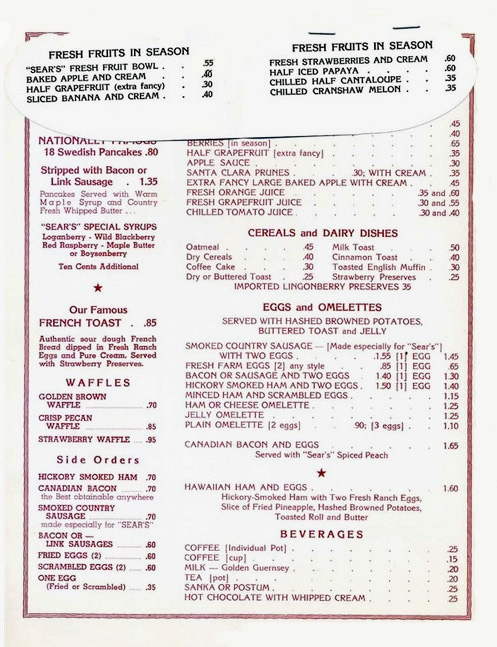
Despite not owning a true Shelton guide, I got a glimpse of a few pages from one in 1968 — when he truly did author it. In it he reviewed Rue Lepic, which he noted was a well-liked restaurant that all his readers wanted him to review, and Sear’s, which was famous for its breakfasts. [Note: the page from the Sear’s menu shown above is earlier than his review.]
Shelton remained a restaurant critic, with a radio show in 1981, but his direct mail business came first. Among the people and causes that he wrote newsletters for were Jesse Jackson and Common Cause.
© Jan Whitaker, 2025


 It's great to hear from readers and I take time to answer queries. I can't always find what you are looking for, but I do appreciate getting thank yous no matter what the outcome.
 Restaurant-ing through history