Tag Archives: movie stars

Restaurant-ing in movieland

In 1916 a newly arrived New Yorker named Adolph “Eddie” Brandstatter and a partner opened a café in Los Angeles. Modeling it on an unnamed New York City restaurant, they named it Victor Hugo and designed it to introduce fine French cuisine and continental service to the cafeteria-loving city.

Four years after opening the Victor Hugo, Brandstatter turned his attention to a Santa Monica project, the Sunset Inn, buying it with a new partner and selling his share in the Victor Hugo. His short tenure at the Victor Hugo was an early sign of his seeming “love it and leave it” relationship to most of the restaurants he created. Despite that, he rapidly became a well-known and well-liked public figure.

Trying to track all his restaurant ventures is a dizzying job.

By June of 1920 the Sunset Inn, which had served as a Red Cross center during WWI, had been remodeled and outfitted with a jazz band. Wednesdays were devoted to performances by Hollywood actors. But in 1922, less than two years after its opening, and despite the Inn’s apparent success, Eddie sold his share and moved on.

That same year, only a few months after departing from the Sunset Inn, he bought a new restaurant, the Maison Marcell, remodeling and reopening it. A little more than a year later he remodeled it again, renaming it the Crillon Café. Meanwhile, shortly after opening the Marcell, he had advertised the sale of his home’s furnishings, including suites from the living room, dining room, and two bedrooms, along with curtains, draperies, oriental rugs, flatware, and tableware.

Presumably the sale was meant to raise funds for his next project, the Café Montmartre which he opened in January of 1923 on Hollywood Boulevard, with a coffee shop below it on street level. At the luxurious Café Montmartre he continued the method of luring customers that had been adopted at the Sunset Inn: linking the café to the movies, attracting stars and a gaping public. Reputedly this often involved subsidizing meals for actors short on funds. [photo: Los Angeles Public Library]

The Montmartre would become the restaurant most closely identified with him, and the longest lasting of his cafes, staying in business for nine years. He took an active role in it, greeting and mingling with guests from the film industry, as well as overall management. Yet that workload barely slowed him down. In May of 1923, the Los Angeles Examiner announced that Eddie, “Little Napoleon of the Cafes,” was planning to open “the exclusive Piccadilly Coffee House on West Seventh street between Hill and Broadway.”

1925 was a busy year of ups and downs. The Crillon closed, as did his newly opened cafeteria called Dreamland, not even open for a full year. It was the only cafeteria I’ve ever come across that had dancing!

He also began a catering company that furnished food to movie casts and crews. In the next few years, the catering company took on some big projects. In one case it provided meals for 2,500 in Yuma AZ when the Famous Players-Lasky studio was filming Beau Geste. [above photo] To do that it was necessary to build a plank road atop the sand and to drill wells. The company also catered to studios when they filmed in Hollywood at night, as was the custom. That could mean serving as many as 25 studios on some nights.

The Depression – and probably the end of silent film — took a toll. When Montmartre began to sag, he opened a swanky club next door for film people called the Embassy. It opened in 1929, closing three years later when his decision to open to the public failed to rescue it. [above: the public waits to get in] Also, in 1932 he was caught removing art objects and furnishings from the then-closed Montmartre, planning to use them in his next venture. At his trial it came out that the actual owner of the Montmartre was the realtor who had built the Montmartre and backed him by putting up capital, loaning him personal funds, and paying him a salary of $100 a week. He was found guilty and put on probation for two years.

In 1933 he opened a restaurant he called Sardi’s but in no way connected to New York’s Sardi’s. With booths, tables, and fountain service, and featuring his popular set-price buffet luncheon, it quickly became a success. Its success did not stop him, however, from launching another restaurant, a chop house called Lindy’s that he seemed to have no further link to. In 1936 Sardi’s was destroyed by fire. When it was rebuilt two years later he sold his share to a partner. [rebuilt Sardi’s shown above]

In 1939 he opened his final eating place, the Bohemia Grill, with prices as low as 35c for Pot Roast and Potato Pancakes. The following year he took his own life, apparently troubled by money worries. Among the honorary pall bearers at his funeral were Charlie Chaplin, Tom Mix, Bing Crosby, and studio head Jack Warner.

© Jan Whitaker, 2024

8 Comments

Filed under patrons, popular restaurants, proprietors & careers, restaurant catering

The celebrity connection

Celebrities – and their names and faces – have had multiple connections with restaurants, generally adding to the glamour or appeal of the restaurants involved. One of the most obvious and probably the oldest attraction is the chance that customers will spot celebrities in a restaurant.

Restaurateurs and silver screen celebrities capitalized on that attraction in the 1930s and 1940s by encouraging gossip columns to publish sightings of dining celebrities. Despite their lack of real significance or accomplishments, the Duke and Duchess of Windsor were one of the celebrity couples most often attracting columnists’ attention in restaurants.

About the same time, there were also eating places, especially delicatessens, that named sandwiches for stars of stage and screen. Reuben’s was the best known, but in 1931 there was also Dave’s Blue Room, another NYC deli. As late as 1960 a Hollywood deli menu was full of humorous names such as Lox Hudson, Lucille Matzo Ball, and Judy Garlic.

Other eating places such as The Brown Derby and Sardi’s displayed portraits of celebrities who were past or present patrons of that restaurant.

But the BIG bump in celebrity links to restaurants came in the late 1960s and 1970s with the franchising boom. Many restaurant chain franchisers believed that by linking a chain to the name of a well-known athlete, singer, or actor, they would sell more fried chicken or hamburgers. Usually the celebrity was paid a fee and possibly a percentage of profits for their participation, which could involve taking the role of chairman of the board or as little as lending their name or likeness or making an occasional appearance at openings.

Much of the time the deal turned into a losing proposition for those celebrities who put their own money into the venture, as well as for stock market investors and franchisees. Joe Namath dismayed investors when he announced in 1969 that he was retiring from football to become chairman of Broadway Joe’s. The following year he pulled out when the chain’s stock plummeted downward. Within two years of becoming chairman of the soon-defunct Mickey Mantle’s Country Cookin’, the former New York Yankee resigned.

Some other sports figures who lent their names to restaurants included Dizzy Dean, Rocky Graziano, Fran Tarkenton, and Brady Keys.

Among Black celebrities failure took on a sadder note, given that some of them had hoped to bring business opportunities to Black communities. Other Black entertainers with restaurant connections were Fats Domino, Mahalia Jackson, and Sammy Davis, Jr. Black athletes included Jackie Robinson, Muhammad Ali, and Brady Keys, who created and headed All-Pro Chicken. In 1969 he had 10 outlets in San Diego, where he began the chain, as well as in Pittsburgh, Rochester, and New York City. Like Muhammad Ali, Keys hoped to spur Black business, and enjoyed much better luck than Ali, who lost a lot of money fast with his short-lived Champburger chain.

Among singers and musicians who joined restaurant ventures in the 1960s and 1970s were Trini Lopez, Tony Bennett, Julius LaRosa, Eddie Arnold, Tennessee Ernie Ford, Hank Williams, Pat Boone, and Al Hirt. Most of them took a bruising. Some other entertainers were Minnie Pearl, Dean Martin & Jerry Lewis, Jackie Gleason, Arthur Treacher, Johnny Carson, and Rodney Dangerfield. [Tony Bennett display above]

Observers were quick to point out that the celebrities who did well with a restaurant or chain were those whose places had good food and management. Of themselves, celebrity connections counted for little or nothing. A frequently cited example of a success story was the Gino’s Pizza chain [not to be confused with Papa Gino’s]. Its good fortune was attributed to food quality and good management, rather than a name. In fact, most customers had no idea that Gino was Gino Marchetti, formerly of the Baltimore Colts.

But while a celebrity name could not guarantee restaurant success, it could be helpful. As Steve Chrisman, manager of two Sam’s Cafes in NYC (the name was the nickname of his wife Mariel Hemingway), would observe in the 1980s, “You need to get customers in to become visible. Mariel’s notoriety was important.”

The new wave of celebrity involvement in restaurants came in the late 1980s when it became popular to invest in restaurants, particularly for film stars. The restaurants were nearly all located either in NYC or the Los Angeles area. Involvement was largely financial and rarely meant day-to-day management. In some cases stars grouped together as was true of Malibu Adobe that came into being in 1987 through a venture by Dustin Hoffman, Tony Danza, Bob Newhart, Stacy Keach, Alan Ladd Jr., and Randy Quaid, with Ali McGraw [shown above] in the role of decorator.

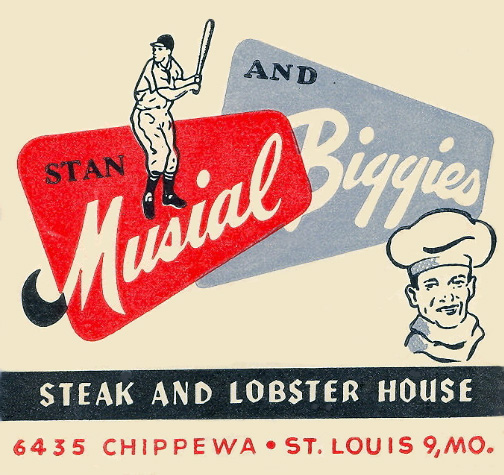
The 1980s wave was not about franchised chains, but mostly single restaurants. And that probably tended to give them a somewhat higher survival rate – as it had earlier for Joe DiMaggio, Joe Lewis [above, ca. 1940], Jack Dempsey [shown at top], and Stan Musial. Some of the new restaurants bore celebrity names, for example Charo’s Cantina, Tommy Lasorda’s Ribs and Pasta, and Bono, owned by Sonny Bono. Most did not, e.g., Dolly Parton’s Dockside Plantation, Tom Selleck’s Black Orchid, Clint Eastwood’s Hog’s Breath Inn, or Midwestern exception Oprah Winfrey’s The Eccentric. But their connections were widely known by patrons and they could sometimes be spotted dining in “their” restaurant.

The next wave of celebrity restaurants would feature famed chefs. But that’s another chapter in restaurant history.

© Jan Whitaker, 2023

11 Comments

Filed under chain restaurants, proprietors & careers