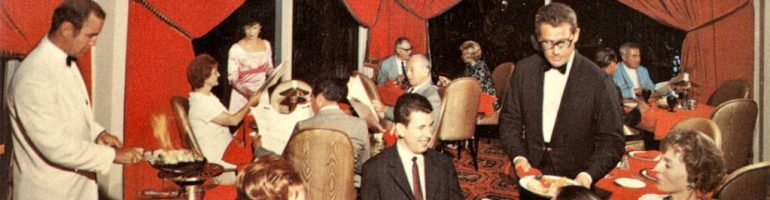

I wish I could explain the Vesuvio’s holiday cards, but I can’t. Maybe it’s enough to know that the Café was a beatnik gathering spot in San Francisco.
The café was founded in 1949 by Henry Lenoir, who wore a beret and undoubtedly preferred to spell his first name as Henri. I’m guessing he’s the aging cherub on the left on the 1956 postcard above. I couldn’t find much about him other than that he was born in Massachusetts around 1904. The son of a Swiss university professor, he was a college graduate at a time when that was fairly unusual. In 1940, before he opened the café, he worked as a salesman in a San Francisco department store that I like to think was the Emporium. He was an art lover who enjoyed the company of beats and hipsters.
I don’t know if the Vesuvio served much food. It seemed to be more of a drinking than an eating place back in the days when Henry presided behind the bar. A sign in the window advertised “booths for psychiatrists” and a “Gay ‘90s Color Television” flashed old photos of women clad in bloomers. In the late 1950s it was on the North Beach circuit for beatniks who made the rounds from the Vesuvio to the Coexistence Bagel Shop and a nameless bar called “the place.” No doubt they stopped in at the City Lights bookstore too; Henry lived upstairs.
 It was the day of the Hungry I, the Purple Onion, and the Anxious Asp (where the restroom was papered with pages from the Kinsey Report). “The place” and the Coexistence, considered the birthplaces and headquarters of the San Francisco beats, were both gone by early 1961. But, although Henry sold the Vesuvio in 1970, it continues even today. Of course it isn’t the same. Given that Beatnik dens became tourist sites almost overnight, it already wasn’t the same in 1964 when the card with the 5 nude mannequins and one real woman modestly dressed in a long-sleeve leotard was produced.
© Jan Whitaker, 2013
 What could be more starkly different from the somber coffee shops of today with their earnest and wired denizens than the beatnik coffeehouses of the 1950s? Could Starbucks be anything but square to the beat generation?
 Although the word beatnik came into usage around 1958 (inspired partly by Sputnik), the phenomenon of dropping out of the “rat race” to lead an existentialist, non-consumerist life was part of the aftermath of World War II akin to the “Lost Generation” after World War I. The first coffeehouses sprang up in Greenwich Village in the late 1940s, but the beats weren’t averse to hanging out in cafeterias either — their “Paris sidewalk restaurant thing of the time.” When coffeehouses began levying cover charges for performances, beatniks tended to drop out of them too.
 The heyday of the coffeehouse was the late 1950s into the early 1960s. Few did much cooking so they weren’t restaurants in the true sense, but many of them offered light food such as salami sandwiches (on exotic Italian bread) and cheesecake, along with “Espresso Romano,” the most expensive coffee ever seen in the U.S. up til then. Of course the charge for coffee was more a rent payment than anything else since patrons sat around for hours while consuming very little. Other then-unfamiliar food offerings included cannolis at La Gabbia (The Birdcage) in Queens, Swiss cuisine at Alberto’s in Westwood CA, Irish stew at Coffee ’n’ Confusion in D.C., les fromages at Café Oblique in Chicago, “Suffering Bastard Sundaes” at The Bizarre in Greenwich Village, and snacks such as chocolate-covered ants and caterpillars at the Green Spider in Denver.

 It's great to hear from readers and I take time to answer queries. I can't always find what you are looking for, but I do appreciate getting thank yous no matter what the outcome.
 Restaurant-ing through history