Category Archives: popular restaurants

High-volume restaurants: Crook & Duff (etc.)

crook&nashADV1875Luxury restaurants are more likely to become memorialized by time, but often ordinary restaurants have a history that is equally rich and played a more significant role in the everyday functioning of society.

That was certainly true of a restaurant that opened in New York City’s “Newspaper Row” in 1858 under the name of its two proprietors, Crook & Duff. The popular restaurant persisted until at least 1906 under nine different names and with four different addresses. It was considered not only a fine place to eat — “a marvel of gastronomic entertainment” – but also a depot where ideas were exchanged.
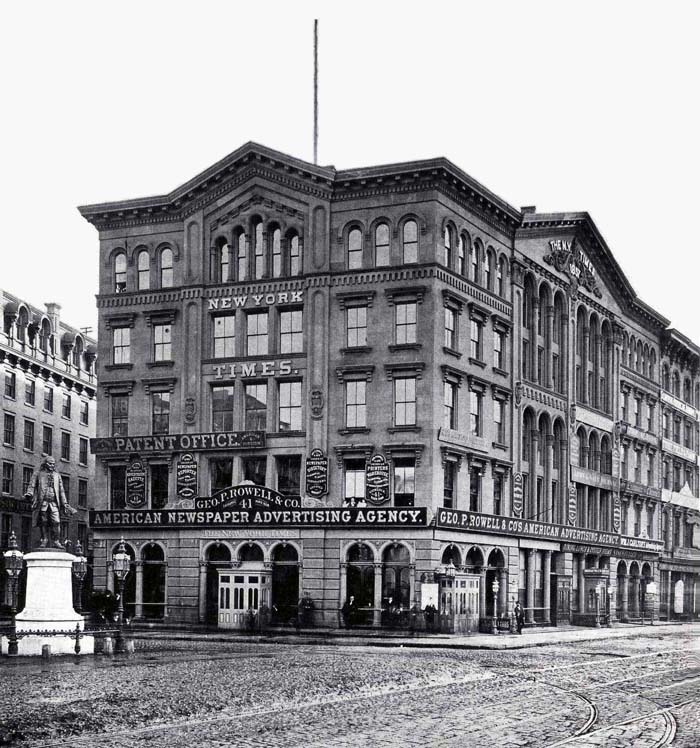
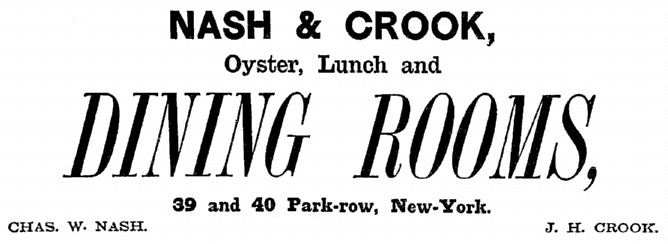
crookNYT1874Proprietor John Crook was already an old hand in the restaurant business by 1858, having learned the business from his uncle who ran an eating stand in Fulton Market. Crook then went into business with a brother, and next ran several places on his own before he and theatrical manager John Duff opened a restaurant in the newly constructed New York Times building on Park Row. [Unfortunately no signs for the restaurant are visible in the 1874 photograph shown above.] It was an excellent location since City Hall, the main Post Office, a new court building, and many newspaper and periodical offices were located close by. Journalists and printers especially, with their odd hours and relative freedom to roam the city, were frequent patrons of eating and drinking places such as Crook & Duff, aka Crook, Fox & Duff; Crook, Fox & Nash; Nash & Fuller; Nash & Crook; Nash & Brush; George S. Brush; Brush & Foy; and Foy & Crook.

The people of prominence who ate at Crook & Duff and its successors were numerous, many of them lawyers, journalists, business men, and political figures. Feminist publishers of Woodhull & Claflin’s Weekly, Victoria Woodhull and Tennessee “Tennie” Claflin, were frequent patrons in the 1870s – probably eating in a room reserved for ladies (assuming they found  that acceptable). The restaurant was popular with women clerical workers in the 1880s when their numbers were on the increase.

The restaurant remained in the Times building, occupying the basement and much of the first floor for thirty years, while doing business under five different names, the best known and longest lasting being Nash & Crook. In 1888 it moved a short distance to 16 Park Place.

Nash & Crook (etc.) was known for good food, reasonable prices, and fast, expert service. Broiled oysters and corned beef hash were specialties. Fruits and vegetables came from the Oneida Community, a religious commune in upstate New York. The bar did a brisk business in gin slings and brandy smashes, especially during election season.
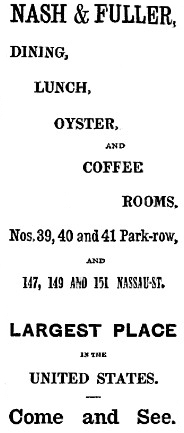
crook&NashSept51870Serving food from early morning until late at night, the restaurant was a high-volume business, dishing out up to 2,000 mid-day meals daily. In 1870 it claimed to have the largest dining room in the U.S. The lunch counter was 60 feet long. Even so, from noon to 3 p.m. it would often become so crowded that customers would stand and eat from plates in their hands. Many customers were regulars, including men who took all their meals there – and only there – for decades.

Reputedly it was the second restaurant in New York City to hire African-American waiters. During the Civil War draft riots of July 1863 when white mobs attacked Black men, the restaurant sheltered its staff in the basement. Many of the staff from both races were long-term employees. A Black waiter, John Thomas Cooper, worked at the restaurant from 1859 until his death in 1893, becoming a favorite for his sense of humor.

As late as 1927 a letter to the editor of the New York Times mourned the loss of Nash & Crook’s corned-beef hash.

© Jan Whitaker, 2015

2 Comments

Filed under popular restaurants, proprietors & careers

Ohio + Tahiti = Kahiki

kahikiExterior

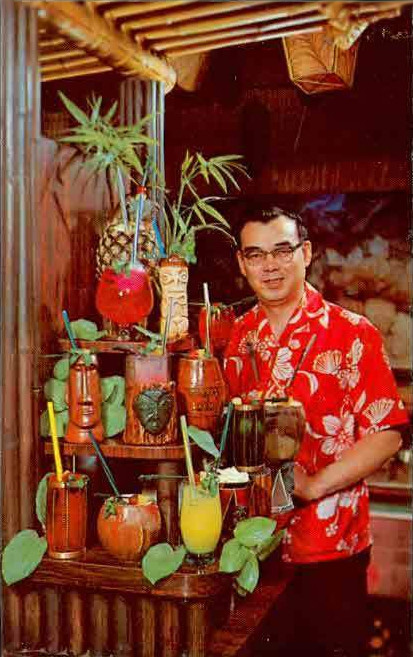
In the heyday of Polynesian restaurants, the 1960s and 1970s, the business attracted operators because of high profits in rum drinks. Their marketing relied on bar decoration, bartender apparel, drink names, elaborate serving vessels, and imaginative presentation.

The same was true for “Polynesian cuisine.” There could be no such thing as a Polynesian restaurant without fabulously kitschy decor.

Whatever Polynesian cuisine was, it certainly wasn’t what real Polynesians ate past or present. The Kahiki’s reference point was Tahiti. So, what were Tahitians eating in 1961 when the Kahiki opened? According to a geographer, the traditional Tahitian diet consisted of baked fish, breadfruit, and taro, but natives then preferred French baguettes with Australian butter, rice from Madagascar, canned beef from New Zealand, and Canadian canned salmon, all “washed down with generous drinks of Algerian red wine.”

KahikiDrinksIt’s doubtful that Tahitians ate much in the way of Oriental Beef or Tahitian Flambee (flaming ice cream with rum). Not to mention Tossed Green Salads, Eggs Benedict, or Reuben Sandwiches.

But people didn’t go to the Kahiki mainly for its food. As an unenthusiastic reviewer wrote in 1975, “If decor is your reason for dining out, the Kahiki in Columbus is the place for you.”

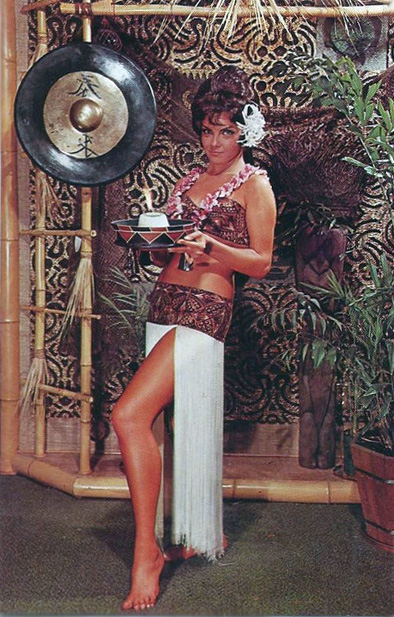
Its drinks, on the other hand, were hard to resist. With three bars on the ground floor alone, the Kahiki’s menu at one point illustrated drinks served in 30 different glasses, goblets, and ceramic cups and bowls. The most expensive was the Mystery Drink served with four straws. Its presentation involved a scantily dressed server, a gong, a lei, and a kiss. There were also Smoking Eruptions, with fumes emanating from chunks of dry ice, as well as Pago Passages, Malayan Mists, Tonga Tales, and Native Nectars.

kahikiserverBeyond rum, customers were dazzled by the restaurant’s architecture, decor, and theatricality (e.g., periodic thunder and lightning). In the restaurant’s last decades its fans celebrated it as a temple of kitsch but, surprisingly, in earlier years it was often regarded as authentic.

The building reportedly cost $1 million to build in 1960 and, with 560 seats, was the largest Polynesian restaurant in the U.S. In a flat landscape peppered with indifferent utilitarian structures, it was a startling sight that promised relief from drab ordinariness. Stepping beyond the up-swooping 50-foot facade the visitor entered a darkened Tahitian village with tall palm trees, waterfalls, thatched huts, idols, and a wild profusion of South Seas-style artifacts.

The Kahiki’s decorator, artist and engineer Coburn Morgan, was a prominent Ohio restaurant designer whose career may have been launched by his work on the Kahiki. The flamboyant design of the Kahiki was undoubtedly due to him.

In 1960, when he drew the sketch shown above, Morgan was head of the design division of the Tectum Corporation which furnished many of the composite building materials used in the construction of the Kahiki, including pressed wood for roof supports as well as for soundproofing and decorative wall panels. It may also have been used for flooring and for the stylized fish arrayed along the roof’s crest.

kahikiTangierCMorganFollowing completion of the Kahiki, Morgan designed the Aztec-themed Thunderbird Restaurant (Lima), a red-fronted prototype for the Bob Evans chain (Chillicothe), McGarvey’s Nautical Restaurant (Vermillion), the Wine Cellar (Columbus), Jack Bowman’s Steak House (Columbus), the Brown Derby (Columbus), the 18th-century-themed Old Market House Inn (Zanesville), the Tangier Restaurant (Akron — pictured), Mawby’s (Cleveland), and the “Western Victorian-style” Judd’s (Cleveland).

For theme-restaurant inspiration, Morgan traveled to the American West for the Bob Evans chain and to Lebanon for the Tangier, which was modeled on the summer palace of the head of state. The Wine Cellar, owned by Kahiki creators Bill Sapp and Lee (Leland) Henry, had a Shakespeare theme. When it failed in 1991 “16 tall carved knight’s chairs” and a “grand piano bar with winged dragon” were among the furnishings auctioned.

During its more than 50-year run the Kahiki, which was also a nightclub and banquet center, entertained hundreds of thousands of individuals and groups such as Jaycee-ettes, senior citizens, anniversary and wedding parties, and so on. Despite its listing on the National Register of Historic Places and the efforts of local preservationists who felt the Kahiki was an important part of Columbus’ cultural identity, it was demolished in 2000.

© Jan Whitaker, 2013

Leave a comment

Filed under Polynesian restaurants, popular restaurants

Reuben’s: celebrities and sandwiches

Once upon a time there was a famous NYC restaurant called Reuben’s. Today there is a famous grilled sandwich of corned beef, Swiss cheese, sauerkraut, and Russian dressing on pumpernickel called a Reuben. Wouldn’t it make a nice story if the sandwich came from the restaurant?

The connection has been well researched yet it remains unresolved. For anyone who wants to examine the matter in detail, I recommend Jim Rader’s excellent account. He has the last word, inasmuch as there is one.

Two important points. 1) No one has come up with an early menu from Reuben’s that lists the Reuben sandwich as it is known today. It does appear under the name “Reuben’s Pioneer” on a 1971 menu but by then the sandwich could be found everywhere. 2) Despite being a publicity hound – and despite an Omaha woman winning a national contest for creating the sandwich in 1959 — founder Arnold Reuben never laid claim to it as his restaurant’s creation.

What is certain is that the fame of Reuben’s restaurant and delicatessen was built upon sandwiches — and the celebrity patrons who ate them.

I have seen a menu from Reuben’s said to be from 1922. Under the top heading “Reuben’s Famous Sandwiches” are listed 42 sandwiches. Nine are named after celebrities of stage and screen of that time. What is striking about the named sandwiches is that they cost more than the others. At the low end are ordinary sandwiches priced at 35 cents such as Salami, Corned Beef, and Liver Wurst. The special celebrity sandwiches range from 75 cents to a dollar, amounts that would then buy a whole dinner in many restaurants. The specially named sandwiches probably had more ingredients and may have been larger, but the aura of celebrity around them must have added a few cents too.

Naming sandwiches for celebrities was a publicity gimmick probably thought up by a press agent. The columnist Westbook Pegler claimed that Reuben’s initially acquired fame because of publicity generated by the audacious Harry Reichenbach who encouraged Arnold to sue a well-known New Yorker over the price of a ham in 1920. Thereafter, like Lindy’s and the Stork Club, Reuben’s was constantly in the nationally syndicated gossip columns of the 1920s, 30s, and 40s.

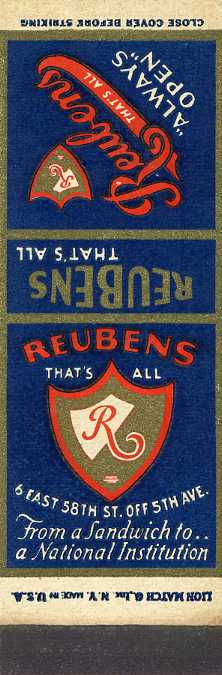
Arnold Reuben was a German Jew who, with his family, immigrated to the US as a young child around 1886. He helped out by peddling produce, then worked at a delicatessen. In 1908 he opened his own deli, which he later referred to as a “shtoonky little store.” By the end of the teens, he was thriving; he had incorporated his Pure Food Shop at 2102 Broadway and opened an eating place at 622 Madison Avenue which was popular with Broadway performers and stars from Hollywood. (Transitions from food store to restaurant are not uncommon and, as was also the case with Texas butcher shops-to-barbecues, often begins with sandwiches.) In 1928 he had a third restaurant in Philadelphia and was said to be “enormously rich.” Adopting the slogan “From a Sandwich to a National Institution,” he often told a story about the first celebrity sandwich he created – ham, cheese, turkey, cole slaw, and dressing — for a struggling young actress.

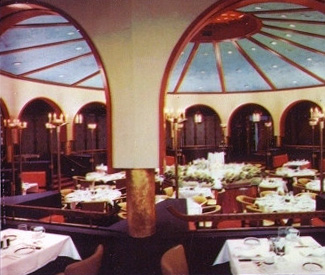
He experienced some financial difficulties in 1933 and filed for bankruptcy but only two years later was back on course with a bigger and better restaurant [pictured] to replace the one on Madison Avenue. Of critical importance to his comeback was the end of Prohibition. His opening announcement in the New York Times attested to this with a prominent display of the names of Reuben’s “friends,” seven liquor manufacturers and distributors.

In 1946 he opened a restaurant on West 57th near Carnegie Hall, with a front nearly identical to East 58th Street. Like his others it was open 24 hours. No doubt it, too, had a doorman who greeted patrons with the bywords “Reuben’s, that’s all.” Larger than the East 58th place, it was billed “A City in Itself,” and contained shops for delicatessen, flowers, chocolates, cigars, and theater tickets, as well as a perfume bar and a barber shop. Despite all, it silently disappeared a couple years later.

Arnold retired to Florida in the mid-1960s and sold the business, which he had turned over to his son to manage years earlier. Reuben’s in NYC continued under new ownership at various locations until 2001. A Reuben’s was also opened in Miami in the 1940s but I have not been able to determine its subsequent fate.

© Jan Whitaker, 2012

4 Comments

Filed under food, popular restaurants, proprietors & careers

Steakburgers and shakes

After recently reading Roger Ebert’s wonderful book Life Itself, I decided to write this post and dedicate it to him. I loved his depictions of his childhood, which included his first restaurant meal, a steakburger at Steak n Shake, near the campus of the University of Illinois in Champaign where his father worked as an electrician. He has also written about the restaurant on his Sun Times blog.

Even though I grew up in St. Louis, where there were many Steak n Shakes, most with curb service in the early years, I knew nothing about the chain’s history then and mistakenly believed it originated in St. Louis. I’m embarrassed to admit that I held a widespread St. Louis prejudice that few good things came from Illinois, the chain’s first home.

The chain was founded by Gus Belt and his wife Edith. Their basic problem was the Depression. The gas station Gus operated in the town of Normal, Illinois, was not thriving. In 1932 he and Edith decided to extend into the restaurant business by converting a house on the property to an eating place serving Edith’s fried chicken and beer, which was about to become legal in the first stage of Repeal. They called it the Shell Inn.

According to Robert Cronin’s Selling Steakburgers, beer was a bigger hit than chicken. Because Normal was the home of a state college that trained teachers, who were supposed to be morally upright, the town had a long history of forbidding the sale of alcoholic beverages. After a brief wide-open period following Repeal, the town voted 2 to 1 to remain dry. Seeing what was about to befall their eatery, Edith and Gus decided to turn it into a hamburger joint.

They followed an honored tradition in the restaurant business of studying the successful practices of others and copying them like crazy.

The Shell Inn’s prime customers were the students at the nearby teachers college. No doubt the Belts had observed how much college students in the neighboring town of Champaign enjoyed hamburgers at the White Spot, the White House Lunch, Wimpy’s, and Maid-Rite. With the switch to burgers, the Belts renamed their place “Whitehouse Steak n Shake.” Later, they would adopt another idea from Champaign’s hamburger sellers, that of selling burgers by the bag (“Buy ‘Em by the Sack” advertised White Spot), borrowing the “Takhomasak” slogan from a Colorado restaurant. The idea of advertising that your hamburgers contained higher grades of steak was not unique to Steak n Shake. In Detroit during the Depression, there were a couple of places advertising this: the Marcus All Steak Hamburger Restaurant chain, and Meyers Real Steak Hamburgers. I wonder too if the Belts got the idea of serving food on china from Champaign’s Wimpy’s.

Their timing was good. Led by youthful first adopters, hamburgers, once shunned by the middle class who associated them with poverty and adulteration, were gaining respectability. Also reassuring was Steak n Shake’s squeaky clean white tile interior characteristic of 1920s lunch rooms and hamburger chains such as White Castle.

Theirs was among a number of hamburger chains that proliferated in the Midwest and other non-coastal areas during the Depression. Among the chains that got their start then were Little Canary Castle (Winston-Salem NC, 1931), Krystal (Chattanooga TN, 1932), Wimpy Grills (Bloomington IN, 1934), White Hut (Toledo OH, 1935), and Rockybilt (Denver CO, 1936). So the 1930s, which had begun so poorly for the couple, turned out well for them.

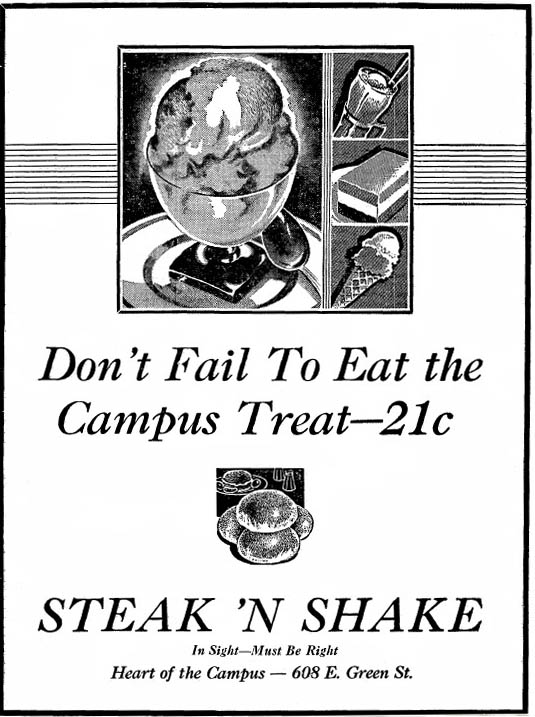
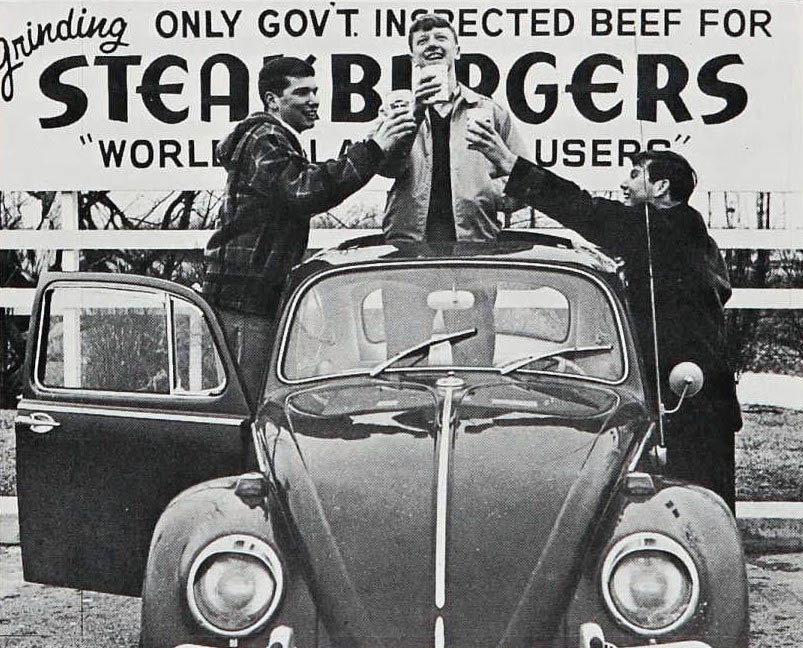
By 1940 the Belts had units in Normal’s twin city of Bloomington, as well as Champaign [1937 advertisement above], Decatur, E. Peoria [pictured at top], Galesburg, Danville, and Springfield. In the late 1940s Steak n Shake moved into St. Louis and in 1959, five years after Gus’s death, with Edith at the helm, there were 14 units in that city. Indianapolis [pictured 1965] and Florida were other early markets. By the time Edith sold the family’s controlling interest to the Longchamps corporation in 1969, there were 50 or so units.

After that the story shifts to corporate history, with decades of ups and downs, aborted openings in Chicago and Texas, modernizations and returns to roots, changes in ownership, and further expansion until today when there are almost 500 units in 22 states.

© Jan Whitaker, 2012

15 Comments

Filed under drive-ins, popular restaurants

Famous in its day: Miss Hulling’s Cafeteria

In 1978 two of the nation’s top grossing independent restaurants were New York’s Tavern on the Green and Mama Leone’s, according to Restaurant Hospitality magazine. At the first, guest checks averaged $14.50, while at Mama Leone’s the average was $13. A big aspect of both restaurants’ business was alcohol, accounting for 30% of revenues in the case of Warner LeRoy’s Tavern on the Green.

Meanwhile, a sturdy favorite in downtown St. Louis, the venerable Miss Hulling’s, home of chicken livers, creamed spinach, and carrot marshmallow salad — with a negligible drinks business – had a check average of $2. Yet it still managed to rank #58 out of the 500 restaurants in the survey.

Miss Hulling’s was the creation of Florence Hulling, who came to St. Louis around 1907 as a teenager from rural Illinois to work as a private cook. After a few years in domestic service she went to work for the Childs restaurant chain. Eventually she was promoted to manager, a rare status for a woman at that time. Childs closed in 1928 and she and her sister Katherine took over management of the cafeteria in the Missouri Hotel. When it closed in 1930 Florence bought the failed restaurant on the opposite corner and named it the Missouri Cafeteria.  It would stay in business there for the next 62 years [shown just before razing].

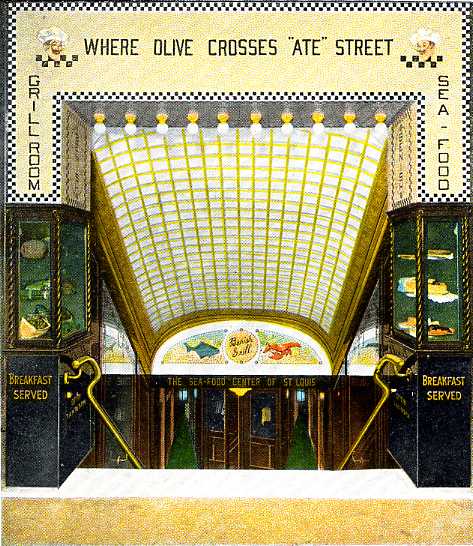
Florence married Stephen Apted in 1931 and in 1934 the Apteds opened a second cafeteria at 8th and Olive, calling it Miss Hulling’s, a name that would eventually apply to the Missouri Cafeteria as well. The Olive Street restaurant occupied a basement site that had previously held the Benish cafeteria [entrance shown] and before that – I think — Lippe’s, a restaurant operated by Detlef van der Lippe.

How well I remember a job I once held chauffeuring an alcoholic boss to Miss Hulling’s, his regular eating place and virtually his true home when he wasn’t bunking in the office of his advertising agency. I suspect he was not the only St. Louisan who relied on Miss Hulling’s for more than just food.

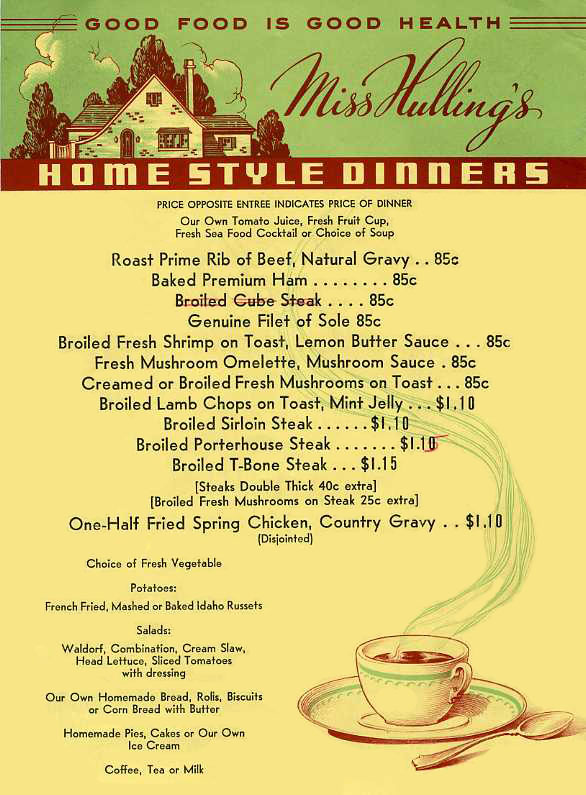
A 1939 Miss Hulling’s menu reveals the kinds of homelike dishes featured there. In addition to those shown, a mimeographed attachment lists a number of dishes not found much in restaurants now. Among the choices are Stuffed Baked Veal Hearts and Braised Ox Joints. If a complete dinner was ordered, for about 50 cents, the diner also got soup or salad, bread and butter, a vegetable such as Creamed Kohlrabi or Fried Egg Plant, a beverage, and a dessert such as Peach Rice Pudding. (See Miss Hulling’s Sour Cream Noodle Bake and her German Chocolate Cake on my Recipes page.)

In the 1940s and 1950s Miss Hulling’s was just the kind of place that earned high ratings from Duncan Hines and Gourmet’s Guide to Good Eating, the latter reporting, “Everybody in St. Louis swears by Miss Hulling’s. Food is exceptionally delicious, clean, and of high standard.” The cafeterias served their own ice cream and baked goods, used fresh fruit for pies, and prepared food in small batches.

Through succeeding decades the Miss Hulling’s enterprise, headed by the couple’s son Stephen J. Apted, grew large. It acquired Medart’s (turning it into the Cheshire Inn), and opened numerous restaurants in the metro area, among them The Cupboard and the Open Hearth, as well as running food services at two hospitals. Headquarters, including a bakery, were at 11th and Locust above the two-floor cafeteria. At the same location were the more formal dining spot Catfish and Crystal, His Lordship’s Pub, and a bakery and ice cream shop. In 1993 the entire operation at this site was closed down, the same fate having befallen the Olive Street cafeteria some years before.

© Jan Whitaker, 2012

107 Comments

Filed under cafeterias, popular restaurants, proprietors & careers, women

Famous in its day: Reeves Bakery, Restaurant, Coffee Shop

The renowned Reeves of Washington, D.C. was a many splendored thing. So much so that for lack of space I had to leave out its other historical identities as Grocery Store, Tea Room, Confectionery, and Soda Fountain. Though called a restaurant, it was really a lunch room of the bakery/confectionery type which closed for the evening.

Over its eleven decades in business the homely eating place expanded, changed focus, remodeled, went through three generations of Reeveses plus two or three other owners, burned, rebuilt, closed and disappeared for a few years, reopened at a new location, and through it all managed to build and hold onto an army of loyal followers who still miss it four years after it closed for good in 2007.

How old was it when it closed? I figure it had been 112 years since its founding as a grocery store by Sewell A. Reeves in 1895. Although the restaurant itself as well as newspaper stories usually dated Reeves’s beginnings to 1886, I have found no evidence for that. In 1887, and up to at least 1892, the 1209 F Street site was occupied by G. E. Kennedy’s grocery store, while Sewell Reeves was identified in city directories as a clerk for other businesses. But whatever … Reeves was D.C.’s oldest surviving restaurant when it closed. According to a 1989 column by restaurant reviewer Phyllis Richman, its nearest competitor for longevity was Napoleon’s, established in 1925.

During its first three years of existence, Reeves expanded his grocery store by adding coffee roasting and candy making operations, a bakery, and a lunch counter which at first seated only 12 people. By 1902 he had enlarged the building with the bakery and candy departments occupying the second and third floors and the lunch counter lengthened to seat 150. At Sewell’s death in 1941 his son Algernon, who had managed the business since 1916, took ownership.

After Algernon died the business was sold in 1966 by his son John to the Abraham brothers who remodeled the premises and successfully broadened the clientele from its traditional feminine base which had largely deserted F Street stores in favor of suburban shopping centers. The middle and late 1960s, characterized by racial unrest and downtown desolation, marked a low point for Reeves, and it would not have been at all surprising if had met its end around 1970 – but in fact it still had close to 40 years of life left in it.

Reeves remained the kind of comforting eating place known for waitresses with long tenure and a menu untouched by the latest food fashions. Affordably priced dishes such as chicken salad sandwiches and pie, especially strawberry pie, were dependable favorites.

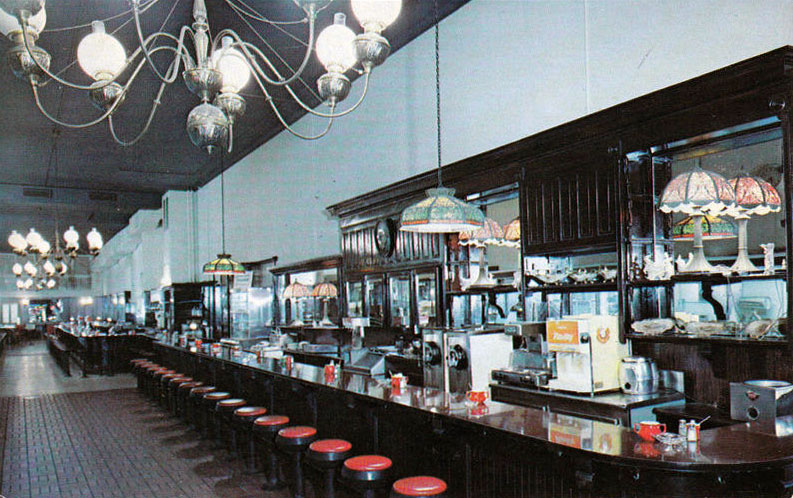
Reeves went through the 1970s with its somewhat dowdy appearance intact. High ceilings were equipped with fans and brass chandeliers, while Tiffany lamps hung over the 100-foot dark cherry counter. [pictured] Then, in 1984, a disastrous fire destroyed the interior. When Reeves reopened in 1985 it had an entirely new look, with blond counters, exposed brick walls, and a dropped ceiling effect with recessed lighting. The old booths were gone, replaced with more comfortable ones padded in dull maroon. Of the original fixtures only the wooden counter stools remained.

Customers had barely adjusted to the modernization when the next blow came in 1988 when the property was sold for $7 million to a developer planning an office building. But Reeves wasn’t finished yet. In 1992 the restaurant’s former general manager reopened it barely a block away on G Street, rehiring much of the old staff and for the next 15 years turning out thousands more strawberry pies.

I have no doubt that even now the occasional visitor can be found on F or G streets looking for Reeves.

© Jan Whitaker, 2011

33 Comments

Filed under confectionery restaurants, popular restaurants

“Hot Cha” and the Kapok Tree

What kind of career might the son of a junk dealer father and a mother who owned a restaurant end up with?

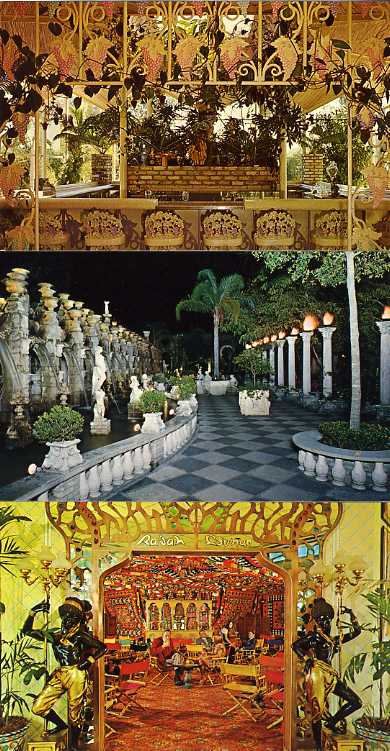
If he was Richard Baumgardner he would run restaurants raucously decorated with gilded and spray-painted objets d’art — wonderfully kitschy palatial junque bought by the ton in Europe (70 tons of statues in 1966). When his warehouse ran low on statues and urns, he would make plastic replicas with rubber molds.

His customers would find it all enchantingly “different.”

But first, he’d take a detour into the entertainment world as a jazz-era musician and bandleader known as Dick “Hot Cha” Gardner. As an introduction to his restaurant career in 1936, Dick inaugurated the Hot Cha Supper Club in conjunction with his mother Grace’s tea room, the Peter Pan Inn in rural Urbana MD. After she died in the 1940s, Dick took over the Peter Pan and transformed it into a let’s-drive-to-the-country mega-attraction for Washington DC families. In 1958, retired from bandleading, Dick opened his first Kapok Tree Inn in Clearwater FL, on the site of a tree planted in the 1880s.

It’s hard to know how to classify his restaurants. They fall into two of my classifications: 1) the high-volume restaurant, and 2) the curiosity-shop restaurant filled with quaint stuff.

The decor at the Clearwater Kapok Tree was a mix of light fixtures from Paris, chandeliers gathered from the DC Italian Embassy and old theaters in Baltimore and New York City, paneling from a De Medici compound replicated in plastic, and on and on.

Yet for all their madcap faux elegance, Dick’s restaurants followed a rigid formula designed for maximizing profits and minimizing costs. Magically, it worked. Despite ticket windows where customers were required to prepay their dinner tab, a teen-age staff, long waits for tables (in the bar), sticky sweet rum drinks, and limited menus with pedestrian cuisine, customers absolutely adored these zany buses-welcome eateries.

For years diners had just four dinner choices: fried chicken, ham, deep fried shrimp, and steak. When customers sat down at their tables, servers collected their receipts, knowing immediately by the prices what they had ordered. A complete meal included a typical 1950s melange of appetizers which never varied year in and year out, whether in Maryland or Florida — cottage cheese, (sweet) pickled vegetables, muffins, and apple butter. Sides were roast potatoes, peas in mushroom sauce, beets, and hush puppies. Ice cream for dessert and seconds on everything but the entrees. Boxes were provided for leftovers and the complimentary tall cocktail glasses. Few left empty-handed.

The Kapok Tree Inns prospered with the Pinellas County boom of the early 1970s. By 1978, two years after Dick died, there were three Kapok Tree Inns, in Clearwater, Madeira Beach, and Daytona Beach. The first remained the largest, seating at least 1,700. On really busy days upwards of 5,000 meals were served there.

Controlling interest in the Kapok Tree corporation, which also included the Peter Pan Inn and a couple of Baumgardner’s Restaurants in Florida, passed to Dick’s widow, a former waitress at the original Clearwater restaurant, who had largely been running the operation since he had a stroke in 1970. A year after his death, she told a reporter that hers was the most profitable publicly-held restaurant chain in the nation. The Daytona Beach Kapok Tree closed  in 1981, and the Clearwater restaurant closed ten years later.

I wonder what happened to all the wacky furnishings?

© Jan Whitaker, 2011

23 Comments

Filed under popular restaurants, restaurant decor

Famous in its day: Wolfie’s

Wilfred Cohen was an opener. He’d buy or start up a restaurant and once it became a success he would sell it for a nice profit. The former Catskills busboy came to Miami Beach around 1940 and bought Al’s Sandwich Shop on 23rd St. off Collins Ave., selling it after turning it into a popular spot “known coast to coast.”

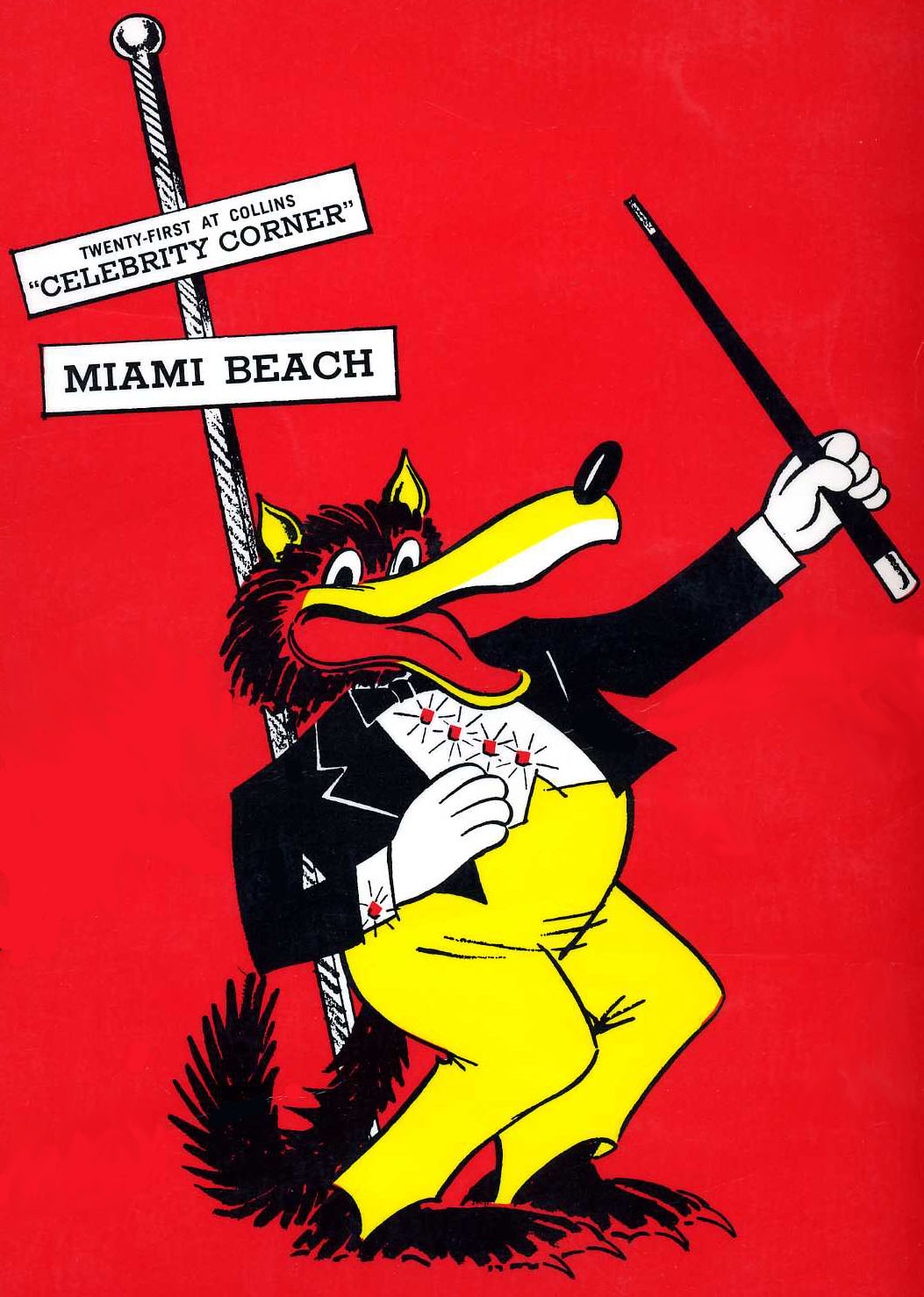
Overstuffed sandwiches were his ticket. In a short ten years or so he opened and sold not only Al’s but four other restaurants, among them Wolfie’s at Collins and 21st St., which would become a landmark and continue until 2002. Wilfred “Wolfie” Cohen would keep just one of his restaurants, The Rascal House, located on motel row at 172nd St. Wolfie Cohen died in 1986 but his Rascal House survived until 2008.

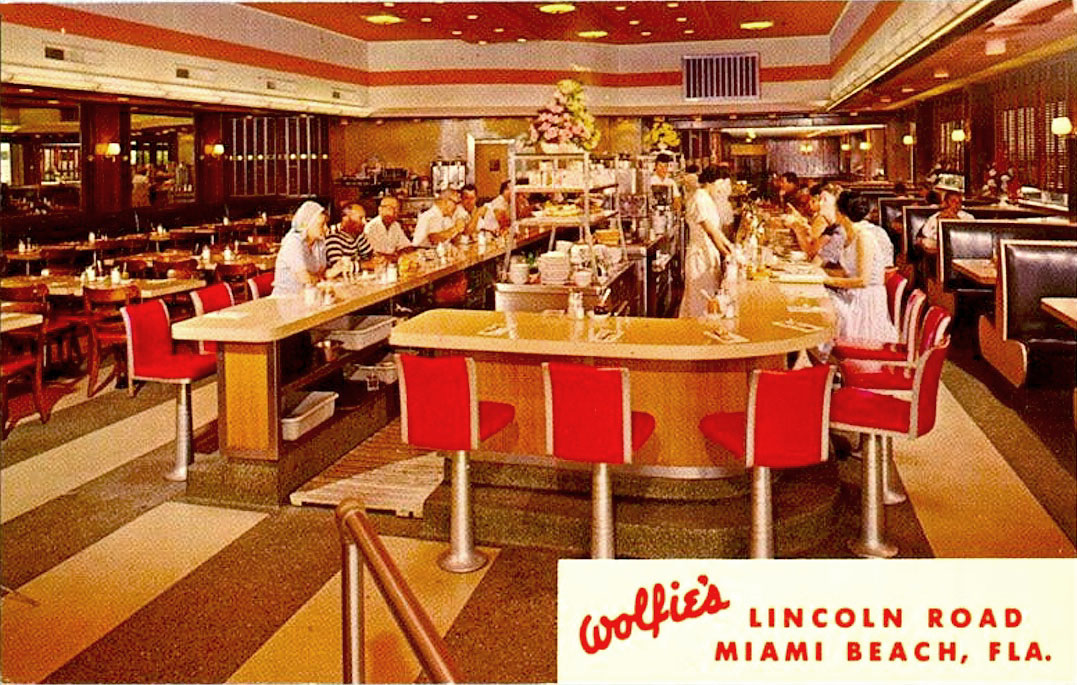
In the end the original Wolfie’s at 21st Street became known as “the” Wolfie’s, but at one time there were at least two others of significance, a flashier Wolfie’s at Collins and Lincoln Rd. and another in North Miami Beach. Both closed around 1983. Whether Cohen was involved with all three is unclear but I am fairly sure that the Wolfie’s, original included, were backed by financial syndicates. There were also, at various times, Wolfie’s branches or franchises in St. Petersburg, Boca Raton, Fort Lauderdale, Gainesville, Cocoa Beach, and Jacksonville. Brooklyn NY’s Wolfie’s, though, was an entirely different operation.

The boom years for Wolfie’s and all of Miami Beach’s deli-style eateries came after World War II when Jewish veterans and retirees, mostly from New York and the Northeast, flowed into Miami Beach by the thousands as permanent residents, snowbirds, and tourists. Then, lines of people often wound around the block waiting to get into Wolfie’s. So closely was Wolfie’s identified with Miami Beach that in 1959 Northeast Airlines chose it to cater meals for Miami-to-NY passengers; Lindy’s supplied delicacies to those flying south.

Wolfie’s was a 24-hour-a-day haven for the elderly living in kitchenless beachfront rooming houses (destined to be restored as art deco boutique hotels in the 1990s). It also attracted politicians looking for the liberal vote and visiting borscht-belt performers such as Milton Berle and Henny Youngman, as well as big and little gangsters and bookies with a yen for chicken livers, pastrami, and cheesecake. In the 1970s mobster Meyer Lansky, pursuing the simple life of a philosophical, Chevrolet-driving, book-borrowing library patron, was often spotted noshing in Wolfie’s.

By the mid-1980s, after the original Pumperniks closed (another Wolfie Cohen 1950s start-up), Wolfie’s was one of few, or perhaps the only, large-scale deli left on the South Beach. Pumperniks’ owner Charles Linksman attributed Wolfie’s survival to its proximity to theaters and boxing ring. That and tourism helped it get through the next decade, but a sense of decline was inescapable. The Beach’s population of Jewish retirees dropped dramatically, due to natural causes as well as a flight northward to Broward and Palm Beach counties to escape a perceived threat of crime and a cultural shift.

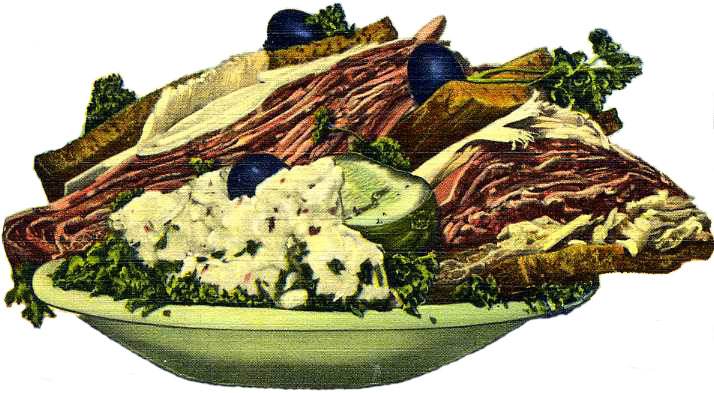
In its waning days Wolfie’s still managed to draw foreign and domestic tourists, such as moi, seeking vestiges of the old Miami Beach. I can’t remember what I ordered but I’m certain it wasn’t a Bowl of Sour Cream with Cottage Cheese ($4.75). I wasn’t quite in the “what’s a blintz?” category of so many patrons then, but close.

© Jan Whitaker, 2011

293 Comments

Filed under popular restaurants