Category Archives: Offbeat places

Chain restaurants: beans and bible verses

Although the restaurants run by Alfred W. Dennett in the 1880s and 1890s were popular and earned him a cool million in just a few years, some people took a strong dislike to them because of the framed bible quotations which covered the walls. Newspapers regularly ridiculed them, noting for instance that burglars who cracked the safe at the Park Avenue Dennett’s in New York City did so right under a sign that read, “Be ye strong, therefore, and let not your hands be weak, for your work shall be rewarded.” But no one took such a negative position against the Northeastern coffee/dairy/beans & fishcakes-based chain as did Terrence Powderly, head of the Knights of Labor. In a talk in Brooklyn he offended some audience members when he declared, “I, temperance man as I am, would go into the lowest rumhole in the city, and get blind, rolling drunk, rather than go into that restaurant where they have such signs as ‘Love Thy Neighbor as Thyself,’ to get a cup of coffee.”

Founder Dennett, born in 1840 the son of a storekeeper in Topsham, Maine, was a zealous religious believer and temperance advocate who required his waitresses to attend daily prayer services and took a leading role in citizen vice squads. In New York City he disguised himself — as streetcar conductor, laborer, or man about town — to conduct surveillance and collect evidence against suspected sites of immorality. He gave away his fortune to charity, was forced out of his company by stockholders, and had numerous mental breakdowns, culminating in a declaration of insanity after being found wandering the streets of San Francisco with a pillowcase over his head. When the Childs brothers took over the chain in 1900 evidently they retained the Dennett’s name and left the bible verses on the walls. The chain of about 16 outlets continued until at least 1912.

At various times Dennett and his son George tried for a comeback on the West Coast, operating several places in San Francisco and Los Angeles in the early 20th century (and possibly earlier) but they did not succeed and some of the San Francisco locations were taken over by the Puritan restaurant chain, which continued in a religious vein under the management of the appropriately named Mr. Goodbody.

© Jan Whitaker, 2008
2 Comments

Filed under chain restaurants, Offbeat places

Joel’s bohemian refreshery

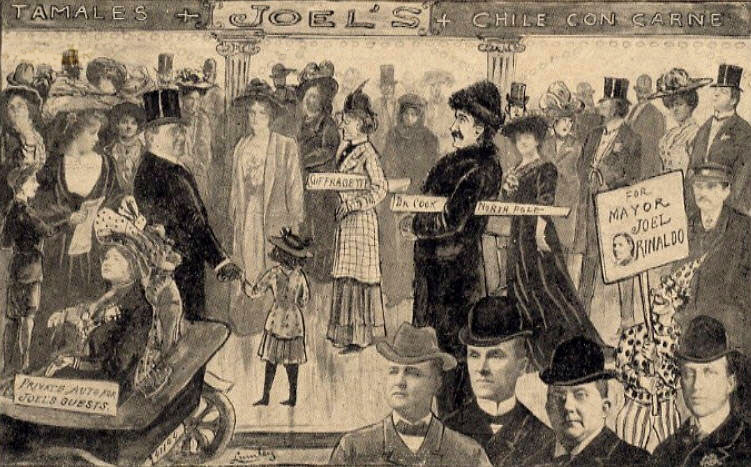
Joel Rinaldo’s was one of the all-night eating and drinking places that thrived around Times Square in New York before the First World War. “Refreshery” was an unusual term that probably related more to drinking than to eating since saloon owners often referred to their offerings as “refreshments.”

Exactly when Joel’s opened is unclear but chances are it was in the late 1890s. The real estate parcel at 206 West 41st Street that became Joel’s was part of his father’s estate when he died in 1895.

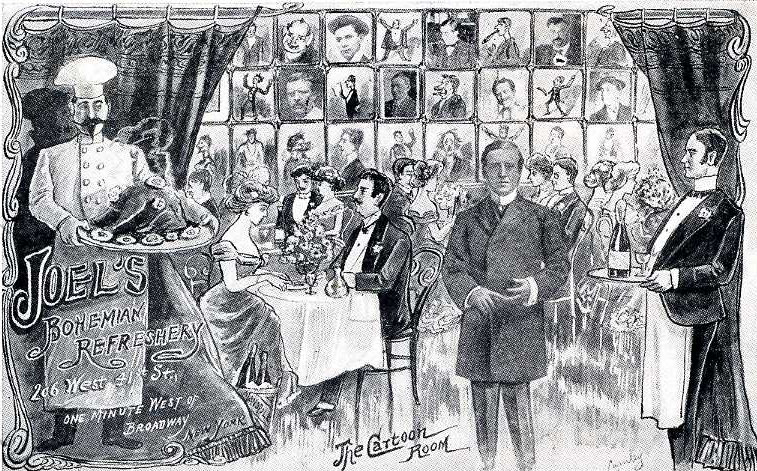
Looking at these 1910-ish postcards of Joel’s you might be misled into thinking it was an elegant after-theatre spot. It attracted all kinds of late-night visitors but was mainly famous as a hangout for musicians, artists, writers, heavy drinkers, “hop-heads,” and Mexican revolutionaries. In 1910 the restaurant was the headquarters of the Mexican Liberal Party opposed to the presidency of General Porfirio Diaz. The short story writer O. Henry was a regular also, though he may have spent more time drinking in the first-floor bar than eating in the café on the second floor. It is likely that El Refugio, a café described in O. Henry’s short story “The Gold That Glittered,” was based on Joel’s.

One of the most popular dishes at Joel’s was chili con carne, a dish not easily found in New York in the early 20th century. He also served tamales and “frijoles colorado.” In addition to Mexican dishes, Joel concocted a drink that became famous – or, more likely, notorious — called a Blue Moon. Only one to a customer but that was enough reportedly to “keep the patron pleasantly mellow the rest of the evening.”

Joel’s walls were filled with drawings, which can be seen on in the image above. Some were by caricaturist Carlo de Fornaro who spent time in jail after being successfully sued by a Mexican official in NY courts for libelous statements Fornaro made in his book, Diaz, Czar of Mexico. Joel, born in NYC around 1870, also had intellectual ambitions, was attracted to psychology and philosophy, and wrote an obscure treatise against Darwin’s account of evolution called Rinaldo’s Polygeneric Theory.

Joel took a paternalistic role toward many of his patrons, keeping prices low and announcing on a gilt sign that touring actors and musicians (he was near the Metropolitan Opera House) could send him their money and he would keep it safe for them. It is said that many took him up on the offer. Perhaps his motive for keeping a bank was to insure that eventually he would get paid, to offset all the bad checks he took from his erratic patrons.

The interesting thing about bohemian places like Joel’s was how they loosened up a middle class still under the spell of Victorian correctness. After a few hours in a heady atmosphere like this and they’d be talking to strangers (without even being introduced!), singing out loud, and ordering drinks all around.

Joel’s closed in 1925, a casualty of Prohibition.

© Jan Whitaker, 2008

8 Comments

Filed under Offbeat places