Category Archives: night clubs

Dining on the border: Tijuana

TijuanaGardenCafe1922Borderlands are fascinating social and cultural mixing bowls. Their restaurants exemplify how variable these places can be. Lacking tradition as well as a local clientele and culture, there is little shaping them other than market forces. In Tijuana prominent historical factors shaping the market were drinkers’ desire for alcohol and restaurant owners’ need to recoup lost business.

The history of restaurants and cafes in Tijuana is marked by all the instability and calamity that the restaurant business is known for – and then some! Partnerships shifted, scandals erupted, and fires swept through the main street, Avenida Revolucion.

When Prohibition became the law in the United States, a number of San Diego restaurant, café, and bar owners – Italians, Jews, Slavs, and others — set up shop a stone’s throw away, in Tijuana, then a village of little more than 1,000 people. American visitors who began to head there did not go to soak up Mexican culture, but to escape restraints [see 1922 advertisement above]. Tourist eating places, all furnishing drinks and often entertainment, had names like Johnny’s Place, Aloha [American teens in Aloha Cafe, 1940s, below] , and Alhambra. Few were run by Mexicans and Mexican food ranked low on the culinary scale.

From the point of view of San Diego’s anti-alcohol, cafeteria-loving reformers, the drinking, gambling, and prostitution that went on in Tijuana made it a hell hole. Tijuana’s reputation, of course, did not stop everyone from going there, even many respectable, well-off San Diegans and Los Angelenos, as well as civic organizations. Determined to limit vice, prohibitionists waged vigorous battle to restrict passage by shortening border crossing hours, finally succeeding in closing the border from 6 pm to 6 am in 1926.

TijuanaAlohaCafeca1949

Despite the curfew, San Diego’s hotel and restaurant industries protested in 1931 that the 6 pm closing “ha[d] not prevented one single person from going to Tijuana,” and had actually reduced their business by 25%. They alleged that visitors went for the whole day or stayed overnight, enabling them to engage in more drinking, gambling, or whatever than previously. Tijuana flourished, opening more cafes, clubs, and hotels.

The better restaurants specialized in “international cuisine” which consisted mainly of steaks and seafood along with Italian, French, German, and Mexican dishes. In this category were restaurants variously operated by Alex and Caesar Cardini of salad fame. Julia Child wrote in her 1975 book From Julia Child’s Kitchen that she remembered going to Caesar’s for lunch in 1925 or 1926 with her parents. They had heard of his special salad and were eager to taste it. “Caesar himself rolled the big cart up to the table, [and] tossed the romaine in a great wooden bowl,” she wrote.

The border curfew was relaxed in1932 and lifted entirely in 1933. But if that had an adverse impact on Tijuana tourist trade, it was nothing compared to the blows delivered by the repeal of U.S. Prohibition in 1933 and a Mexican gambling ban in 1935. Tijuana bartenders correctly predicted few bars and cafes would survive. Sure enough, proprietors headed back to the U.S. Caesar Cardini opened a place in San Diego in 1936.

TijuanaGermanrestaurant

The tourist economy waxed and waned thereafter, thanks to such things as the 18-year-old drinking age, the availability of marihuana, and incidents of violence. Mexican cuisine became more popular in Tijuana’s tourist district in the latter 20th century. Richard Nixon, then Vice President of the United States, ordered Mexican dishes and German beer in an informal visit to the Old Heidelberg there in 1960.

Today Tijuana is a large global city, yet Americans tend to stick to the main tourist avenue as of old. There is a diversity of restaurants, many with Hispanic names and owners. Caesar’s has continued, off and on, since the Cardinis departed. Yet, as much as I’d like to believe a recent comment about it on TripAdvisor.com (“nice place to feel the real culture and history of Tijuana”), I have to ask, “Real culture? Real history? What?”

© Jan Whitaker, 2013
2 Comments

Filed under miscellaneous, night clubs

Find of the day: the Stork Club

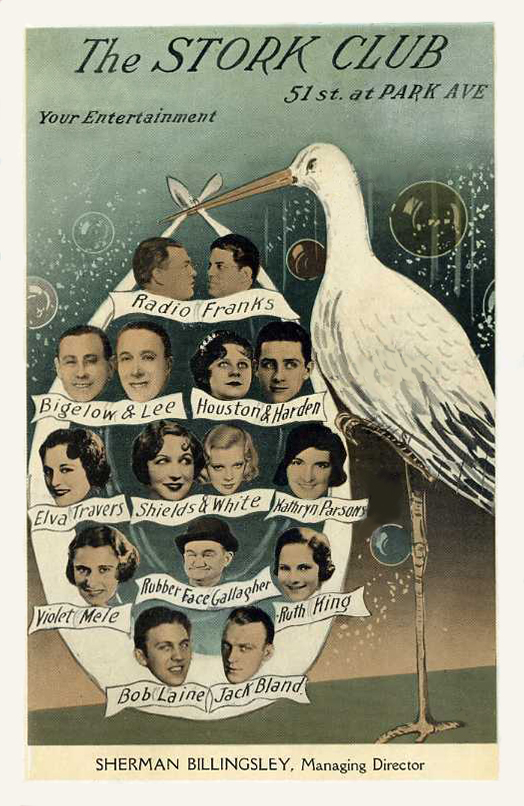
It seems harder all the time to find interesting things at flea markets and vintage paper shows, but I got lucky at Brimfield last week and turned up an unfamiliar Stork Club postcard. What is special is that it dates from before the nightclub/restaurant’s 1934 move to its well known address just off Fifth Avenue on East 53rd Street in NYC.

The postcard shows some of the “Stork’s” entertainers just before the era when its patrons became bigger attractions than its performers. When debutante Brenda Frazier, featured on the cover of Life magazine in 1938, started coming, attention shifted to who was seated at the tables. The early dinner crowd was followed by a late-night set of glamorous publicity seekers, many of them movie stars. Proprietor Sherman Billingsley installed a telephone at the entrance so that the orchestra could strike up an appropriate tune as celebrities were escorted to their tables. [William Boyd, aka Hopalong Cassidy, pictured]

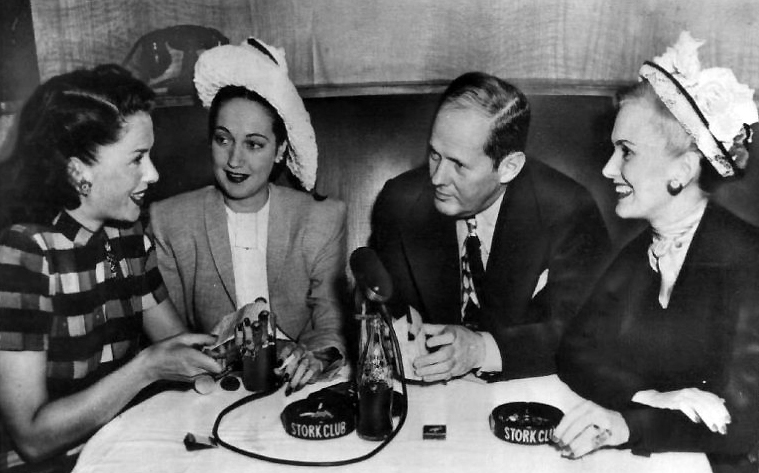
To feed the celebrity mill, newspaper columnist Walter Winchell, always at table no. 50, informed all America of the evening’s highlights the next day. Billingsley had his own radio and TV shows for many years [a 1946 photo shows him interviewing some of the club’s stars]. During its prime in the 1930s and 1940s the Stork Club was the country’s best known nightclub. It’s closest rival was El Morocco. There could never be any doubt about the location of photos taken at the Stork Club thanks to the club’s black and white ashtrays and oversized matchbooks which always appeared prominently.

Nightclubs are a special type of restaurant in which food does not always figure too importantly. But the Stork Club was said to take its menu seriously, for example, flying in fresh crab and pompano from Florida in the 1930s. Unlike others, it opened for lunch. It had a staff of a couple hundred, about 30 of whom worked in the kitchen under longtime French chef Gustave Reynaud. In its best years it reportedly served 1,000 to 3,000 meals a day.

But I am not completely convinced that it was a diner’s mecca. Clearly tastes have changed, yet even by the standards of the day a 1948 menu looks like a real hodgepodge. Some selections are in quasi-French (Calf’s Sweetbreads Under Bell, Eugenie), others are standard American fare (Cold Cuts and Potato Salad). There are a few uninteresting specials stapled to the top (Minute Steak with Baked Potato and Green Salad) and a strange section labeled Chinese Specialties. And, 22 desserts?

Sherman Billingsley, whose background was in Oklahoma bootlegging and Bronx real estate development, began his club career in 1928 or 1929 when he took over management of several NYC speakeasies, one of them named The Stork. He bought out his mob partners, and when prohibition ended went legit. Sherman also ran The Streets of Paris at Coney Island and had interests in other places, while his brother Logan at one point owned a NY restaurant called Madeira House. He and Logan (the latter officially banned from Oklahoma in 1919 as a condition of parole) lived lives of contentiousness and court appearances – perhaps inescapable experiences for bootleggers, developers, and nightclub owners.

The Stork Club fell out of favor in the 1950s, a decade in which Sherman poured hundreds of thousands into defeating unions at his club. His lawyer, the infamous Reds-hunter Roy M. Cohn, told a NY state labor relations committee in 1957 that the Stork Club had been losing money for years. Nevertheless it ranked high as an attraction for out-of-town visitors for some years before its closure in 1965, in dismal condition. One sign it is still remembered is Ralph Blumenthal’s well-researched book, The Stork Club: America’s Most Famous Nightspot and the Lost World of Café Society (2000).

© Jan Whitaker, 2012

17 Comments

Filed under night clubs

Spectacular failures: Café de l’Opera

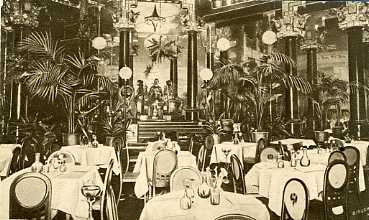
In 1910 the media was abuzz with the new Café de l’Opera on Broadway between 41st and 42nd streets in NYC. Its enormous cost and the stunning, over-the-top lavishness of its interior set a new standard for opulence on the glittering White Way. Could anyone have guessed that in a mere four months this splendid “lobster palace” would fail?

Given its fate, how perfect was it that the crowning jewel of the interior decor was a billboard-sized painting of the fall of Babylon installed prominently on a landing of the 22-ft wide staircase?

The after-theater eatery was designed to be the showplace of Times Square. It was financed by a consortium of investors that included architect/decorator Henry Erkins and John Murray, impressario of the almost-as-splendiferous Murray’s Roman Gardens, also designed by Erkins. The team sunk millions into gutting the old Saranac Hotel and turning it into a fantasy Babylonian stage set worthy of the Hippodrome. The bill for interior renovations and decor, under Erkins’ direction with Stern Brothers department store acting as general contractor, came to $1,250,000, a sum that borders on $30 million in today’s dollars.

The silver service alone cost a quarter of a million 1910 dollars, while a huge painting by Georges Rochegrosse cost something like $50,000. Er, or so it was gushingly reported. However another source claimed the painting was a copy, which is probably true. As for many of the imported ancient treasures, they were replicas cast from Middle Eastern artifacts housed in British and French museums. The gleaming black marble covering interior surfaces and pillars on the ground floor and balconies was artificial.

The interior was a startling demonstration of the transformative power of life-size statuary, concealed lighting, mirrored walls, and a million or so sheets of gold leaf. The electrical industry was thrilled with the restaurant’s flair for showcasing what miracles modern lighting could perform. But the architectural community was rather scandalized. They hid their distaste in a haze of apparent flattery, producing choked praise in which adjectives like magnificent served as insults. The “lurid and gorgeous” restaurant was so overwhelming it could “overcome at once the more sober judgment of the critic,” claimed The Architects’ and Builders’ Magazine.

The restaurant’s dining rooms occupied four floors with its main kitchen located above them. Manager Henri Pruger, hired from the Hotel Savoy in London at the princely salary of $50,000 a year, oversaw a staff of 750. Six months after arriving in NYC he headed back home, and one can only wonder how much of his salary he managed to collect. Stern Brothers wasted no time seizing all the furnishings for auction but a goodly number of them apparently were acquired by the new owner, Louis Martin. A restaurant pro, he had formerly presided over the famed Café Martin at Broadway and 26th with his brother J. B.

Martin quickly made changes, moving the kitchen to the basement to solve the problem of food arriving cold at the tables as had happened under the previous management. He installed a bar on the first floor and eliminated the previous regime’s terrifically unpopular formal dress requirement, said to be an English notion. But the jinx was on. If ever a location reeked with bad omens, it was this. On opening night in December 1910 an employee of the Café de l’Opera started an accidental fire in a storeroom causing firemen to parade through the dining room with axes. Well, there was that foreboding fall of Babylon depicting invaders in the banquet hall. But what possessed Louis Martin to create a dining room lighted by a dozen perched owls with electrified eyes the size of silver dollars?

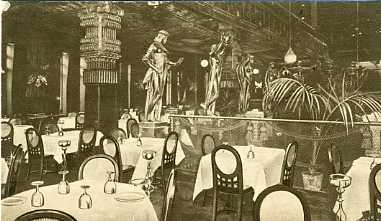
Martin, who ran the restaurant as Café Louis Martin, withdrew from the business in 1913. The new management renamed it the Café de Paris. On the color postcard shown here it is clear that the golden statues on the balcony are gone, replaced by flowers during this incarnation. In 1914 the Café de Paris went bankrupt and in February the restaurant’s “furniture, pictures, ornaments, rugs, carpets, curtains, linen, tableware, kitchenware, and other equipment and furnishings” were auctioned. The building was razed in 1915.

© Jan Whitaker, 2011

13 Comments

Filed under elite restaurants, night clubs, restaurant decor

Subtle savories at Nucleus Nuance

nucleusnuancelogoIf it weren’t for the steady number of souls searching the spheres for Nucleus Nuance, I’d hesitate to touch this subject. After all, it was a clubby hangout that I never experienced personally so I’m at risk of leaving out things that true-blue fans care about. On the other hand, there doesn’t seem to be much written about the restaurant side of this jazz nightclub, so here goes.

First, why the goofy name? My guess, based on my knowledge of 1960s counterculture, would be it’s not supposed to make sense but, according to Tom Rosenberger who supplied the color photo (with Joni Mitchell’s painting on the wall), the name meant “the center of subtle change.” Regulars shortened it to “the Nucleus” which seems to make a lot of sense for a source of good food and good music.

In 1969 Rudy Marshall, as chef, and Prince Forte, as maitre d’, opened NN at 7267 Melrose Avenue in Los Angeles, serving “subtle savories for the discerning palate.” According to their own account which appeared on the back of a 1983 menu, a couple of years before moving to this location they had operated a “health-conscious cafeteria” which managed to attract regulars such as Howard Hughes. Throughout its tenure, until it closed ca. 1993, the Nucleus remained committed to organic food.

Marshall, once a cook at the Aware Inn, followed the Inn’s moderate approach to healthy cuisine which permitted meat eating. One of the Nucleus’s specialties, “Ra, The Untouchable” (“Prime ground lean steak, mixed with chopped mushrooms, cheddar cheese, black olives, bell peppers and onions”), was reminiscent of the “Swinger,” a burger served at the Aware Inn during Marshall’s stint in the kitchen. It’s likely that “Ra” was kin to an earlier NN incarnation called the “Evolution Burger.”

nucleusnuance84In 1979 Nucleus acquired new partners, the Venieros, who introduced fine vintage California wines, hooked up the restaurant with the Garlic Festival, and expanded the premises. Evidently, though, it remained unbeautiful. According to the Los Angeles Times in 1976, the dining room was windowless and “The front door leads you down a long corridor that makes you think you’ve walked in the back door by mistake.” In 1988 it sounded pretty much the same. A review by Alan Richman describes the entrance as “a nightmare, a series of twists and turns along a gloomy cinder-block passageway,” adding that the uninviting exterior was “white cinder-block, the front door solid black, the overhead awning worn out.” (He liked the place once he got settled.)
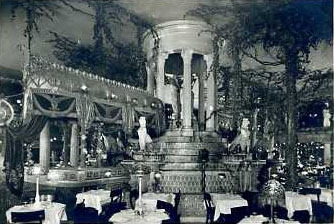
But face it, jazz clubs are supposed to look like that – and, unlike NN, many of them have horrendous food to boot. Appearances aside, with new partners the Nucleus began to build its reputation as a venue which attracted stars such as Herbie Hancock. Joni Mitchell was frequently seen in the audience and commemorated the Nucleus in paintings.

The menu expanded but kept old favorites such as The Ra, Salmon Soufflé, Delectable Duckling (“with our incomparable papaya-cranberry sauce”), Oak Grove Cheese & Walnut Loaf (vegetarian, with curry sauce), and Lady Jana (carob mousse). In the first edition of The Best of Los Angeles (1984), a guide by France’s Gault Millau team, NN was named as the best place in town for salmon soufflé.

See also: “Eating healthy” and Early vegetarian restaurants

© Jan Whitaker, 2009

13 Comments

Filed under night clubs

Cabarets and lobster palaces

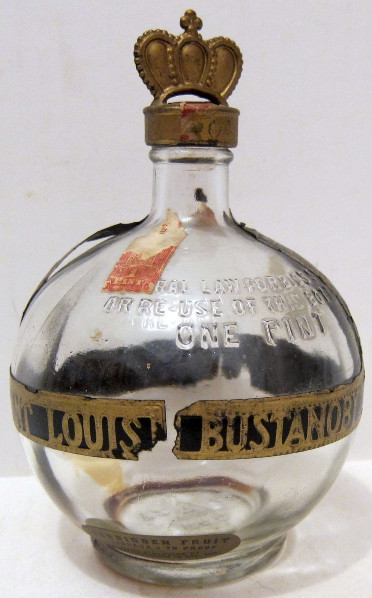
Around 1908 Murray’s Roman Gardens in Times Square, pictured here, was just the place to sample the “high life” after seeing the popular operetta The Merry Widow. Murray’s, which has been called “New York’s first theme restaurant,” demonstrated a kind of decadent Roman-Pompeian-Egyptian-Babylonian grandeur that appealed to tourists. It was one of the so-called lobster palaces that sprang up around the turn of the last century. Other cities had them, but New York led the trend with Murray’s, Bustanoby’s (known for its Forbidden Fruit liqueur), Churchill’s, Faust’s, Martin’s, Maxim’s, Rector’s, Reisenweber’s, Shanley’s and others. After surviving the depression of the 1890s, Americans were ready to drink champagne and order the most expensive dish on the menu, preferably lobster. Restaurants, department stores, and soon movie theaters all styled themselves as palaces outfitted with marble fountains, chandeliers, and velvet draperies. The era’s “luxury for the masses” set a precedent later followed by Las Vegas.

New York’s lobster palaces were in possession of a valuable asset, the all-night liquor license which enabled them to sell drinks round the clock. Anti-liquor forces were determined to clamp down on the partying. One by one cabarets saw their licenses revoked, forcing them to close by 1 a.m. In 1913 the early closing rule was applied across the board — and rightly so, according to New York’s mayor. He asserted, “The people who patronize such places after the regular closing hour of 1 o’clock are not, as a rule, decent people. They are vulgar, roystering, and often openly immodest. They get intoxicated, behave boisterously, and indulge in lascivious dancing in rooms devoted to that use.”

Critics insisted that sophisticates wouldn’t be seen in a warehouse-style palace. Despite their high prices, the food they served was prepared assembly-line fashion hours before the rush. Waiters made a grand table-side show of shaking and pouring drinks which had been premixed before the crowds arrived. Patrons dressed to the nines vied for a table. Critic Julian Street sneered at the whole scene of what he regarded as social pretenders. He commented in 1910, “About the wide doorway of this room stood a knot of twenty or thirty men and women, all in evening dress and eager to get in – a comic sort of bread-line, held back by a plush rope and a young head waiter, who, St. Peter-like, examined the candidates with a critical eye.”

Although they instituted cover charges when national Prohibition began in 1919, lobster palaces could not carry on without the liquor sales which had made up as much as two-thirds of their gross. By 1923 most had closed.

© Jan Whitaker, 2008

1 Comment

Filed under night clubs