Frequently when I write about the demise of a restaurant chain I can almost be certain to hear from at least one person who lets me know there is a survivor of that long-gone chain.

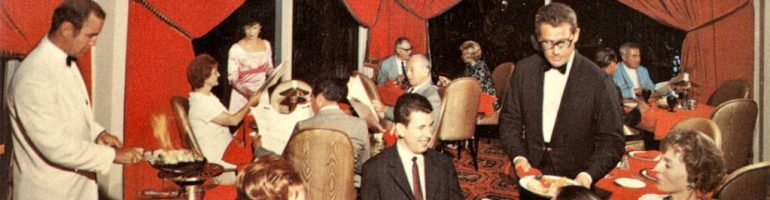
And, yes, that is also true of Chicken in the Rough, a franchised process for preparing fried chicken. As recently as now, Palms Krystal Bar & Restaurant in Port Huron MI offers “The World’s Most Famous Chicken Dish,” as it has for decades. In 2000 a Palms order consisted of an unjointed half fried chicken, with shoestring potatoes, hot bun, and jug of honey. Two orders cost $9.99 and they even threw in free coleslaw. In the 1930s an order usually was priced at 50 cents. [above, 1940s menu from an Arkansas restaurant]
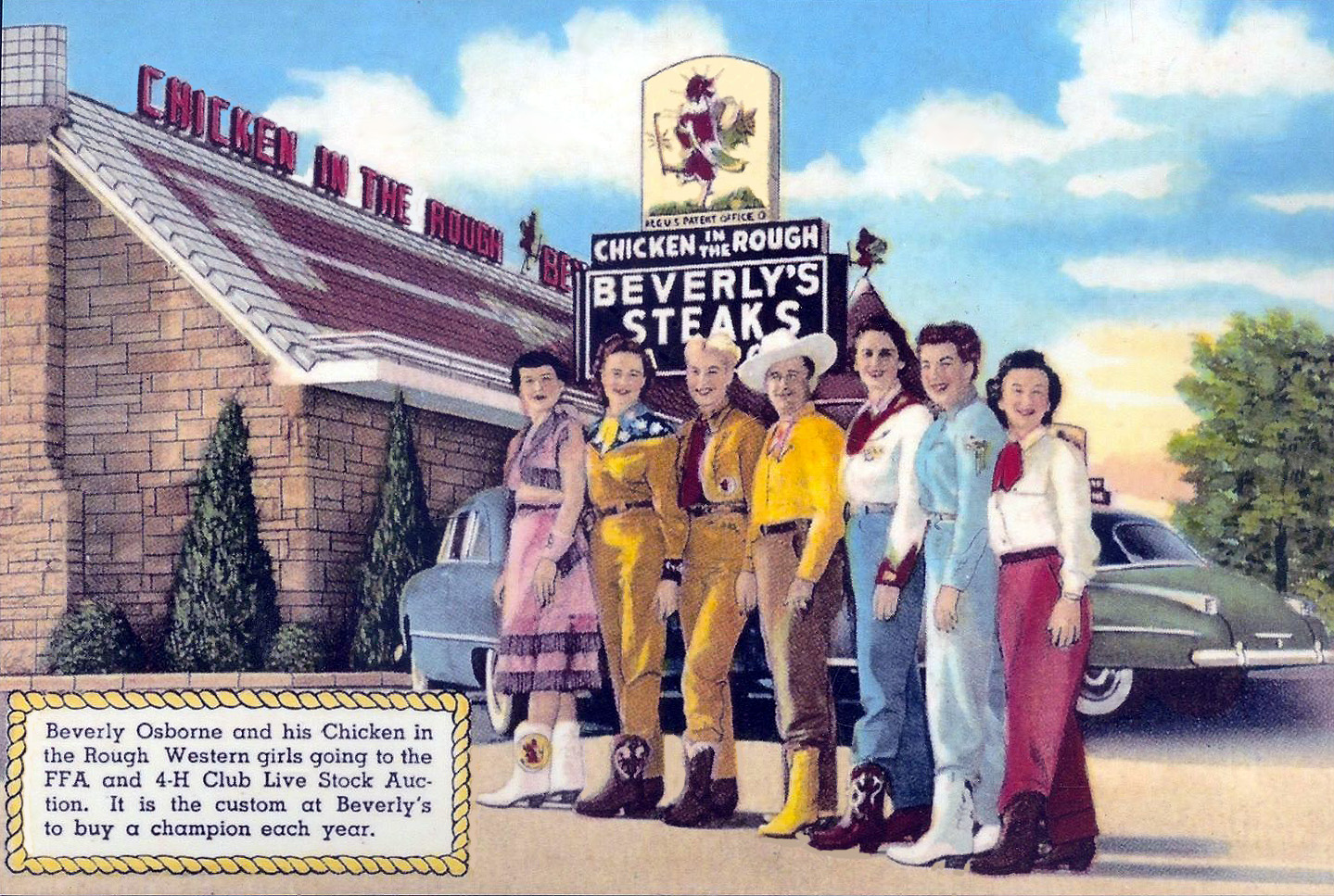
The developers of the Chicken in the Rough formula were a husband and wife team, Beverly and Ruby Osborne. They ran roughly nine cafes and waffle shops in Oklahoma City and even the 1930s Depression could not halt their enterprising spirit. [above: Beverly Osborne pictured in yellow boots]
Their operations employed the magic word in modern management of that time – “system” – to streamline their operations and reduce costs. In 1936 they opened a drive-in in Oklahoma City which introduced customers to their method of preparing chicken. They soon began franchising the process and the trademark. In 1942, they patented their imprinted dishware and glasses, and the image of a chicken with a broken golf club, all of which had been in use for several years.
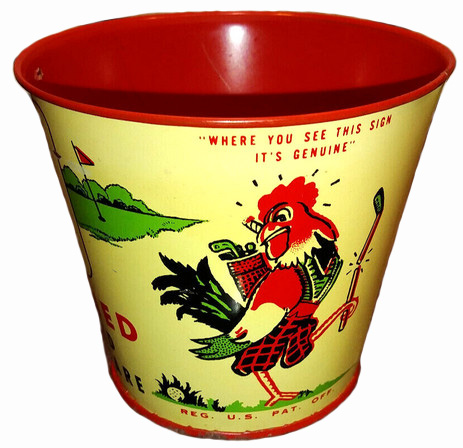
“In the Rough” was a perplexing phrase that often needed an explanation. It meant no silverware was provided despite the half chicken being unjointed. Evidently customers proved willing to adapt to “roughness,” although I’ve run across some evidence that over time some franchisees served the chicken in pieces. Another alternative was to serve the meal with a small metal pail filled with water for cleaning hands.

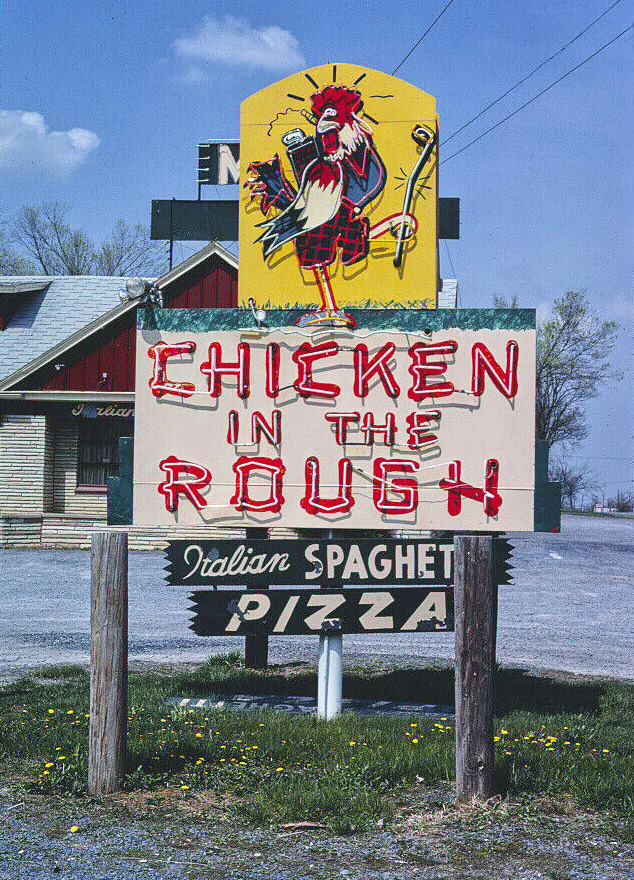
When the Osbornes opened the Ranch Room at their Oklahoma City drive-in in 1937 a large advertisement appeared in The Daily Oklahoman. Just in case anyone reading it didn’t realize the name Chicken in the Rough had been copyrighted, they were informed of this six times in the text: Yes Sir, “Chicken in the Rough.” (Copyrighted) – In one year we are known from coast to coast for “Chicken in the Rough.” (Copyrighted) – Served without silverware. In one year we have sold over 50,000 chickens or 100,000 orders of “Chicken in the Rough.” (Copyrighted) – We are now able to offer for sale franchises on “Chicken in the Rough.” (Copyrighted) . . . We took the town by storm – “Chicken in the Rough.” (Copyrighted) 50c. [Above: Madison WI franchisee]

The Osbornes were very particular about the meal’s composition, preparation, and presentation. Franchisees were required to use a freshly killed chicken, weighing 2 pounds and graded A, meaning it had been raised in an incubator and had sustained no injuries. No batter could be added to falsely make it look bigger and it had to be cooked in vegetable oil that had not been used for any other purpose. Inspectors came by regularly to make sure franchisees were following the rules.
World champion runner Jesse Owens, winner of four gold medals in the 1936 Olympics, was slated to open a restaurant featuring Chicken in the Rough in Chicago in 1953, for which he planned to use delivery wagons decorated with large images of himself racing. I could not determine the fate of that plan, but I don’t think it ever materialized.
The Osbornes sold the rights to their franchised process in 1969 and ten years later ownership changed hands once again. At the time of the first sale of the business there were only 68 franchises in 20 states left, compared to possibly 379 in 38 states at the peak, which I am guessing was in the late 1940s. Judging from a 1946 postcard that claimed to list all the U.S. restaurants with franchises then, most of the populous states without franchisees were in the Northeast. By contrast, Michigan had the most, followed by Indiana and California.
Unlike that of Harlan Sanders, who also began by selling a chicken recipe across the U.S. some years after the Osbornes, their venture remained a franchised cooking process and did not develop into a chain of restaurants.
© Jan Whitaker, 2023

 It's great to hear from readers and I take time to answer queries. I can't always find what you are looking for, but I do appreciate getting thank yous no matter what the outcome.

 Restaurant-ing through history
Ha! I was going to mention “Broasting”! Then I saw the earlier post…I worked at a deli in NY and we began selling it. Big, weird pressure cooker oven in the back…not many takers, if I remember right. Still easier than soup. Only the owner delt with the broasting machine.
https://www.facebook.com/groups/1325730577502867/search/?q=osborne%27s%20waffle%20shop
Osborne’s Waffle Shops (Beverly Osborne) Oklahoma City OK. According to David Cathey author of “Classic Restaurants of Oklahoma City”. A small chain started in the 1920’s, eventually becoming the Chicken in Rough.
Yep!
Jan, I have found chicken in the rough dinnerware in Beverly Osborne ‘s lake house (27 pieces). I need guidance from someone to help me to take the next step in what to do. Wadebrown45@gmail.
You could try to sell them on e-Bay or at an antique show.
A fascinating story! I found this news article that covers the fate of the “Chicken in the Rough” (copyrighted) franchise in the post-Osbourne period: https://www.franchisetimes.com/article_archive/return-of-the-golf-playing-chicken/article_4cbfee34-fc67-57e5-a5f6-6bbc29f2dcfb.html
Happy Thanksgiving Jan!
-Rhonda S.
Thanks for the link, Rhonda. Apparently the revival did not work.
This Franchise Times article mentions a “patented special griddle” developed by Osborne. I located the patent: https://patentimages.storage.googleapis.com/f9/9f/5d/b25a66626ebff6/US2211545.pdf
The griddle is a rectangular pan with a built-in reservoir/trap into which the detritus from frying could be collected without the need to drain any oil. From the diagram, you can imagine the difficulty in cleaning out the trap which eventually led to its disuse.
Thanks again for your research. I decided to leave it out and you’re right that it was eventually rejected.
I have heard of “lobster in the rough,” not a particular restaurant, but just folks in my family using it as a term for rustic restaurants & eating outdoors, a la a picnic vs dining al fresco.
Imagine if restaurant operators had such high standards for chicken today? Sigh. I was looking up “disjointed chicken” & I guess I just never knew the term. https://www.youtube.com/watch?v=ZfBCQ0KdkNo
Hi Jan — Another fun and informative article! I always look forward to your posts! This brings me back to my early childhood — my parents would take me to a Chicken in the Rough somewhere in the metro Detroit area. Two things stand out in my memory. First, the tiny little pitcher of honey served with each order (my mother didn’t like honey so we never had it at home.) Second,the image of the cigar smoking rooster with the busted golf club and little “upset lines” shooting out of his head just imprinted itself on my memory! I will definitely have to plan a drive to Port Huron (a nice little resort area in itself) to have some fried chicken!
Be well and have a nice Thanksgiving
Bob
Thanks so much, Bob, and a happy Thanksgiving to you too. The image is a striking one, and the little pitcher of honey is charming and unusual.
You could follow up with a story about “broasted” chicken, which is a trademarked process and restaurants still have to pay a licensing fee to serve it.
What is ‘unjointed’? Does that mean that the chicken was butchered into separate pieces, or that it’s uncut but somehow the joints are broken? I did a quick search, but most of the hits are for this chain/franchise, not for explanations.
A whole chicken is unjointed, for example. For Chicken in the Rough a whole chicken was cut in half but not separated into pieces as is commonplace.
Why does a clever graphic of a golfing chicken make me want to try the food?! Road trip to Port Huron!
Or a chicken wedge, if you don’ have a chipping wedge handy.