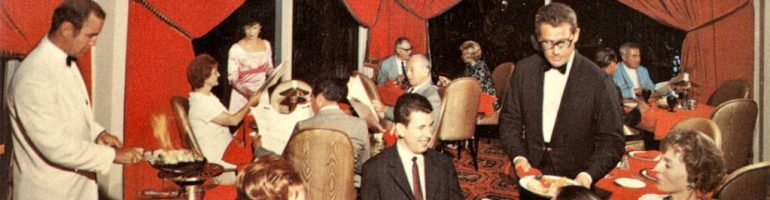
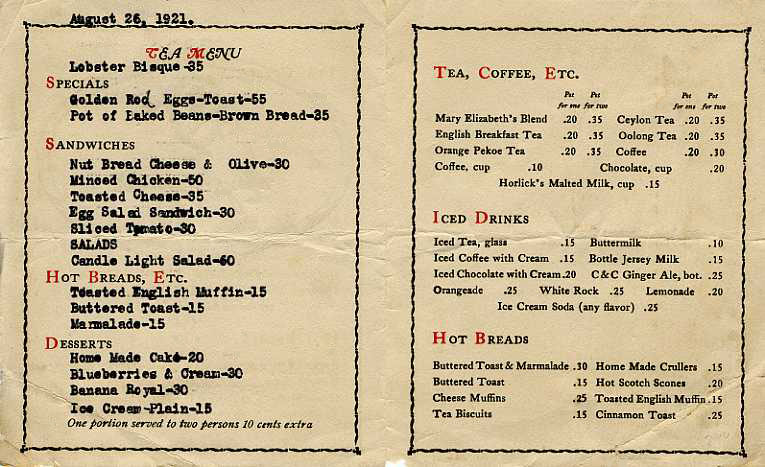
Mary Elizabeth Evans, for whom the landmark tea room was named, began her career in 1900 at age 15 as a small grocer and candymaker in Syracuse. After one year in business she cleared the then-handsome sum of $1,000 which she contributed to the support of her family while supervising a growing crew of helpers which included her two younger sisters who served as clerks and her brother who made deliveries.
Her family, though in seriously reduced circumstances, had valuable social connections. Her late grandfather had been a judge, her uncle an actor, and her departed father a music professor. That may help explain how she achieved success so rapidly – and why her story garnered so much publicity. By 1904 several elite NYC clubs and hotels sold her candy and soon thereafter it was for sale at summer resorts such as Asbury Park and Newport and in stores as far away as Chicago and Grand Rapids. In 1913 the all-women Mary Elizabeth company, which included her mother and sisters Martha and Fanny, was prosperous enough to sign a 21-year lease totaling nearly $1 million for a prestigious Fifth Avenue address close to Altman’s, Best & Co., Lord & Taylor, and Franklin-Simon’s.
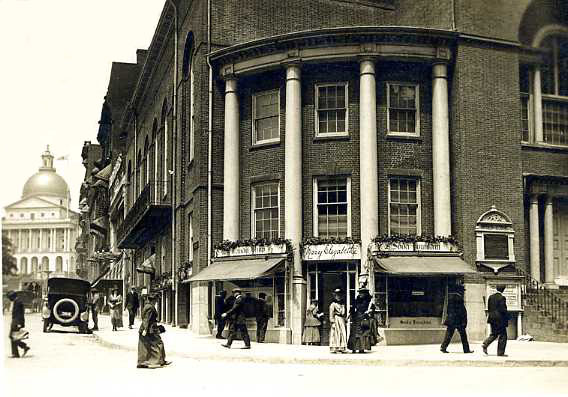 By the early teens the candy store had expanded into a charming tea room with branches in Newport and two in Boston, one on Temple Street and the other in the basement of the Park Street Church near the Boston Common (pictured ca. 1916). Like other popular tea rooms of the era, Mary Elizabeth’s bucked the tide of chain stores and standardized products by emphasizing food preparation from scratch. Known for “real American food served with a deft feminine touch,” Fanny Evans said the tea rooms catered to women’s tastes in “fancy, unusual salads,” “delicious home-made cakes,” and dishes such as “creamed chicken, sweetbreads, croquettes, timbales and patties.” For many decades, the NYC Mary Elizabeth’s was known especially for its crullers (long twisted doughnuts).
Mary Elizabeth distinguished herself as a patriot during the First World War by producing a food-conservation cookbook of meatless, wheatless, and sugarless recipes, and by volunteering to help the Red Cross develop diet kitchens in France. After her marriage to a wealthy Rhode Island businessman in 1920 she apparently played a reduced management role in the business.
In its later years the NYC restaurant passed out of the family’s hands and began to decline, culminating in an ignominious Health Department citation in 1985.
© Jan Whitaker, 2008

 It's great to hear from readers and I take time to answer queries. I can't always find what you are looking for, but I do appreciate getting thank yous no matter what the outcome.
 Restaurant-ing through history
Does anyone recall a tiny hamburger place on Madison very near Mary Elizabeth’s. It was another favorite of mine in the 70s. Believe it was called Tailor Made and was run by a proper southern gentleman (who hired only black waiters – can you imagine in today’s world!!) Served the greatest burgers. Tables were actually old school desk/chair combos. Place was across from the Morgan library.
I worked at 200 and later 198 Madison from 1976 to 2008 and do remember a burger joint on that block. There was Bienvenue between Madison and 5th which was preceded I’m told by a similarly small coffee shop.
In the ‘70s it was one of the few places to get a really good scone. They came out only during the day, and were often sold out by closing.
The Hot Cross Buns were amazing, I haven’t found one even close……
hi — I would go to Mary Elizabeth’s in the 80’s with my younger brother (both of us working in the neighborhood) we would meet in the morning for breakfast and sit at the counter ….my memory was of the delicious muffins…we would get jam and butter along w them — they would split right down the center …seemed like they were just out of the oven…
My Grandmother worked there as a hostess (Mae Flahive Sweeney) for 50 or so years. I would spend my childhood summers washing dishes and helping with the cakes in the bakery.
My beautiful Irish, red haired Mother Mae was a waitress in the cruller bar. I also worked there while I was in college, ‘80-‘83.
My Mother Mae and I worked with your Grand Mother❤️ She was beautiful and funny!! When I would whistle Mae would say, “ a whistling women and a crowing hen, will frighten any man from his den’ 🤣🥲❤️ I was 18 years old.
Those crullers were amazing! So wish we could have recipes for them, and for the white cake with chocolate frosting.
On a Friday before I headed home either from school or work I’d stop and get a cake…perfect never too sweet…and I’ve never had Hot Crossed Buns as good as Mary Elizabeth’s
Did you by any chance help with the making of their date madeleines? They were soooooo good! I’ve developed a recipe for them, as close as I can come to the original, but I have a feeling I’m missing some key ingredient.
Thank you for the “whistling woman” comment! I’m happy you knew her!
My beautiful Irish, red haired Mother Mae was a waitress in the cruller bar. I also worked there while I was in college, ‘80-‘83.
Hello,
I was so excited to hear about your book on tea rooms, and even more so to read your piece in Mary Elizabeth’s in NYC. I would go there often in my early (& penniless) days in book publishing in the late ’70s.
Wonderful motherly Irish waitresses who would look sternly at you if there was food left on a plate– and who would make sure men at the table were served extra large portions (and remind them to pay you compliments– a male friend was told that the more you tell a woman she’s lovely, the lovelier she becomes– all in a soft West Kerry accent!).
Have ordered a copy of your book & signed up for your restaurant history blog! Hope also that WriteAngles will return? (A friend in western Mass recommended that to me, which was how I discovered your writing.)
Many thanks!
Ruth Josimovich
Thanks, Ruth!
Is your book published? Available through Amazon?
It was published in 2002 and is out of print and only available used.
Hello Ruth,
Would you by chance recall the name of the waitress with a “soft West Kerry accent” (I believe that may have been my Grandmother)?
In the early 1970s my new husband and I used to go to the Cruller and Sandwich Bar which was on E37ish. The Sandwiches were made of homemade meatloaf, brisket, chicken etc and served in wax paper. I always had Maple walnut cake for dessert and took home a boxful of the date madeleines. In later years my husband would bring home a briefcase full of the date madeleines. There was an Anglo-Indian restaurant attached. Mary Elizabeth’s is a treasured memory
Yes there was a back room and drinks were served….My Grandmother adored going and having a cocktail and salad…
As I remember it was mostly business men…being right off Madison Ave..
I liked the lamb loaf sandwich with ravigote dressing — not often on the menu on 37th Street.
Pingback: Life With Father – A New Yorker State of Mind
I’ve been on this thread since 2011 and am a book publisher based in Brooklyn. I’m close with the folks at Abrams and would do whatever I can to get the recipes and history into print. Contact: enchantedlion.community@gmail.com
http://www.enchantedlion.com
I’m replying to this. Please be in touch:
Scott commented on Mary Elizabeth’s, a New York institution.
in response to henri gilbert:
Steve…My father was the last owner of the restaurant. Mother was the daughter of Martha… I have most of the original recipes but find no outlet…would like to publish some of them and a short history of what I can remember…I have two of the crueller posters, big board, 4×3, hanging in the house. I […]
Henri, did you find anyone to help you with the publication and preservation of the Mary Elizabeth recipes? If not, I may be able to help.
My mother and I used to meet for lunch at the counter at Mary Elizabeth’s. We would always leave with boxes of crullers and the date madeleines. I am on a crusade to resurrect those most unusual madeleines. Have you had any luck with a deal to publish the original recipes??
Hi Claudia,
I too was enamored by this adorable NYC slice of history. I had been there on my lunch hour when I worked nearby in the neighborhood, at Esquire Magazine, in the 80’s. (Seemed very 1940’s ‘ladies who lunch’).
Have you had any luck making inroads toward a book? I create design for visually-driven ‘illustrated books’, oftentimes with curious, unique or quirky subject matter. As a fan of Mary Elizabeth Restaurant, I’d love to be a part of the team who develops this recipe book!
I’ll email you so you have my info, etc. Sincerely, P Kelly
PS: Recently, an acquaintance + I both thought that the restaurant could be documented in a Hopper painting, “Tables for the Ladies”, in a current exhibition on his work of NYC, at the Whitney Museum. (From the permanent collection at the Metropolitan Museum).
That was one of our Favorite spots. Added a touch of gentility to our gritty town. I think my favorite was the Lady Baltimore cake. Do you still have the list of all the cakes?
No, I haven’t seen one.
Ate there with my mom as a kid. Truly miss the white cake with chocolate frosting. Wish we could track down the recipe.
I moved to NYC in 1980 from California…found a loft just off 5th avenue on West 37th. It didn’t take me long to find the treasure of Mary Elizabeth’s. I have been looking for her sandwiches, sticky buns and maple walnut cake ever since…and I married a cook who made desserts for The Odeon. The most unique eatery in America.
Hi Gary! I too was enamored by this adorable NYC slice of history. I had been there on my lunch hour when I worked nearby in the neighborhood, at Esquire Magazine. (Very ‘ladies who lunch’). Didn’t realize you lived in that neighborhood! I must’ve me you two a bit after this era. Hi to Michelle. Best, P. Kelly
PS: Recently, an acquaintance + I both thought that the restaurant could be documented in a Hopper painting, “Tables for the Ladies”, in a current exhibition on his work of NYC, at the Whitney Museum. (From the permanent collection at the Metropolitan Museum).
The Hot-Cross Buns….best I’ve ever had
There is a book about her husband’s company, “Brown and Sharpe and the Measure of American Industry” which has sections on Mary Elizabeth and her unique style. They are the most interesting and compelling sections of the book.
Good to know, thanks!
Loved to stop there for crullers on my way to teach Business Communications at The Katharine Gibbs School, located in the Pan Am Building in the early 1980s. I loved them; I have never tasted another that could compare.
So loved this restaurant too. Dearly wish someone could track down her recipe for the white cake with chocolate frosting. Moist, light and not too sweet.
I was a young assistant buyer for Bambergers and when we came to NYC we always wanted the shrimp salad from Mary Elizabeth. Love to know the recipe.
Loved Mary Elizabeth it was across the street from the photo studio we used when I was a buyer, the Hot Cross Buns were the best I’ve ever had..and I never went home to my parents without a layer cake…Chocolate with White Cake or Coconut….
The sandwiches on hand sliced bread…oh my
I remember that studio: Madison and 36th. I worked for many years at 200 Madison Avenue so ME was a go-to place for lunch, sometimes downstairs in the Soup Tureen but more often at the sandwich-and-cake counter.
They would make fabulous coconut cakes in the shape of lambs for my grandmother to bring to me! But where oh where can I find their oatmeal cookie recipe?
I worked in the Empire State building in 1974-75 and would lunch at ME. What I remember (and it still makes me salivate) was the grilled cheddar cheese sandwich on homemade bread (served under a silver dome that the waitress removed) and the extraordinary curries (the only place ever that served a curry with genuine Bombay Duck condiment—among the plethora of condiments). I also remember Schrafft’s from way back in the early 60’s….secretaries wearing gloves and hats having an egg salad on cheese toast sandwich and knocking back 3 grasshoppers! Which reminds of Patricia Murphy’s popovers……endless culinary memories a la Proust.
Hi. I’m reading a 01june1925 issure of “Vogue” (it used to be issued twice a month) and there’s an article “the Gourmet in New York” and it mentions Mary Elizabeth’s. Which sent me on this search….and here I am….does anyone have an exact address for the tea room? Thank you in advance.
In 1925 Mary Elizabeth’s tea room was at 392 Fifth Avenue.
Thank you so much for your quick reply. 392-394 is now a 58-story hotel, I pass by it all the time. Italian-owned. I can’t wait to delve further into your blog. Mille grazi!
It was at 12 East 37th Street from as late at least as early as 1976 until it was shuttered.
I worked at Altman’s from 1977 to 1979 and don’t remember this place at all. But I was going to FIT and I was 17 when I started. Maybe not the place for a 17-year old in disco-era Manhattan. When did it close? Thank you!
Some time in the late 1980s, I believe.
oh my Altman’s brownies and blueberry muffins…I miss the food area
It’s long gone it was on 36th or 37th Street between 5th Ave and Madison…
Mary Elizabeth was on 37th bet 5th and Mad. I think the number was 9 or 11 East.
I was living in the Big Apple from 1976-1981 attending design school and working for Bloomcraft Textiles.My boss, Luther Travis would have me bring back a sandwich for him if I was going to have my lunch at Mary Elizabeth’s. One evening before going home I stopped in …there were some doughnuts left over,the lady gave me a bag of them for free.The cheese and tomato spread and pot roast sandwiches were sooooo delish. Richard S. Mundy
I’m in my 70’s now; my wife and myself were in the city to see “the Christmas tree” yesterday, and walking down 5th Ave. I started to remember all my old favorite places, Mary Elizabeth was one of them. I was part of the designer ladies apparel business, and I would walk from B. Altman up to 57th St. and stop into all the departments along the way, and have a bite in Mary Elizabeth’s every time. Boy, do I miss that classic social style, food, ambiance, demeanor, social grace and respect.
My grandmother would take me to lunch at Mary Elizabeth’s in the early 1960s. I vaguely remember her telling me that it was a ladies only tearoom upstairs and a men’s soup bar downstairs. Being five years old, I did not question the logic of this. I also remember a few old restaurants on Wall Street which had a ladies’ entrance where women could be served apart from men. Does anyone else remember these archaic social restrictions? Do young women today even know of them?
By the time I started frequenting Mary Elizabeth’s in 1976 the downstairs Soup Tureen was co-ed, as was the sandwich bar.
My Gran would take me there for lunch because she could have a cocktail, I loved the sandwiches on hand sliced bread and the hot cross buns, the best I’ve ever had.
Pingback: mary elizabeth evans for whom the landmark tea room was named began » Images Search
I remember my dad taking me to work with him on my days off from school in the early 60’s. We would always go to Mary Elizabeth’s for lunch. My favorite was the chopped steak with toast points covered in mushroom gravy. I would then have a cruller and during Christmas, they had the greatest ginger bread boys. What great, treasured memories came back to me by reading everyone’s comments about Mary Elizabeth’s. It is sad that a restaurant like that could never exist today.
I loved the hamburger on toast — mom used to take us into the city at Christmas time. Thanks for the memory.
Remembering !!! My mommy saying it was the place to have lunch when we shopped in N. Y !!—the window always had great looking pastry in it ! And even if we lunched somewhere else we would stop by to take some goodies home to northport long island ! Tuna on rye no lettuce for me then!! joy Sammis Purnell
Would Love to have the oatmeal cookie recipe!!!!!! or anything close to it!!
Me too!!!
Would love just about any recipe that is to be had. Does anyone have anything at all? I ate there with my dad a couple of times a month from age 8 on.
I remember working at 1 W. 37th St. 1967. Under the clock was Sally Gee Creations, Scarfs and Neckwear. Coffee and oatmeal cookies from Mary Elizabeth. We had our own cook, Anna Mae, but those great sandwiches at Mary Elizabeth. I can still taste them!
Was the showroom manager for Vera (scarves, poly pant suits) in the home furnishings division at 417 5th Ave. WJ Sloane was across the street at the time. Wihlemina Models was on the side entrance of our building and Schraffs ice cream parlor was next to 417 5th. ME’s was just the best and very much missed as are hundreds of places of that era.
Hi. Wow. I remember when Vera was oh-so-au courant. And, you are the only person, besides me, who remembers that huge W.J. Sloan furniture store on 5th, across from Lord & Taylor. It is now getting to the point where I’m getting nostalgic for Zum Zum’s and Burger Heaven.
Don’t forget Schrafft’s, Wienerwald, and The Magic Pan all of which were au courant when I moved to NYC in 1973!
Hi. The only Schrafft’s I remember was the one on 13th and 5th. It became the Iguana Club, it had that huge iguana on the roof. Now, it is surprise…..condos. Ahhh, how Manhattan has become Abu Dabi-on-the-Hudson. I have checked-out, from the NYPL, “When Everybody Ate at Schrafft’s,” has history, stories and recipes. I never went to but do remember Weinerworld and the Magic Pan. What was the Swiss chain? I think their speciality was fondue. Child’s Pancakes anyone?
I remember a Schrafft’s on 5th Ave in the high 30’s around Lord & Taylor my Gran took me for cocoa in the winter, there was also one on 34th Street..the one in the Village was before my time living down here…
But Mary Elizabeth was another Gran favorite, they served cocktails so she loved taking me there.
The thing about Mary Elizabeth’s baked goods was they weren’t overly sweet, they were just like home made. The hot cross buns were the best I’ve ever had.
HEY HOW ARE YOU? MY MOM WAS ONE OF THOSE WAITRESSES AT MARY ELIZABETH’S. HOW CAN WE GET THE RECIPE FOR THE OATMEAL COOKIES AND THE MAPLE WALNUT OR BLACK WALNUT CAKE? CAN YOU SEE IT NOW? DON’T THEY LOOK GOOD?
Yes, the oatmeal cookies! I dream of them, the thick round shiny ones.
OMG MY MOM WAS A WAITRESS THERE AND WE USED TO GET THOSE YUMMY OATMEAL COOKIE MUFFINS YUM
I was delighted to find this page, as I have been collecting information on Mary Elizabeth’s family and genealogy. She was the grand-daughter of Judge Henry Riegel of Syracuse, who originally came from Seneca County, N.Y. See my web site for newspaper stories, links to two of her cookbooks (free at Google books), etc. I’d like to hear from any relatives also.
Hello Virginia – I would so love to find her cookbooks!
Can you point me in the right direction?
Alison Parks
aparks@worth.com
Her eatery was “my safe place” in the Big Apple (having migrated from Virginia)
I’m very interested in locating her recipe for the oatmeal, brown sugar cookie. Can you please help? thank you Pete
I would absolutely give anything for some favorite recipes from Mary Elizabeth’s…
like others who have written, I was a very lonely girl from Virginia trying to make her way in the Big City and Mary Elizabeth’s offered the best solace in the world….from the fresh iced tea, to the lady baltimore cake, the cheddar/tomato sandwiches and the lovely Polish waitresses who served them up.
Alison Parks
Does anyone remember the saying that was on the wall that began “someone once said”?
I’d love the know the answer to this too!
As a young graduate student in the ’70s, I used to go three times a week to assist my professor at 50 Park Avenue. We would go to Mary Elizabeth’s for lunch and always, according to my recollection, have the tongue sandwich. I can taste it now.
I was just cooking dinner and listening to NPR’s Splendid Table when they mentioned Mary Elizabeth’s! Just the mention of that place brought me to tears. I recalled how lonely it was living in New York City for the first few years after college. One of the few consoling memories was visiting my parents at their apartment on 36th St. (off 5th), and sharing Mary Elizabeth’s wonderful Coconut Cake–I can just see the white box with the plain white string tied around it. Now if anyone can recreate THAT recipe!!
Gus Reese, right? I worked for many years at 200 Madison Avenue and later at 198 Madison Avenue. I liked the cheddar cheese and tomato sandwich and the Lady Baltimore cake.
Hi – I’ m that gal from Bald Head Island, NC – who used to eat lunch in the soup bar below the sandwich bar at Mary Elizabeth’s and would take those oatmeal cookies home – in the 60’s and 70’s they were 50c apiece. I think I’ve got it pretty close, and left a trail of unhappy folks in NC when I moved to WA two years ago. I do have a nice little mail-order business going. About the name — I was too clever and no one gets it…as Effie is short for Francis Elizabeth, I thought Emmies, short for Mary Elizabeth was only fitting…and I did want to give her some recognition. My business is small, but supports my NYC habit!
My very favorite memory of NYC was working at lord & taylor as a yound girl (20) and joining the older ladies at the counter for the special sandwiches wrapped in wax paper, lady baltimore cake & coffee. My favorite was a corned beef salad type sandwich. Comfort food of the gods! A big thank you to this family for the fond memories. I have since always had dreams of recreating this style of coffee shop. Maybe when i retire….10 years to go!
Mary Elizabeth’s has quite a story. Martha, my grandmother, was one of the three sisters who ran the tradition. They were the first women allowed to sponsor a business on 5TH Avenue as only men were permitted to own a business on the fabled street. It started in the late 18 hundreds…the father, a music teacher went off to the Klondyke in search of gold never to return. The daughters and one son made candies and left them in the hallway with prices. They were never short changed. Those were the days. I go over the recipes from time to time when young. They were a grand bunch.
Henri, I grew up going to Mary Elizabeth’s with my father and always chose to have the vanilla cake with chocolate icing as my birthday cake. I loved the madeline’s with dates & walnuts so much that my dad obtained the recipe for me. I still experiment from time to time and try to make the cheddar/tomato sandwich. I would be delighted to email/talk with you about publishing some of your material about the restaurant. If you visit my website — http://www.enchantedlionbooks.com — you will see how to contact me. Hope to hear from you.
I loved Mary Elizabeth. My favorite was the spiced madelines. For years I have tried to duplicate the recipe. Mary Elizabeth also made the best Pumpkin Pie for the holidays. I never liked Pumpkin Pie until I ate it here.
You have the recipe for the madeleines???? I would love to have it. My mother often bought them to bring home for special occasions. The person at Mary Elizabeth who packed them in the boxes gave her the secret to keeping them fresh: store them in an airtight tin with a small piece of fresh bread. The moisture from the bread kept the madeleines from drying out. To this day, I still use that trick to keep moist, chewy cookies fresher longer. But I would dearly love to be able to make—and taste—those madeleines again. Please help!
I FOUND A WOODEN BOX IN MY PARENTS BASEMENT. IT WAS SO COVERED WITH DUST I COULD HARDLY READ THE WORDING. IT SAID THESE CANDIES ARE MADE AT HOME BY MARY ELIZABETH AND HER SISTERS SYRACUSE NY. SO I DECIDED TO LOOK IT UP ON THE INTERNET.
Any chance you have recipes to share?
I just made a meatloaf that reminded me of Mary Elizabeth’s and I got on here to see if it still exists.
Sadly, no, it seems. In a city with challenging entrees of every stripe, it was a place you could go that made you feel like your Grandma was cooking and your tummy could relax.
So happy to see that others remember Mary Elizabeth’s too… Can anyone help me with the address? I’m working on a photo essay of the ghosts of places in NYC. Low 30s off Madison somwhere I think?
Mary Elizabeth’s was at 6 East 37th Street (Fifth Ave & 37th).
Steve…My father was the last owner of the restaurant. Mother was the daughter of Martha… I have most of the original recipes but find no outlet…would like to publish some of them and a short history of what I can remember…I have two of the crueller posters, big board, 4×3, hanging in the house. I contacted Martha Stewart and left a message…was not interested….I have limited skills on the computer…Contact me if you wish. henri gilbert.
I am looking for Mary Elizabeth’s walnut cake recipe. It was a bit dry, not too sweet, and perfect with tea.
Thanks
Dear Henri –
I’m in the magazine publishing business (financial magazines) and may not be able to help actually get these published but I would certainly be willing to try to help preserve the wonderful history that was Mary Elizabeth. I’m not sure how this works exactly – let me know how best to reach you. Alison
Henri:
In 1978 I owned a home on River Road in Scarborough, Westchester NY. that I was told was built for Martha. It was “New Orleans Colonial”, white cedar shingle with beautiful black wrought iron balconies off each bedroom window and a 40 foot covered porch with lovely wrought iron. We were told many stories: including that our living room was build after the dimensions of the Parthenon and was 40 feet by 20 feet. The floor of the home were all wide old wooden planks. The few old residents in the neighborhood told us stories of amazing parties there. This was the time the Vanderlips lived in Beechwood and many bankers lived in the area. Supposedly, the fireplace mantle was from England and supposedly given to Martha (I was told at one point it was actually Mary Elizabeth who had the home build), by one of the bankers who was fond of bestowing these upon friends in the area. When I sold the home, the new owner did not appreciate the fabulous old architecture, plantings or mantle and expressed his notion to replace it with something more modern, whereupon I had it removed and moved with me.
I would love any information, stories or pictures of Martha or Mary Elizabeth”s tea room.
Thank you so much!
Andrea Gordon
andgo_2000@yahoo.com
914-656-4470
OMG the Hot Cross Buns…fantastic, have you thought of self-publishing ?
I would buy a copy…
My Grandmother took me for lunches….they served cocktails..lol
Hi!
I am a book publisher and would be VERY interested in this project. I grew up going to Mary Elizabeth’s with my dad, who was also a book publisher.
You can find my company Enchanted LIon Books on Facebook. My email is enchantedlion@gmail.com. My name is Claudia. Please contact me.
We can discuss doing the book and can send Steve some free copies!!
You need to contact Henri Gilbert. I’m just a Mary Elizabeth lover. I will be on line too buy a copy also.
Would love to hear from you, Henri!
enchantedlion@gmaiil.com
I am a book publisher and would be happy to discuss this with you.
I also have many colleagues at larger publishing houses.
Henri, did you find anyone to help you with the publication and preservation of the Mary Elizabeth recipes? If not, I may be able to help.
I don’t know what made me think of Mary Elizabeth’s today. I wondered if anyone else remembered the place and I’m glad to see it listed here. My memories of it are from the mid 70’s when I lived and worked in the area. The food was fine but it was the atmosphere of an era gone by that intrigued me. Rumplemeyer’s and the old Russian Tea Room are two other places I remember fondly for the same reason.
We ate at Mary Elizabeth’s three times a week and under the direction of Edgar Tallman and Bob (Bubbles Manes) designed the beautiful windows at Lord and Taylor and the model rooms at W.J. Sloan. It was a great shock to see all these handsome Gay Young Men eating in this Tea Room among the lady shoppers who ate their lunch here.
The menu in the 1960’s was great and included a restaurant in the basement that served homemade soup and a sandwich. What great times to remember.
Could this be my boss and friend from BCYL? I know your post is from 2009,but I still hope you get this!!! I remember the lunches there! Felt like an old Altman shopper before my time. Fond memories…
I REMEMBER the soup kitchen downstairs. i worked in advertising on Madison in the 80s and we would have a fun lunch for a few bucks including lemonade and a dessert.
Hello, I have been looking for that recipe as well….they were perfectly round and the oatmeal was not blended. they were the best cookies!
Hello, I have most of the recipes as my father was the last to own the thriving business. Virgie was the head cook ever since they moved to NYC. Could not read nor write yet made the best cod fish cakes in town. I will look for those cookie recipes and others but I fear it disappeared with others like the Lady Baltimore and the Lemon cake. henri gilbert
You wouldn’t have the recipes for chopped roast beef sandwiches? I think they were made with chopped pickles and mayo. They also served chopped pot roast with chopped mushrooms and mayo.
I would LOVE to have the recipe for the white cake with chocolate frosting! The cake was not too sweet, and the frosting was fudgy but not heavy on buttercream. I have never found another like it and have been searching for years for a recipe that could even come close.
I used to eat at Mary Elizabeth’s as a child with my mother when shopping downtown. We often sat at the counter and ate sandwiches from waxed paper bags. My mother loved the coconut cake and would be thrilled to have another slice today. Oh, and the crullers – they were brought home for a weekend treat.
PLEASE SHARE YOUR RECIPES!!!!
Thanks!
Mary Elizabeth’s Restaurant used to have a cookie made of oats, brown sugar, butter, vanilla and salt.
Do not know the recipe (all natural ingredients). Does anyone know any of her cookie recipes?
Thanks
I bought those cookies at a little bake sale on Bald Head Island in North Carolina. The baker titled them, “Emmies” made from a recipe from Mary Elizabeth’s in NYC. I tried to contact her for the recipe but she didn’t want to divulge it. I’ve been searching for those cookies for three years so if anyone finds that recipe, I’d be most grateful.
Hi — see my entry on Mary Elizabeth’s and my cookies, called “Emmies”
Kirby — hi there — I just learned about the Mary Elizabeth site, and have
posted a message…missing you all…I may make an appearance this year.
Can’t believe it’s been 2 years and 3 months. The adjustment has not been
easy…but Bob is in hog heaven.
Everyone on Bald Head Island adores the Emmies Cookies.