Category Archives: guides & reviews

“Distinguished dining” awards

HolidayAward470After World War II American consumers were filled with pent-up demand accrued over years of rationing and deprivation. They wanted to sample the joys of the good life, which included American and world travel, even if only in their imaginations. A sophisticated magazine – Holiday — was created to cater to their aspirations.
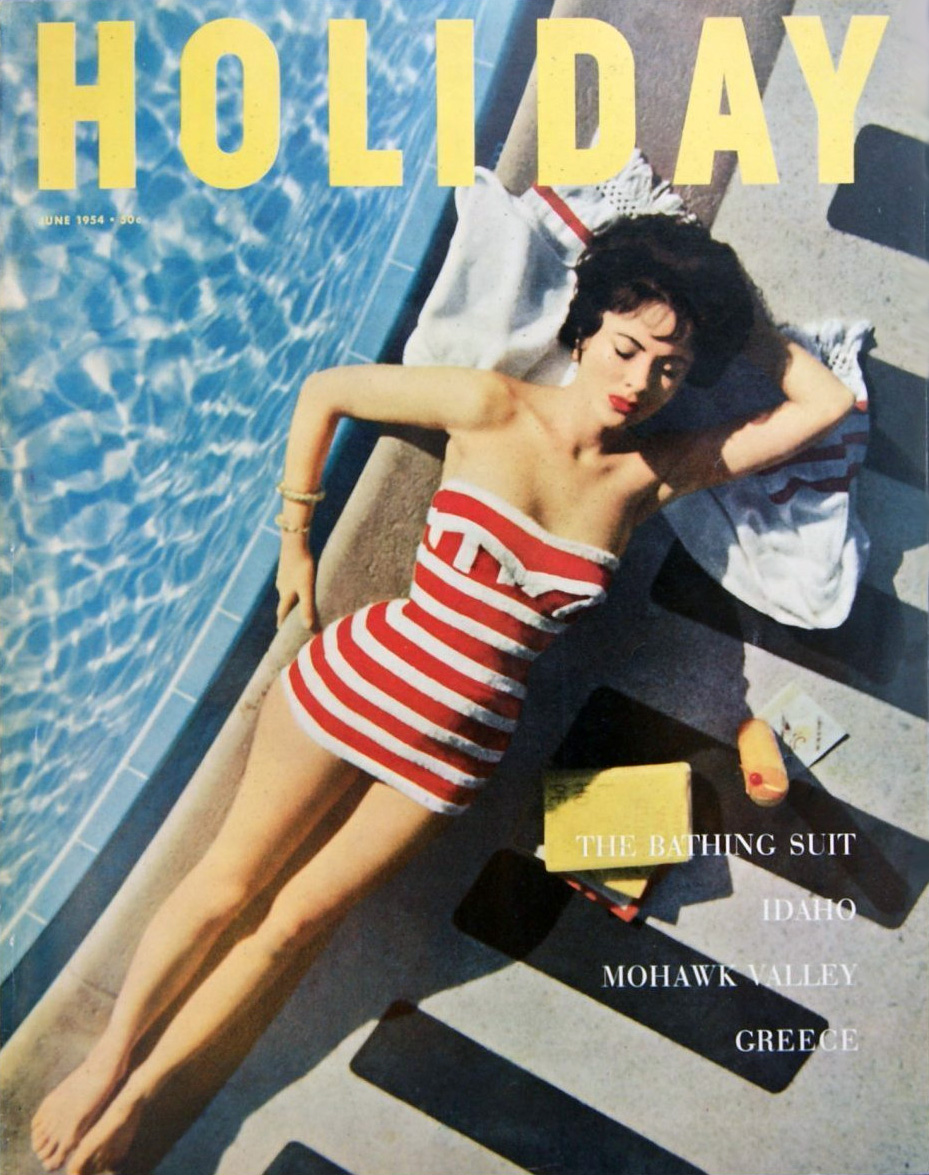
HolidayMag1954Holiday’s first issue came out in March 1946. A couple of months later Madison Avenue advertising man Ted Patrick took over as editor. A gourmet and bon vivant, Patrick gravitated toward fine restaurants. In 1952 the magazine began presenting awards to American restaurants that achieved dining distinction, recognizing 49 the first year. Among the winners were Bart’s (Portland OR), Commander’s Palace (New Orleans), Karl Ratzsch’s (Milwaukee), and Win Schuler’s (Marshall MI).

Winners tended to remain on the list, though it was not guaranteed. Win Schuler’s (still in business today) featured steaks, prime rib, and pork chops, and hosted 1,200 patrons a day at its Marshall location [menu below]. In 1971 it won its 20th Holiday award, no doubt not its last.

Even if, as Harvey Levenstein writes in Paradox of Plenty, Holiday stuck to “safe, sound, and usually American” choices where “the steak, lobster, and roast beef syndrome . . . reigned supreme,” its recommendations carried weight and raised the seriousness with which many American diners and restaurateurs regarded restaurants.
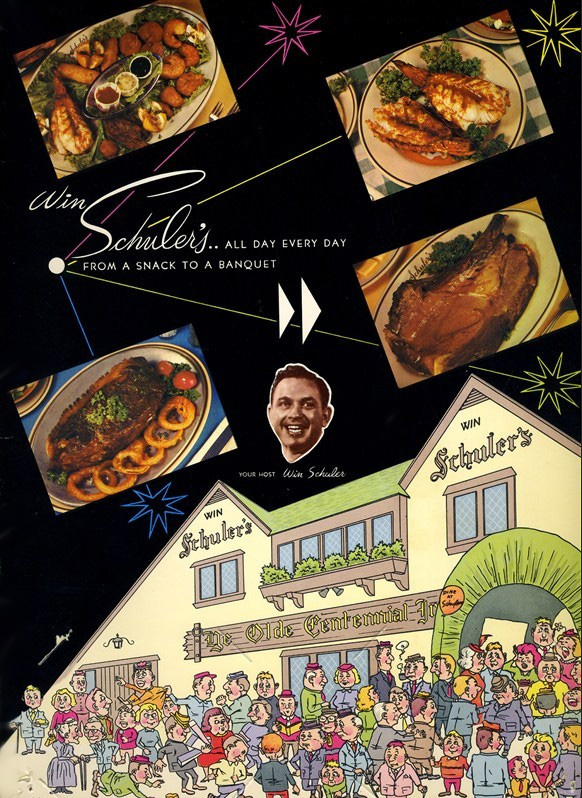
HolidayWinSchuler'sMenuTo win, a restaurant’s offerings were supposed to compare to French cuisine. It’s hard to see how a steak-and-baked-potato place could do that, but plenty such restaurants won awards. On the other hand, many of the winners were French inflected, particularly in NYC. A quick scan of restaurants included in the 1976 Holiday Magazine Award Cookbook shows that nearly 25% had French names and many more specialized in French dishes.

What some thought was a bias for restaurants in NYC and, to a lesser degree, NY state prevailed until 1968 when California restaurants won as many awards as New York (even though the number of winners in San Francisco still lagged behind NYC, 17 to 25).
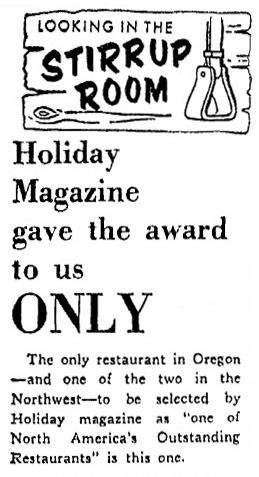
HolidayAug1953The overall volume of winners grew over the years, reaching over 200 by the mid-1970s. The numbers reflected the growth in dining out – and maybe the tendency of award programs to expand. In the beginning whole swaths of the country had nary a winner. Winners would boast that they were “the only” restaurant – for example, in Wisconsin, in the South outside of Florida, among Midwestern states, etc. But over time winners could be found in all parts of the country, requiring some adjustment in the meaning of distinction. Statements appeared saying that awards were not given solely to elegant places. As Patrick’s successor Silas Spitzer said, “Elegance has a certain value in making our judgment of restaurants – but it’s not essential.”

I suspect that the significance of the awards was greatest during Patrick’s editorship, which ended with his death in 1964. The magazine fell on hard times in the 1970s and was sold in 1977. Even earlier the awards were losing clout. Among those in the 1976 cookbook were several that had come under harsh criticism. Many specialized in “continental” cuisine which had lost its glamour by this time, or were considered uninspired. In 1974 John Hess wrote that The Bakery in Chicago and Ernie’s in San Francisco were “disappointing.” NYT critic John Canaday declared in 1975 that Le Manoir was the French restaurant where he had the worst meal in the past 20 months, Le Cirque the “worst restaurant in proportion to its popularity,” and the “21″ Club “least worth the trouble.”

The awards, called Travel-Holiday awards after Holiday’s 1977 merger with Travel, continued until 1989.

© Jan Whitaker, 2013

9 Comments

Filed under guides & reviews

Duncan’s beefs

Duncan Hines celebrated simple, home-style American food. But as a printing salesman whose territory covered the entire country he ate in enough restaurants that by his 60s he had accumulated quite a few dissatisfactions with cuisine and service. “Every day on the road adds to my list of pet peeves,” he told an interviewer in 1947. In retrospect it’s clear that the decades in which he rated restaurants for the Adventures in Good Eating directories, the 1930s and 1940s, were not the country’s finest for restauranting. Some of his complaints are dated but others still ring true today.

● Chef’s specials: “Most Chef’s Specials are ground-up leftovers.”

● Chicken a la king: “I always dodge chicken a la king, if it is offered at bargain prices.”

● Cover-ups: “Foods doused with gravies or sauces.”

● Warmed-up baked potatoes.

● French fries kept warm under a heat lamp: “The grease soaks through.”

● Restaurants that steer patrons into the bar while they wait for their table.

● Being seated at a table that hasn’t been cleared of the previous patrons’ dirty dishes

● Restaurants that crowd patrons “like sardines.”

● Certain small towns: “The states between the Mississippi River and the Pacific Coast are pretty much the Gobi Desert as far as good cooking in the small towns goes.”

● “Maryland fried chicken” which is widely advertised but often turns out to be “old chickens covered with thick batter.”

● Long menus that contain nothing outstanding.

● Roadside stands: “Never eat at hot dog or hamburger stands.”

● Drug store counters: “How in God’s name can anyone who regularly eats drugstore snacks ever be expected to recognize a good meal when it’s served?

● Restaurants that ignore local specialties, such as those on the Gulf that feature chicken and steak rather than red snapper. Why no fiddleheads on menus in Maine? he asked.

Leave a comment

Filed under guides & reviews

“1001 unsavorinesses”

I’ll never forget a meal I once had at a local inn – where I went against my better judgment to entertain a visitor entranced by New England quaintness. To accompany whatever it was I ordered I received a little side dish with two whole boiled potatoes ladled with tomato sauce. As they would have said so eloquently in the 19th century, what an abomination!

Observations about bad food in restaurants span the ages. But in gathering together these comments I noticed a curious thing. Despite the incursion of frozen food and other shortcuts into 1950s restaurant kitchens, that decade’s reviews were strangely upbeat. Not totally surprising to me because I consider the 1950s the “Everything is ok!” decade. For instance a newspaper review in 1959 noted that Tad’s Steak House in Chicago featured “low price steak on assembly line basis,” but removed all the negative implications by immediately asserting “you seldom find a toughie.” Yet, as diners from every other decade reveal below, eating out has always been chancy.

1790 “Whether you call for breakfast, dinner, or supper, it is all one; the constant fare is bacon and eggs.”

1823 “In vain you ask for French soup – a basin of thin water-gruelly kind of admixture is served up, with scarcely any flavour of meat … and the ghosts of carrot slicings, with rice nearly raw…”

1832 “All the food was of the cheapest kind, and cooked in the most atrocious style. The steaks were burnt leather, the sausages were hard, and in gravy like tallow; the potatoes were cold and watery, and bit like an apple…”

1843 “The dressed dishes were decidedly bad, the sauces being composed of little else than liquid grease, which to a person like myself, who has an inherent detestation of every modification of oleaginous matter, was an objection altogether insuperable.”

1865 “All the articles they parade on their bills of fare, from pork and beans to meringues and Charlottes, have a peculiarly mauvais gout … many things look good to the eye but do not taste good, as their odor reveals, and if the eater shut his eyes he would not know what he was eating at all…”

1872 The average hotel dinner at an American-plan resort hotel “is an unwholesome mass of ill-cooked and indigestible abominations … greasy soup, the tasteless meats, the sodden vegetables, the thousand and one unsavorinesses with French names.”

1880 “[The oyster pie] is like a small cart-wheel, of pale complexion, and most uncertain age. When one is called for it is steamed a little to take the rheumatism out of the oysters, and then, after being drowned in a milky compound, is placed in a condition of fragrant hotness and pliability before the devourer.”

1885 “An unordered boiled potato, with the skin on, is the second grand characteristic of an American dining saloon. It matters not what meal it is, the boiled potato will always appear…”

1897 “The potatoes are mostly soggy boiled or salvy mashed, the corn and peas are overripe and overdone, and may properly be described as ‘fodder.’ The eggplant is greasy. If the turnip and squash get misplaced no one can tell them apart.”

1903 “We are now in the season when the discreet diner shudders at the thought of the typical table d’hote, with its greasy soup, its fragment of doubtful fish, its over-rich entree submerged in thick gravy, its choice of roast chicken or roast beef – which taste exactly alike – its impossible pudding, equally impossible pie or cubic inch of factory ice cream, its microscopic fragment of crumbly Brie, dry Swiss, or leather-colored Camembert cheese, and its demi tasse of black coffee.”

1908 “Most of the restaurants in which I’ve cooked have a stock pot. All the bones and scraps of meat that are left on the plates are thrown into this pot. … Every day [the cook] takes out enough to make the soup and whatever dirt and filth has gotten into the mass of bone and meat is skimmed off while the soup is boiling. For instance, when you scatter cigarette ashes over the remains of a steak and throw the butt in the plate, you can congratulate yourself on having helped to flavor the next day’s soup.”

1914 “I had a sandwich that was made of dry bread, cut so thick at one end that a man would break his jaw trying to bite it. … The meat was evidently cut with a rip saw and when I tried to eat it, the bread broke, leaving the meat hanging from my mouth, at which a couple of [women] gave me the laugh.”

1922 “On one vast surface [of the “platter dinner”] the jumble is made ready …, an offense to the eye and, more serious, to the palate. To eat so many things together is to taste nothing. Most serious of all, the jumble must be eaten at top speed or else it grows stone cold, reduced to a loathsome swamp of grease before the platter can be cleared.”

1932 “It is safe to say that a combination of caviar, tuna fish, canned shrimps, mayonnaise, whipped cream and lemon juice might puzzle anyone who survived the eating of it.”

1947 “Most Chef’s Specials are ground-up leftovers. … I steer clear of hashes and meatloaves with fancy names, and from dishes disguised with French names that don’t mean anything in a Mid-west hotel. I always dodge chicken a la king, if it is offered at bargain prices…”

1965 “The menu is a genuine jumble of dishes including egg roll, antipasto and the Reuben sandwich. … The Mexican dishes are not recommended. They taste for all the world like TV dinners.”

1974 “Food for the chain is assembled by technicians in Cleveland. … The ‘gourmet’ menu that day featured a veal-crabmeat-and-whipped-cream concoction, and in the absence of pastry, the most popular dessert was orange sherbet with chocolate sauce.”

1988 “The salad was soggy, as though it had been premade in large batches. The rigatoni was overcooked and came with thin sauce, tasteless sausage and good rib meat. The steak was bizarre — a good piece of sirloin thinly breaded for no apparent reason and covered with what tasted like a nutmeg sauce.”

© Jan Whitaker, 2011

3 Comments

Filed under guides & reviews

Celebrating restaurant cuisine

“Recherché viands.” “Splendid appurtenances.” “Bibular veritabilities.” Wonderfully novel words of praise have been spun by proprietors, patrons, and reviewers in praise of restaurants and their fare. Although the modern era produces few phrases so elaborate as those before the Civil War, the examples below show there are no end of restaurant features that can be lauded.

1816 The owner of the Town and Country Refectory in Providence promises his meats and liquors are “calculated to make glad the heart of man, to revivify exhausted nature, to restore the valetudinarian to health, and to refresh the weary traveller.”

1838 A patron says of a dinner at the American and French Restaurant, Washington DC: “…it was one of the most splendid entertainments ever served up at a public house in the United States, and I much doubt whether the London Tavern, the Café de Paris, the Rocher de Cancale, or any other restaurant or hotel in Paris or London ever surpassed it, either in the qualities of sumptuous and recherché viands, splendid appurtenances, or fine wines.”

1855 Touting Shelley’s Restaurant Sans Pareil, NYC, a notice says “Gentlemen curious in gastronomy, and choice in their selection of Epicurean Varieties and bibular veritabilities, must of necessity visit this classically chaste Palazzo, sooner or later.”

1878 Tony Faust’s Café and Oyster House, St. Louis, claims to be where people can “enjoy the finest oysters ever introduced into this market; delicate brook trout, the most delicious wines, the excellent Anheuser beer, a fragrant cigar, or any of those palatable and delicious articles which make our appetites so vigorous and unruly.”

1896 At a small Brooklyn restaurant run entirely by women, a diner is dazzled by its graham bread, which “recalls the hasheesh of Monte Cristo, or the most entrancing story you ever read of the effect of opium. After the first taste you think you’ve found a new kind of nut, the sweetest ever known.”

1921 A Chicago tea room prefers cultured guests and claims “you will observe, seated about the blue tables at Le Petit Gourmet, discerning men and women, who delight in having found a dining room where the cuisine of the most celebrated continental cafes has been equalled.”

1930 At Trotsky’s, 155 West 35th Street, NYC, Hyman Trotsky (brother of Leon*) runs a restaurant “where unusually good food and a strict observance of the dietary laws goes hand in hand!” No butter is served with the meals and “the waiters delight in sassing you back.”

1936 According to its management, the mission of the Riviera Restaurant in San Francisco is to introduce “The famous foods and glamorous environment … of romantic Cannes, Nice, Monte Carlo, San Remo, Genoa! Tempting dishes, delightfully different menus, prepared by a master chef!”

1949 At Karl Ratzsch’s “old world restaurant” in Milwaukee, the management asserts “our Guest-Book proves that World Celebrities flock to us for their favorite Old or New World Dishes.”

1958 A columnist exclaims that L’Escoffier, in the Beverly Hilton, which brands the hotel “for all times as a gourmet’s paradise” is “the best expense-account spot in town.”

1961 In the Van Nuys CA area, The Quail bills itself as “The Gourmet Roadhouse – The Valley’s Most Elegant Secluded Twosome Restaurant.”

1969 Terry Lomax’s El Rancho in Amarillo TX advertises “All You Can Eat! A Wonderful World of True Authentic Italian Spaghetti Awaits You! Cooked the Old World Way. Truly a Gourmet’s Delight.”

1988 A reviewer writes of 72 Market Street, Venice CA, “The food is as wonderful as a perfect wave …”

* A reader has checked Leon Trotsky’s genealogy and found no sibling named Hyman, so it would appear the source I used for this was mistaken. The NY restaurant was, in fact, spelled Trotzky’s.

© Jan Whitaker, 2010

4 Comments

Filed under guides & reviews

Burger bloat

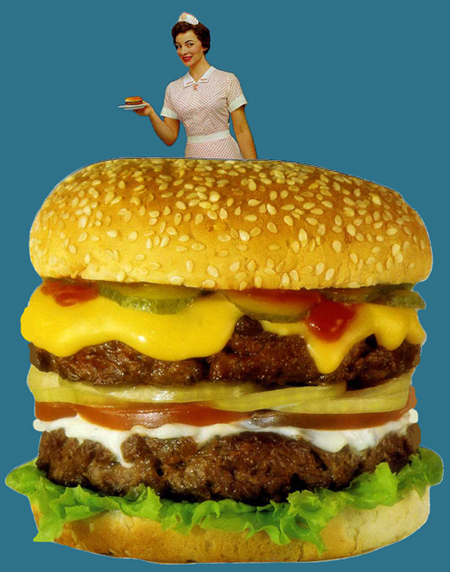
Check out the size of the White Tower hamburger as served by a “Miss Towerette” ca. 1950 and then consider how things have changed over the decades. In the 2000s  a couple of obscenely high-calorie burgers were introduced by fast food chains. Out came the Big Carl from Carl’s Jr. (920 calories) and the Monster Thickburger from Hardee’s (1,420 calories). Makes you wonder how the patrons of White Tower survived on those little morsels of yore.

The sandwiches are mentioned as two “proudly obnoxious fast food options” of the last decade. They rank #6 in Christopher Borrelli’s “10 worst dining trends of the last decade” in The Chicago Tribune.

1 Comment

Filed under guides & reviews

Just ‘cause it looks bad doesn’t mean it’s good

undergdGourmetREVNot many people get as excited as I do about books of obsolete restaurant reviews. I especially like The New Orleans Underground Gourmet. In the 1973 edition reviewer Richard H. Collin zapped a few well-known tourist places as well as some less expensive restaurants which had “little or nothing to recommend them” in order to “spare the reader’s time and stomach.” He not only performed a service but produced enjoyable reading for anyone inclined to find humor in bad reviews.
Thank you, Richard H. Collin, for writing honestly instead of turning out “publicity puffs.”

Please note that this post is not meant to suggest or imply anything at all about any currently operating restaurants and certainly not about New Orleans restaurants in general.

The Court of Two Sisters – “The food ranges from horrible to inedible. The restaurant relies on the fame of New Orleans cooking and the beauty of the French Quarter to perpetuate nothing less than a systematic outrage against all who enter its doors.”Court2Sisters331

Napoleon Restaurant – “The menu is pseudo-French with parenthetical notes after specialties saying ‘Try me.’ … On a recent visit a special treat was the addition of canned fruit cocktail served in the wineglass with the St-Emilion ordered for dinner. More fruit cocktail later turned up on a main-dish plate of gray tough veal. Astonishing!”

Marco Polo Restaurant – “A combination of the worst of two cuisines that deserve better: Italian and Chinese. The food is equally bad from either menu. Poor Marco Polo! Little did he dream on his return from Italy from China in 1295 that someone would build him a monument like this in 20th century New Orleans.”

Pete’s Spaghetti House – “A strong contender for the worst-food-in-New-Orleans award. Steak in a garlic butter sauce (raw chopped garlic and butter) and spaghetti imprisoned under a heavy red sauce are equally atrocious.”

Ben’s Pizza – “Ben is the king of prefab pizza, turning out more of the horrible little things than anyone else in town with a whole bank of miniature heating ovens. Is it better to eat these pizzas quickly before they become unglued or to let them cool, put them aside, and pick up a hamburger on the way home?”

The Smokehouse – “This is a strong contender for the title of Worst Restaurant in New Orleans. For years the Smokehouse has been giving barbecue a terrible name in the city, with its miserable mystery meat and serve-yourself sauce in tiny paper containers. You probably won’t ever taste worse barbecue, and you can have all the joy of taking it to the table yourself and figuring out how many of the little paper cups of sauce will obliterate the taste of the meat.”

Carlos Restaurant – “Slices of packaged white bread, margarine, cans of condensed milk on the table, and a luncheon special that is sold out by 1 P.M. are examples of why not every restaurant in New Orleans that looks bad is good.”

© Jan Whitaker, 2009

Leave a comment

Filed under guides & reviews

Good eaters: James Beard

taits302James Beard enjoyed eating out – in fact much of his life revolved around restaurants. When he was a child his mother often took him to places such as the Royal Bakery in his hometown of Portland OR and Tait’s in San Francisco (pictured). Although he was an accomplished cook, cooking teacher, and author of over 20 cookbooks, like many a New Yorker he patronized restaurants frequently, including Maillard’s, Longchamps, and the Automat. At one point, when he had become more prosperous, he ate almost nightly for a solid month at one of his regular haunts, the Coach House near his home in Greenwich Village, where his favorite dishes included corn sticks, black bean soup, and mutton chops. One summer in 1953 he managed a restaurant on Nantucket.

youngjjamesbeardrevHe preferred restaurants that were “homey” and where he was known and liked, such as the Coach House and Quo Vadis. At the latter he became good friends with owners Bruno Caravaggi and Gino Robusti with whom he shared a love of opera. As a young man (pictured, age 19) he prepared for a musical career at London’s Royal Academy of Music. He said that his early performance training helped him with radio and TV appearances.
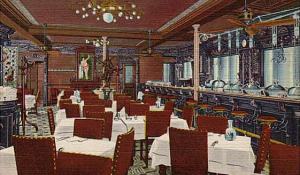
In 1956 he issued his list of the country’s best restaurants, revealing a fondness for clubby male establishments and for places that were friendly — though usually expensive: Le Pavillon, ‘21,’ Quo Vadis (NYC); Jack’s (SF); Locke-Ober (Boston, pictured); Perino’s, Musso & Frank (Los Angeles); London Chop House (Detroit); and Walker Bros. Pancake House (Portland).locke-ober

Restaurants also figured prominently in his professional life. He served as a consultant for restaurants in NY and Philadelphia, including the Four Seasons. For years he wrote a column on restaurants for the Los Angeles Times in which he touted places as diverse as Quo Vadis and Maxwell’s Plum in NYC and the Skyline Drive-In in Portland OR (“they make a whale of a good hamburger”). Despite occasional harsh opinions expressed about women in his 1950s barbecue cookbook days (“They should never be allowed to mix drinks.”), in later years he hailed Berkeley CA restaurateurs Alice Waters at Chez Panisse and Suzy Nelson, co-owner of The Fourth Street Grill.

He advised men on cooking and ways of suavely handling their culinary affairs, being careful, even when promoting French cuisine, to keep a down-to-earth tone. He disavowed the term gourmet, claiming he was definitely not one. In a review of Maxwell’s Plum he declared, “Not being a highbrow about food, I appreciate a really good hamburger or chili as much as a velvety quenelle or a rich pâté en croute.”

In a column he wrote for the National Brewing Company of Baltimore he urged discontented diners to stand up for good food, suggesting, “The only way to combat the stupid treatment of food in many restaurants is to be firm about sending food back to the kitchen whenever it is not right.” If asked how your dinner is, he insisted, do not say (if it was bad), “Oh very good, thank you.” In another piece he chided “mannerless” diners who make multiple reservations with the intention of deciding later which to honor. “When you dine out you have a certain responsibility to the management,” he wrote, explaining that no-shows seriously undermine small restaurants.

© Jan Whitaker, 2009

3 Comments

Filed under guides & reviews, proprietors & careers

Dining with Duncan

In 1935 a Kentuckian named Duncan Hines compiled a list of his 167 favorite places to eat and slipped it inside his Christmas cards. It made quite a hit. The next year his list had grown to 475 and he put it in book form, calling it Adventures in Good Eating. By 1946 the book had gone through 30 printings and had become the restaurant bible of the white American traveling public. “Our family swears by Duncan Hines,” attested a typical reader. His well-off professional and middle-class readers undoubtedly felt they needed a guide when traveling, agreeing with Hines’s comment in a 1947 interview: “I’ve run more risk eating my way across the country than in all my driving.” Distrust of the general run of restaurants reflected the times. Under the economic constraints of the depression and the labor shortages of World War II, standards of cleanliness and cooking in many restaurants slipped badly.

Adventures in Good Eating revealed sharply defined dining preferences. Hines and his legion of volunteer reviewers favored places with women cooks that specialized in home-like meals and made their own rolls, desserts, and salad dressings. WASPy country inns, tea rooms, and cafeterias predominated while relatively few restaurants serving ethnic foods made the list – subtly undermining the promise of adventure. Sprinkled throughout the book were Hines’s reflections regarding sanitation (clean catchup bottle tops, no smears on sugar bowls), essential ingredients (“good butter, fresh eggs, rich milk and a loving touch”), and favorite dishes (cornbread, fried potatoes, codfish cakes, baked beans, and eggs). He freely dispensed advice to restaurant operators, urging them to burnish their silverware, provide sharp knives and comfortable chairs, and use locally available foods.

In interviews through the years he minced no words in expressing his dislikes. Among his memorable quotes are these:
• “After many years of eating my way around the country, I have concluded that the principal reason for looking at the average menu is to see what to avoid.”
• “Baby beef, baby lamb, baby lobster, baby chicken. Who wants to eat babies?”
• “I never order baked potato without inquiring when it was baked, because a warmed-over baked potato is about as edible as a gum eraser.”
• “I would like to be food dictator of the U.S.A. just long enough to padlock two thirds of the places that call themselves cafes or restaurants.”

© Jan Whitaker, 2008

6 Comments

Filed under guides & reviews