 In 1910 the media was abuzz with the new Café de l’Opera on Broadway between 41st and 42nd streets in NYC. Its enormous cost and the stunning, over-the-top lavishness of its interior set a new standard for opulence on the glittering White Way. Could anyone have guessed that in a mere four months this splendid “lobster palace” would fail?
Given its fate, how perfect was it that the crowning jewel of the interior decor was a billboard-sized painting of the fall of Babylon installed prominently on a landing of the 22-ft wide staircase?
The after-theater eatery was designed to be the showplace of Times Square. It was financed by a consortium of investors that included architect/decorator Henry Erkins and John Murray, impressario of the almost-as-splendiferous Murray’s Roman Gardens, also designed by Erkins. The team sunk millions into gutting the old Saranac Hotel and turning it into a fantasy Babylonian stage set worthy of the Hippodrome. The bill for interior renovations and decor, under Erkins’ direction with Stern Brothers department store acting as general contractor, came to $1,250,000, a sum that borders on $30 million in today’s dollars.
The silver service alone cost a quarter of a million 1910 dollars, while a huge painting by Georges Rochegrosse cost something like $50,000. Er, or so it was gushingly reported. However another source claimed the painting was a copy, which is probably true. As for many of the imported ancient treasures, they were replicas cast from Middle Eastern artifacts housed in British and French museums. The gleaming black marble covering interior surfaces and pillars on the ground floor and balconies was artificial.
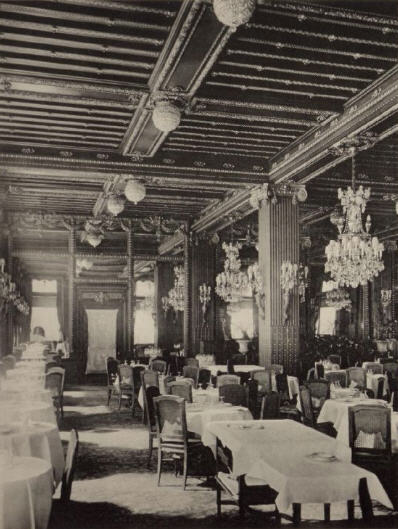
The interior was a startling demonstration of the transformative power of life-size statuary, concealed lighting, mirrored walls, and a million or so sheets of gold leaf. The electrical industry was thrilled with the restaurant’s flair for showcasing what miracles modern lighting could perform. But the architectural community was rather scandalized. They hid their distaste in a haze of apparent flattery, producing choked praise in which adjectives like magnificent served as insults. The “lurid and gorgeous” restaurant was so overwhelming it could “overcome at once the more sober judgment of the critic,” claimed The Architects’ and Builders’ Magazine.
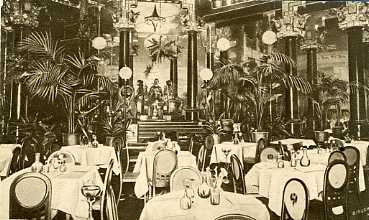 The restaurant’s dining rooms occupied four floors with its main kitchen located above them. Manager Henri Pruger, hired from the Hotel Savoy in London at the princely salary of $50,000 a year, oversaw a staff of 750. Six months after arriving in NYC he headed back home, and one can only wonder how much of his salary he managed to collect. Stern Brothers wasted no time seizing all the furnishings for auction but a goodly number of them apparently were acquired by the new owner, Louis Martin. A restaurant pro, he had formerly presided over the famed Café Martin at Broadway and 26th with his brother J. B.
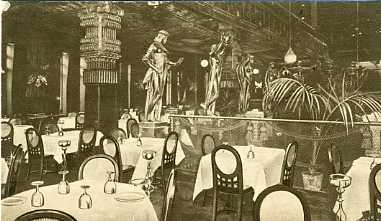 Martin quickly made changes, moving the kitchen to the basement to solve the problem of food arriving cold at the tables as had happened under the previous management. He installed a bar on the first floor and eliminated the previous regime’s terrifically unpopular formal dress requirement, said to be an English notion. But the jinx was on. If ever a location reeked with bad omens, it was this. On opening night in December 1910 an employee of the Café de l’Opera started an accidental fire in a storeroom causing firemen to parade through the dining room with axes. Well, there was that foreboding fall of Babylon depicting invaders in the banquet hall. But what possessed Louis Martin to create a dining room lighted by a dozen perched owls with electrified eyes the size of silver dollars?
 Martin, who ran the restaurant as Café Louis Martin, withdrew from the business in 1913. The new management renamed it the Café de Paris. On the color postcard shown here it is clear that the golden statues on the balcony are gone, replaced by flowers during this incarnation. In 1914 the Café de Paris went bankrupt and in February the restaurant’s “furniture, pictures, ornaments, rugs, carpets, curtains, linen, tableware, kitchenware, and other equipment and furnishings” were auctioned. The building was razed in 1915.
© Jan Whitaker, 2011

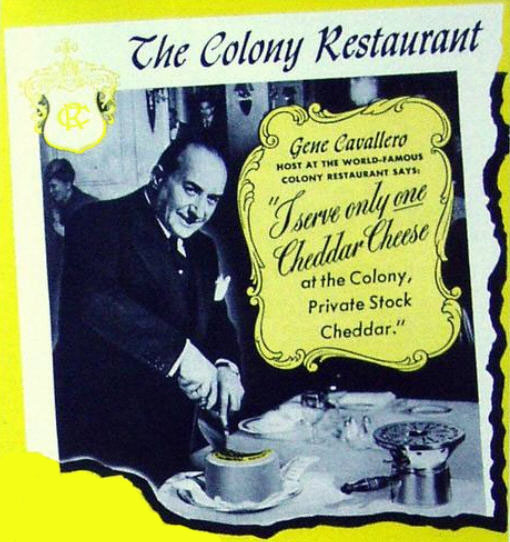
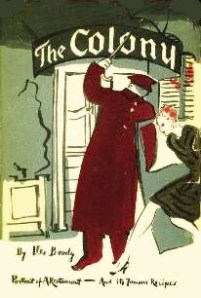 What a pain the rich can be. That’s the message you’ll take away if perchance you pick up The Colony Cookbook by Gene Cavallero Jr. and Ted James, published in 1972. The dedication page is plaintively inscribed by Gene, “To my father and all suffering restaurateurs.” Chapter 3 details what caused the suffering, namely the privileged customers who imposed upon him and his father in so many ways. They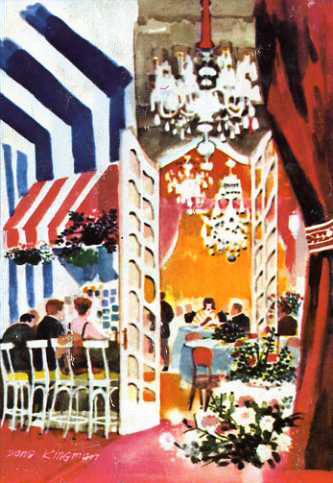
 The London Chop House, Detroit’s 21 Club, enjoyed a ranking as one of the country’s top restaurants in the 1950s, 1960s, and 1970s. James Beard named it as one of the ten best restaurants nationwide in 1961, the same year it won a Darnell Survey award as one of America’s Favorites. It won Holiday magazine awards repeatedly. Honors continued throughout the 1970s, and in 1980 it made Playboy’s top 25 list.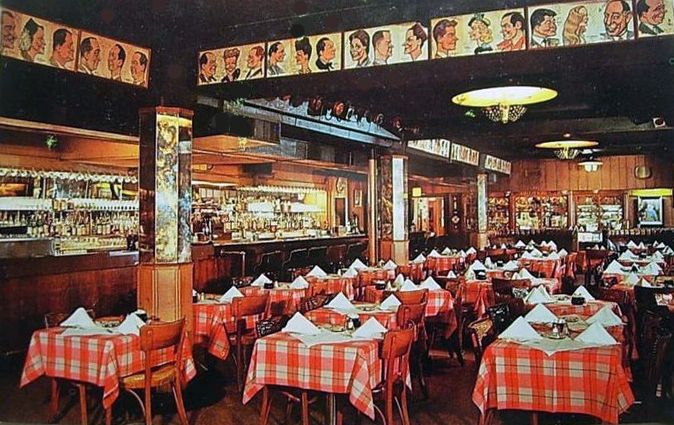
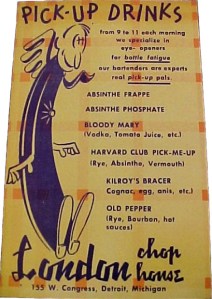 The Grubers were adept at flattering the male ego. When a guest made a reservation, he would arrive to find his table with books of matches and a reserved sign all imprinted with his name, as well as a card with a coin in a slot reimbursing him for his phone call. Alpha types jostled for table #1, while regulars glowed with the knowledge that their suavely jacketed waiter had remembered how many ice cubes they liked in their highballs. To keep up with escalating demand, in 1952 the Grubers opened a second place across the street, the Caucus Club. The 1980s turned out to be a tough decade for the Chop House. Les Gruber sold it in 1982, chef Schmidt left, and the new owner passed away. Despite efforts to keep it afloat, it closed in 1991.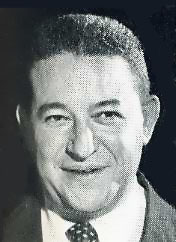
 The name has cast a spell over Americans since the 1890s and bits of its odd history have played out in the U.S. The fortunes of the “world’s most famous restaurant” have risen and fallen. It has won high ratings and lost them. It has been the subject and site of operettas, songs, and movies. It has been declared a French national treasure and an altar to haute cuisine, but also a fraud and a tourist trap. Maxim’s name has appeared on perfumes, airplane meals, and franchised outlets, yet even today it resonates.
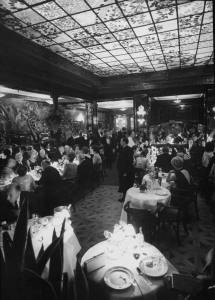 According to most accounts a waiter named Maxime Gaillard began Maxim’s in 1893. Yet another report calls him maitre d’hôtel Signor Maximo, while another stakes a claim for Georges Everard as founder in 1890. Everyone seems to agree, though, that the early Maxim’s was a late-night glamour magnet for American and English visitors to Paris, liberally supplied with friendly prostitutes. In 1899 it acquired a flamboyant Art Nouveau interior with enough murals, curves, and mirrors for a loopy carnival ride. Its prices were high, which may explain why many turn-of-the-century patrons, though dressed in silks and tuxedos, preferred to watch the action while munching pommes frites, an early specialty of the house.
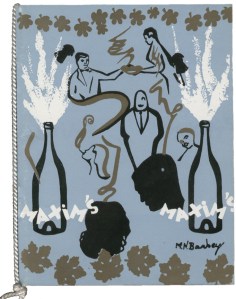 Detractors, such as H. L. Mencken, charged that Maxim’s “gypsy” orchestra was composed of Germans and that the toy balloons floating around were from “the Elite Novelty Co. of Jersey City, U.S.A.” In “Paris à la Carte” (1911), Julian Street, an authority on French food and wines, asserted “I abominate it,” and denounced it as “a brazen fake, over-advertised, ogling, odoriferous; a nightmare of smoke, champagne, and banality.” Debauched merrymakers aside, these were the golden years, before World War I, the era of wine, women, and song on which the Maxim’s legend would be built.
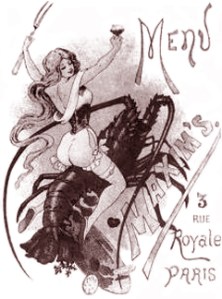 By 1953 the restaurant had earned 3 stars in the Michelin Guide and was starting on a new course. It had developed a frozen food division which supplied airplane meals and was poised to sell frozen sauces and entrées in select American stores. In another twist, Maxim’s authorized a
 It's great to hear from readers and I take time to answer queries. I can't always find what you are looking for, but I do appreciate getting thank yous no matter what the outcome.
 Restaurant-ing through history