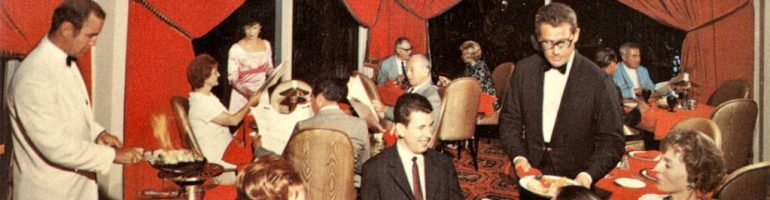
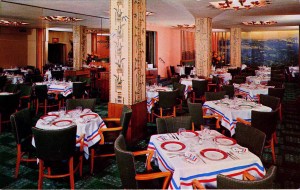
 Where could you — once upon a time – enjoy European pastries, cinnamon toast, and ice cream soda while you hugged a teddy bear? Rumpelmayer’s, of course. A very popular rendezvous for pampered New York children after a visit to the zoo or the ballet. I suppose adults could hug the bears too, but Rumpelmayer’s sweetness – its confections, pink walls, and shelves of stuffed toys — might close in on you if you didn’t hold fast to some grown-up habits such as cigarettes and highballs.
 Rumpelmayer’s tea and pastry café began its Manhattan life in 1930 in the new Hotel St. Moritz on the corner of Central Park South and Sixth Avenue. The hotel almost immediately went into foreclosure though it continued in business. Oh, happy day when Repeal commenced in December of 1933 and the St. Moritz announced, “In Rumpelmayer’s, as in the Grill, we will feature a number of bartenders with Perambulating Bars, for serving mixed drinks.” Bars might be everywhere, but Rumpelmayer’s other attractions were not. For decades it provided a jolly spot for children’s birthday parties, lunches, late Sunday breakfasts, and afternoon teas and hot chocolates. It closed around 1998.
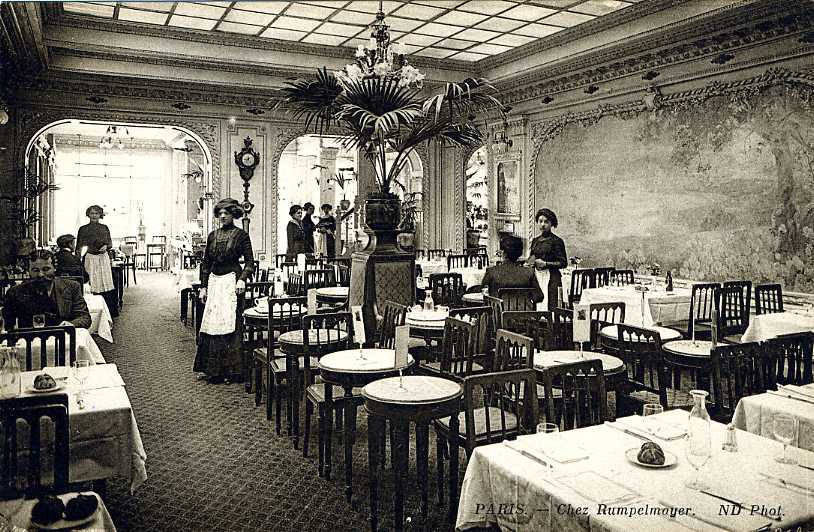
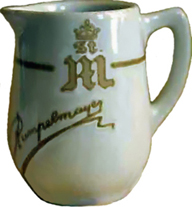 Always proud of its continental delicacies, New York’s Rumpelmayer’s was related (exactly how I’m not sure) to sister tea shops in London, Paris, and on the Riviera. The original Rumpelmayer’s was begun by an Austrian pastry cook in the German resort town of Baden-Baden in the last quarter of the nineteenth century. It then followed its Russian clientele to Cannes and Nice, then later to Mentone and Monte Carlo. In 1903 a shop was opened on Paris’s Rue de Rivoli (pictured, somewhat later) and in 1907 on St. James Street in London. Parisians, infected by Anglomania in the early 20th century, eagerly adopted the afternoon tea custom, in this case reputedly known as having a feeve o’clock-air at “Rumpie’s.” Though it was rated slightly less chic than the Ritz, it attracted mobs of fashionably dressed women who paraded their outfits up to the counter where, according to custom, they speared their chosen pastries with a fork.
 In London before World War I Rumpelmayer’s became incorporated into the daily routine of the elite smart set who spent most of their time at the table, beginning with breakfast at 11:00, lunch at the Carlton at 2:00, tea at Rumpelmayer’s at 4:00, a stroll in the park, followed by dinner, then supper a few hours later. Although some Rumpelmayer’s survived well into the 20th century, the pre-WWI lifestyle that gave birth to them did not.
On tea shops and tea rooms, see also:
— Mary Elizabeth’s
— Schrafft’s
— Vanity Fair, etc.
— Country tea houses
— Lord & Taylor’s Bird Cage
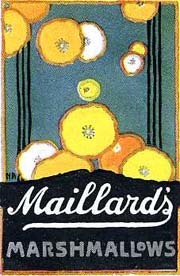
— Maillard’s
— Also, search for department stores
© Jan Whitaker, 2009


 It's great to hear from readers and I take time to answer queries. I can't always find what you are looking for, but I do appreciate getting thank yous no matter what the outcome.
 Restaurant-ing through history