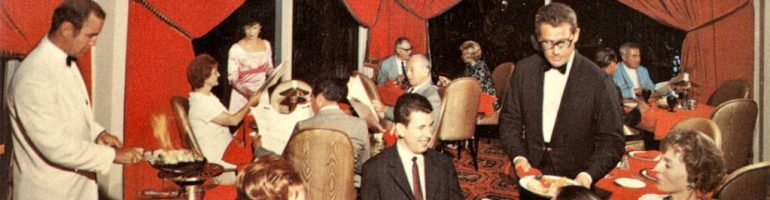
The Marston family ruled their restaurant kingdom in Boston for a very long time, just short of 80 years. It all began modestly. Seafaring Russell Marston, the family’s patriarch, was the first. He went to sea at age 14, and after 17 years in which he ended up with his own ship, he docked and became a restaurant operator.
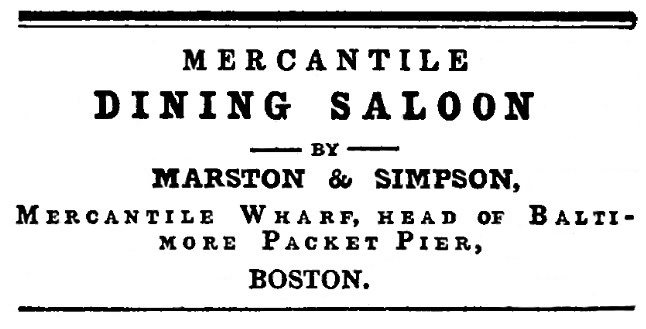
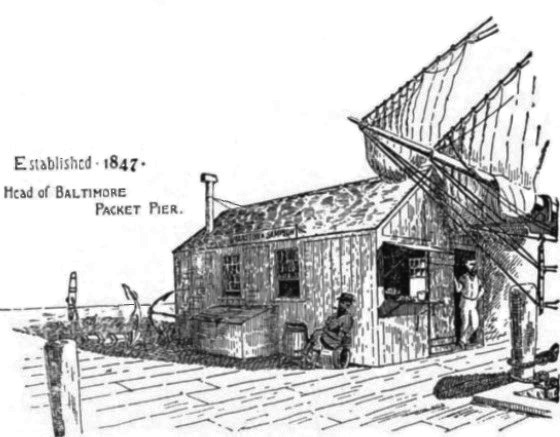
Restaurant is a rather glorified term for his first venture on land. He and his former ship’s cook took over a place on the Baltimore Packet Pier in Boston in 1847. It was tiny, seating only twenty [pictured above]. Nonetheless it was popular and in 1850 they built a new place on the pier, describing it as “beautiful, spacious and commodious.” They named it the Mercantile Dining Saloon. [1851 Advertisement with misspelled name of Marston’s partner] Perhaps it also proved to be too small, because in 1853 they moved and “thoroughly renovated” a new place at 13 Brattle Street.
In 1854 Marston and his cook Sampson moved again, to a new Brattle Street location, number 27. In their pre-opening announcements they stressed that it would be “conducted in the neat and efficient manner which has characterized our Establishments.” Of course, it makes perfect sense that two former seamen would be neat and efficient.
Meanwhile in the 1850s Russell had become a member of the Committee of Vigilance, an abolitionist organization that stood up against the Fugitive Slave Law which required officials in free states to arrest runaway slaves and return them to the South. His opposition to racism and slavery was dramatically on display at the new Brattle street place. On one occasion in 1856, after a white customer strongly objected to the presence of a Black patron in the restaurant, Marston yelled at him in no uncertain terms, then steered the complainer to the street and told him never to return. Not surprisingly the restaurant was popular with civil rights activists, including women suffragists Lydia Marie Child and Lucy Stone.
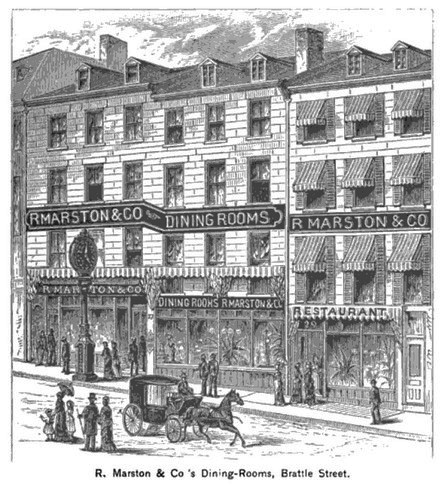
Russell’s brother George was also involved in running the Brattle street place, but in 1866 Russell became the sole proprietor. He began to enlarge, and spread into neighboring Brattle Street buildings, eventually simultaneously occupying three in a row. [Above” 1881 drawing of the Brattle Street Marston enterprise] A few years later his son Howard became his business partner. By 1881 the restaurant at 23 Brattle held 250. To mark the spot, a stately Howard municipal clock inscribed with the Marston name stood in front of the restaurants on Brattle street. [shown below]
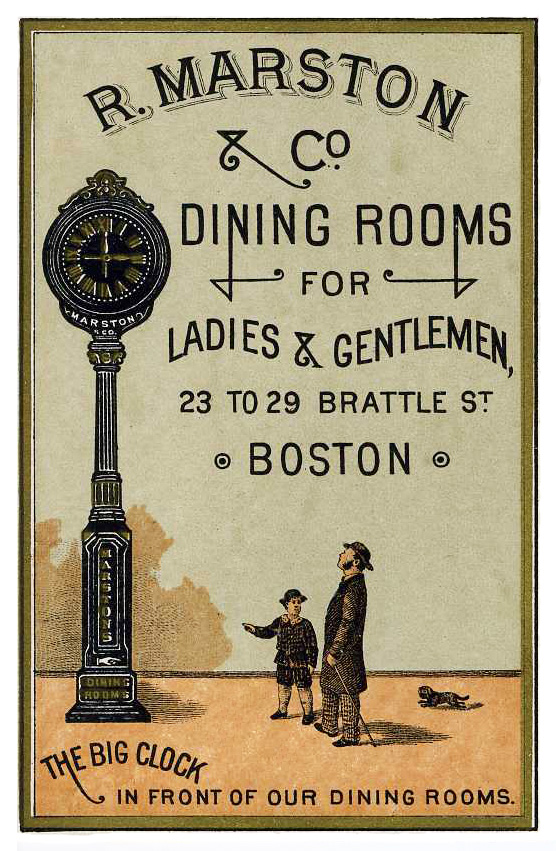
There were said to be 500 restaurants in Boston by 1885. But according to King’s Handbook for visitors to the city, other than those in hotels – and Marston’s – they were of no interest.
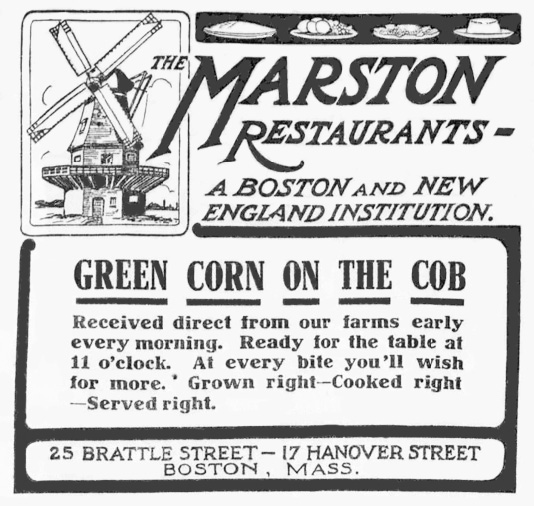
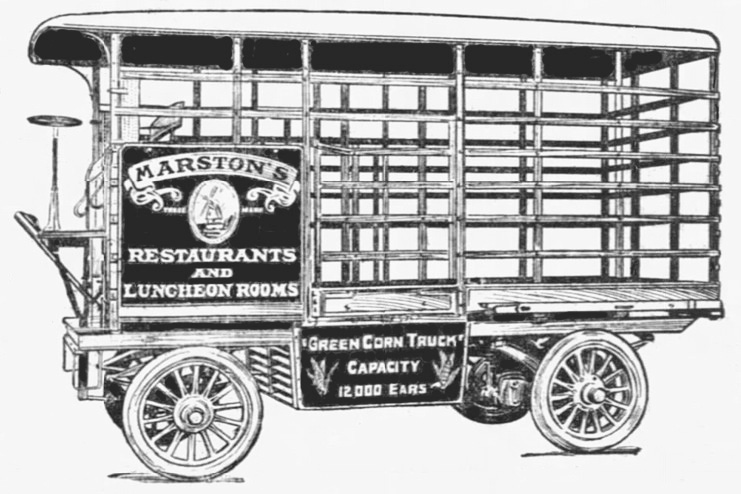
Popular menu items at Marston’s restaurants included corned beef hash and green corn, i.e., corn picked early. Shirley Marston, grandson of Russell, opened a cafeteria in 1926 which featured green corn in season. He emphasized in a 1926 interview that his cafeteria was the only place he knew of where “corn picked before sunrise is served the same day.” [Shown above: 1911 ad; Below: 1906 wagon that brought the green corn from the Marston farm]
In 1893 the Marstons opened restaurants on Hanover Street, where 309 workers served 4,000 patrons a day. Expansion continued in the early 1900s, with branches on Washington and Summer streets. With the death of Russell Marston, Howard took the leading role. In 1910 he opened a lunch place on Devonshire.
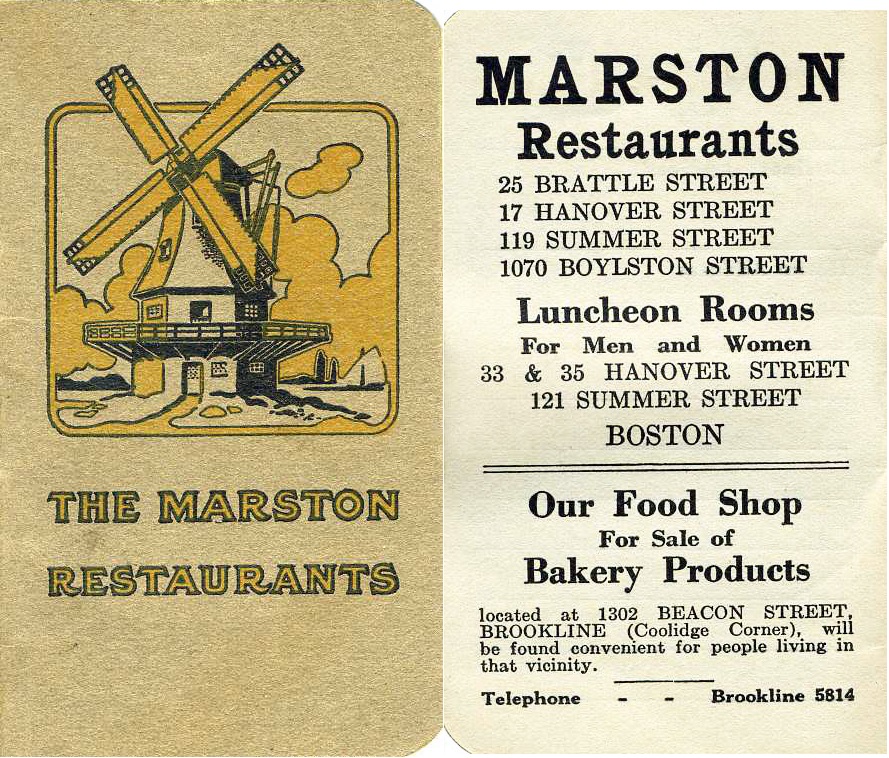
But nothing lasts forever. The Marston kingdom began to crumble in 1918 when the Washington location was closed, with a dismal advertisement that said all fixtures had to be sold by a given date “regardless of price.” Then, Howard Marston died in 1924. The remaining locations carried on for a few years, but in 1926 the family sold all its stock to a syndicate of local men who kept the Marston name. The new owners were not successful in keeping them open for more than a few years. On February 25, 1928 the Globe ran a story with the headline “Marston Restaurants Pass Into History with Closing Tonight,” noting that many of the workers at the Brattle-Hanover Street location had been there for over 30 years. [Above: Ca. 1920s cover and interior page of a small advertising notebook that gives no hint that the “empire” is about to fall.]
© Jan Whitaker, 2026

 It's great to hear from readers and I take time to answer queries. I can't always find what you are looking for, but I do appreciate getting thank yous no matter what the outcome.
 Restaurant-ing through history