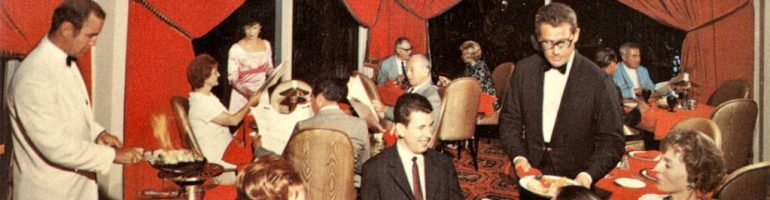
Here are some of my blog posts from the past that were about visiting restaurants when it’s hot outside.

See also “Dining in a garden.”
Americans living in cities enjoyed spending hours in tea gardens in the 18th century and beer gardens in the 19th and early 20th. One example of such a pleasure garden was a grassy Philadelphia spot outfitted with “tables, benches, boxes, bowers, etc. and delightfully shaded by fruit trees.” However, eating outside near a road was disagreeable and largely unheard of. This began to change around the start of the 20th century — but even then only in a small way, except maybe in New Orleans where sidewalk cafes were said to be common.

Ice cream has a long history as a commercial product in this country. For decades it was not sold packaged in stores but was mainly consumed in public settings, often in park-like pleasure gardens. By the 1860s, though, Bostonians could enjoy their ice cream at Brigham & Son’s Ice Cream Saloon which also furnished a variety of other sweet treats such as Charlotte Russe and Jelly Whips. By the 1920s, as car ownership increased, roadside chains selling ice cream began to appear, including of course, Howard Johnson’s.

Summer was a slow season for eating places even into the early 20th century. Small marginal cafes, of which there were many, could not always afford to install large fans, assuming they even had electricity. Another alternative, at least for restaurants higher in the pecking order, was to close up their city location and run another place in a summer resort. Needless to say the adoption of air conditioning around WWII was a life saver for restaurants and they were quick to announce it in their advertising.

Rooftop drinking and dancing became popular in New York City in the 1890s. Over time these spots added dinners. They were especially likely to be atop hotels. Soon their popularity spread across the country. Clearly the attraction was about avoiding summertime heat, so it is not surprising that they tended to disappear as the 20th century found new ways to keep people cool.

 It's great to hear from readers and I take time to answer queries. I can't always find what you are looking for, but I do appreciate getting thank yous no matter what the outcome.

 Restaurant-ing through history
I have no current friends in the restaurant business but in the past I did. All of them said that restaurants do better in the summer as the hotter it gets the more people don’t feel like cooking.
Always enjoy your posts about looking back at historical restaurants and dining. Keep on posting!
Rooftop dining still works: we ate on a 3rd floor roof at Boston’s Prudential Center on a hot summer day and it was 20 degrees cooler on the roof than on the street. Too bad the wind-tunnel effect was a bit strong.