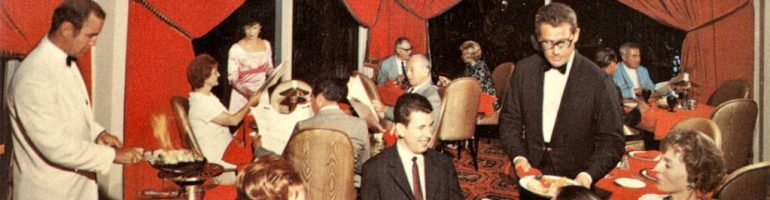
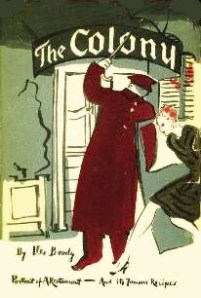
 What a pain the rich can be. That’s the message you’ll take away if perchance you pick up The Colony Cookbook by Gene Cavallero Jr. and Ted James, published in 1972. The dedication page is plaintively inscribed by Gene, “To my father and all suffering restaurateurs.” Chapter 3 details what caused the suffering, namely the privileged customers who imposed upon him and his father in so many ways. They stole peppermills, left behind ermine coats, false teeth, and glass eyes, asked for help getting through customs, requested restaurant staff to chauffeur their children – even called for reservations at other restaurants.
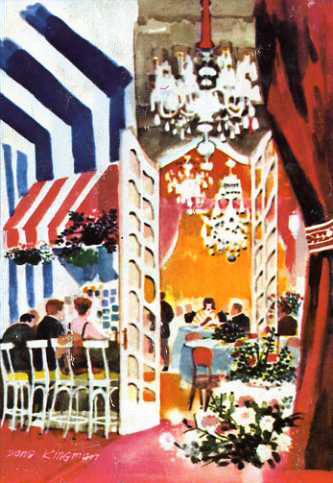
The Colony was the kind of place where terrible things could happen such as – oh god! – countesses and rich men’s wives showing up in the same designer gown. Thankfully they were so well bred that instead of pouting or running home to change they bravely stuck out the evening and even managed a smile as they picked at their truffled Salade à l’Italienne and Chicken Gismonda. Over the Colony’s 50 years all the big names from society, politics, entertainment, and royalty patronized it – Kennedy, Onassis, Capote, Dukes and dukes, Roosevelts, Biddles, Lodges, Cabots, and so on. It was referred to as a “boarding house for the rich” because some patrons were there so often. One woman sat in the same banquette and ate the same lunch nearly every day for over 40 years. Yes, she was an heiress. About 85% of the Colony’s customers signed a tab and received a monthly bill.
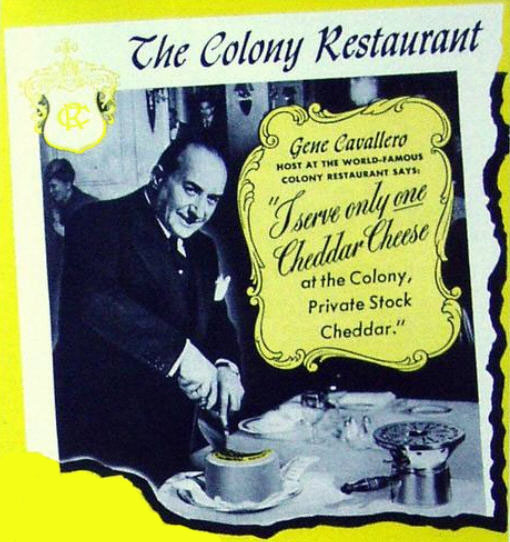 The Colony opened in 1919, at Madison Ave. and 61st Street. Three years later headwaiters Gene Cavallero Sr. (pictured slicing cheddar for the toffs) and Ernest Cerutti joined with its chef to buy it from its founder, legendary impresario and restaurateur Joe Pani. Pani also ran the Woodmansten Inn on Pelham Parkway where he introduced the world to then-dancer Rudolph Valentino. At the same time Pani managed Castles-by-the-Sea, a Long Island resort featuring the dancing Castles, Irene and Vernon.
According to the official story as told in Gene Cavallero Jr.’s book and just about every other account, the restaurant achieved status shortly after the new owners took over and upgraded it from a drinking hole for “two-bit gamblers.” Then capital-S Society, represented by the W. K. Vanderbilts, latched onto it and made it their headquarters. In fact “the 400″ had already been entertaining there while it was under Pani’s ownership. Gene Jr.’s book implies that Pani did not appreciate fine food but, given that Pani had European restaurant training and his own farm which supplied chickens and vegetables, this may have been an exaggeration. Both Pani and Cavallero claimed to have been the first to serve broccoli to New York’s dining public.
Like so many of its regulars, the Colony had slipped into senescence by the time it closed at the end of 1971. Restaurant critic Gael Greene was shocked to find how “tarnished” it was when she visited it about a year earlier (“how shabby and mundane are the haunts of the very, very rich, and how often undemanding their lamb-chop and tapioca palates”). And yet its faithful clientele didn’t seem to care. Truman Capote cried when it closed.
© Jan Whitaker, 2009

 It's great to hear from readers and I take time to answer queries. I can't always find what you are looking for, but I do appreciate getting thank yous no matter what the outcome.

 Restaurant-ing through history
Pingback: The Colony – The New York City Restaurant Archive
Hi! I was wondering on that copy of The Colony Cookbook. Does it have a recipe for Chicken Gismonda? and is it Jean Vergnes’ recipe?
There is no chicken recipe by that name, and the recipes are not attributed to anyone in particular. However I found his Colony recipe in a 1963 newspaper story.
Remove bones from breasts and legs of two fryers, pound to flatten; dip in flour then in 2 eggs which have been beaten with 1 tbsp water and 1 tsp salad oil; then, in fine white bread crumbs into which 1/4 cup finely grated cheese has been mixed. Saute each breaded piece of chicken in melted butter until tender; put layer of cooked, drained spinach leave (unchopped) on hot plate. season with light sprinkle of onion salt; place chicken on top of spinach. Top with sauteed chopped mushrooms, dot with butter and sprinkle with chopped parsley.
Thank you for your reply. What do you mean by your first sentence? Do you mean that the cookbook did not have a recipe for Chicken Gismonda? or the book has a recipe for it, but they never attributed its recipe to the restaurant’s former head chef? I am asking for the sake of clarification because you mentioned the name of the dish on the second paragraph of your blog.
As for the the recipe from the 1963 newspaper, may I ask which newspaper this is? Is it from The New York Times or The Boston Globe? I find it a bit odd that the recipe came in a year late when Jean had already left The Colony to join the commissary department of Stop and Shop.
The recipe was not in the first book I looked at, but it is in The Colony Cookbook, and is the same as the one I quoted except for the addition of sherry in sauteeing the mushrooms. I found the recipe in The Boston Record American, but I assume it appeared in a number of other papers too.
What a wonderful blog! Thank you for writing and illustrating!
Article’s author is clearly so uncomfortable discussing the upper classes, this article is useless. Had to go to amazon and goodreads to get a decent review of the book.
The post is not intended as a book review.
I would have cried as well when it closed down.
Your post on The Colony inspired us to take a look.
http://cookbookoftheday.blogspot.com/2010/01/colony.html
What a great article…I’m always intrigued by history, especially when it concerns catering. Thanks for sharing this.
The Colony is great, the history behind it is amazing