
“Meal ticket” is a term known better for its metaphorical meaning than for its original usage. It’s easy to conjure up a gangster in a 1940s film noir complaining that someone thinks he’s their meal ticket. Meaning, of course, that the person (probably a woman, alas) believes s/he has a found someone who can be manipulated into picking up the tab. This meaning came quick on the heels of the introduction of meal tickets around 1870.
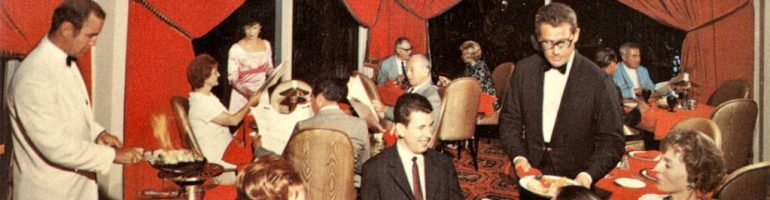
Meal tickets were a way of life for young single people typically employed as department store clerks or office workers of the 1890s and early 20th century. They probably carried a meal ticket with them all the time. They lived alone in furnished rooms without kitchens, ate all their meals in restaurants designated for “ladies and gents” (see below), and were known as “mealers.” Periodically they would buy a meal ticket good for a week’s worth of restaurant meals. Because they paid in advance, they received a discount. A ticket for 21 meals costing 25 cents each might sell for as little as $4.00 rather than its face value of $5.25, giving the purchaser several “free” meals. If they could afford it, mealers would keep more than one ticket on hand so they could enjoy a little variety. Living lives of stupefying monotony and near-poverty, most needed all the variety they could come by.
Tickets did not have to be used up within a week, but their owners knew that holding a ticket for too long ran the risk that the restaurant would go out of business before it was all punched out. The unused meal ticket from the White Front Café of Joplin breaks down quarters into smaller sums thereby allowing that some meals might cost less, some more. It appears to be from the 1930s, a time when meal tickets were no longer being used in larger cities.
© Jan Whitaker, 2008

 It's great to hear from readers and I take time to answer queries. I can't always find what you are looking for, but I do appreciate getting thank yous no matter what the outcome.

 Restaurant-ing through history
Recently discovered this site and greatly value the content!
I am trying to understand why you say the meal ticket users lived lives of “stupefying monotony and near-poverty”. The $4 discount ticket you mention in the text, gets a person 3 meals per day, 7 days per week, at a rough cost of 20 cents each meal. What was the daily or weekly wage of a store clerk in Joplin, MO, in ~1890?
For comparison, BLS data says that unskilled manual labor went for between $1.50 and $2 per day, at approximately that time.
Granted, a store clerk’s life is nothing too super-exciting, also today. Before WWI, though, money was still mostly silver- and gold-backed, so there was little paper money inflation. The War to End All Wars (and those that followed) took care of that.
It would be difficult to easily answer your question about Joplin MO. But Where I got the strongest sense of dreariness was from a book published in 1906 entitled The Lodging House Problem in Boston. Most of my research is based on larger cities because that’s where most restaurants have been located. I once had a friend living in Boston’s South End in a small three room flat. One day it hit me that the three small rooms (living/dining room, bedroom, Kitchen) had been three separate rental units in earlier days and that all three had shared the bathroom which was in the hallway. The front room (living/dining) was the largest and would have cost the most.
Jan!
Fascinating stuff. Thank you for your article. I was just looking around the web to see what, if any, sites were linking to ours, and your site popped up for the phrase ‘your meal ticket’. Quite unexpected, but a good read nevertheless.
How things have changed now though, eh? Although if everyone were to have to go out for supper every evening, maybe that would make my job a little easier.
Thank you again for an interesting read (now I must get back on with my work!)
All the best,
Derek